





 Portuguese
  English
  Spanish
  5 min of reading
  5 comments


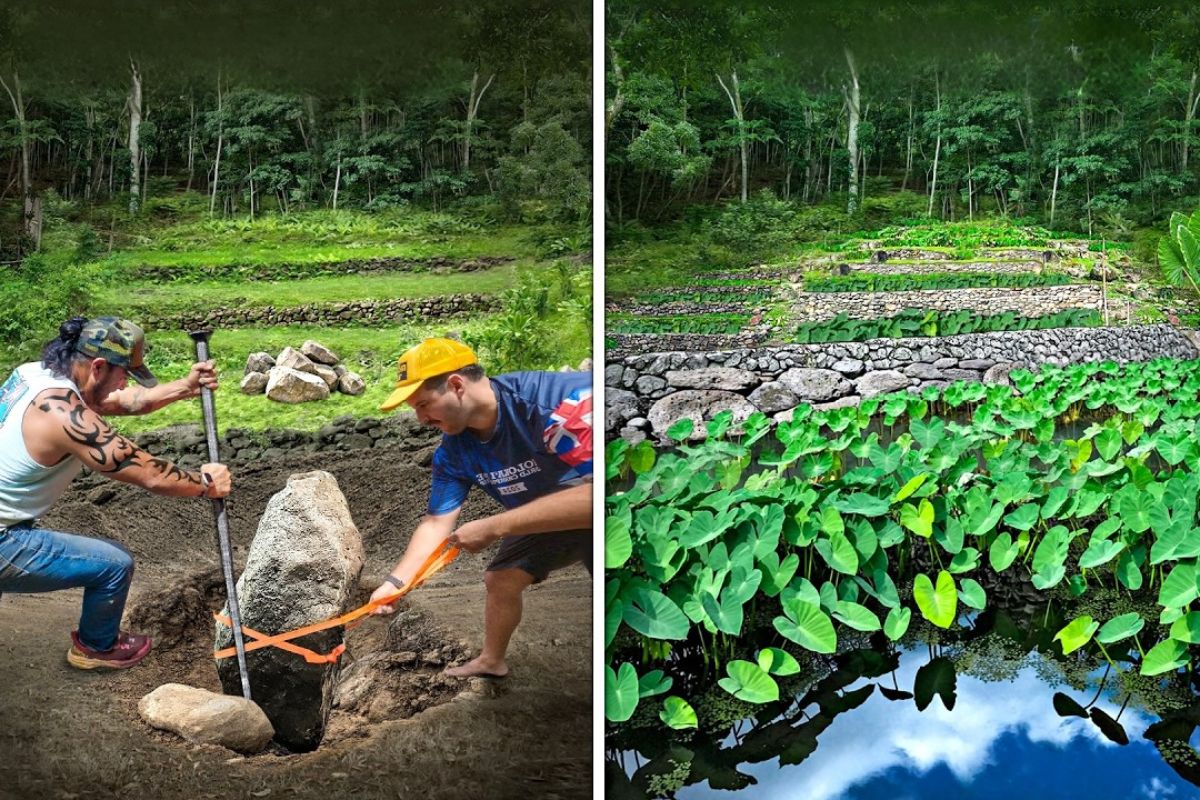


In A Hawaiian Valley, Beneath Invasive Forest, Native Teams Unearth Stone Walls, Channels, And Terraces That Guided Fresh Water By Gravity To Taro And Fish Tanks. The Arrangement Fed Thousands Before The 1848 Privatization And Today Tries To Reduce Dependency On Imported Food In The Islands
The invasive forest that now covers the slopes of Hawaii does not only hide uncontrolled vegetation, but also a design of social and hydric engineering that once sustained entire communities. By removing layers of roots and fast-growing trees, native groups reveal terraces, stone walls, and water diversions that are back in operation without pumps and electricity.
The central point of the debate is not nostalgia, but food security and real autonomy in islands where about 90% of food is imported. The restoration of the traditional system repositions water, taro, and community cooperation as infrastructure, and exposes why the disruption of this model has left cultural, economic, and environmental effects that still weigh heavily.
A Watershed System That Transformed Water Into Food

In Hawaii, the ahupua’a organized the land from the mountain to the ocean, treating fresh water as the axis of production and governance.
-
Motorola launched the Signature with a gold seal from DxOMark, tying with the iPhone 17 Pro in camera performance, Snapdragon 8 Gen 5 that surpassed 3 million in benchmarks, and a zoom that impresses even at night.

-
Satellites reveal beneath the Sahara a giant river buried for thousands of kilometers: study shows that the largest hot desert on the planet was once traversed by a river system comparable to the largest on Earth.

-
Scientists have captured something never seen in space: newly born stars are creating gigantic rings of light a thousand times larger than the distance between the Earth and the Sun, and this changes everything we knew about stellar birth.

-
Geologists find traces of a continent that disappeared 155 million years ago after separating from Australia and reveal that it did not sink, but broke into fragments scattered across Southeast Asia.

The flow was continuous: the water descended, passed through cultivation areas, went along terraces, and returned to the natural course, connecting those who lived above and those who depended on what came below.
This design made taro a strategic crop because it requires moist soil and fine control of water depth.
Flooded terraces created stable growing conditions, and water became the most precious resource, with collective access and shared responsibility, without the logic of private property that would come later.
What The Invasive Forest Hides, And Why It Needs To Go

The invasive forest functions as a disorganized lid over a technical and archaeological site, and also as an active threat.
Invasive trees and other species compete for space, displace ancient stones, and can dismantle walls that still indicate where the terraces existed and how the water was channeled.
The urgency is explained by the speed.
Some of these invasive trees grow among the fastest in the world, and each year without intervention increases the work of reopening paths, recovering stones, and reconstructing sections of channels.
Removing the invasive forest, in this context, is not aesthetic: it is the minimum step to restore function to the system and reduce the loss of what was already mapped on the ground.
Simple Technology, High Precision, Clean Water As An Indicator
The operation described in the valley is based on a principle of engineering that seems basic but requires calibration: diverting water from the stream to a point of entry, controlling the level at each tier, and ensuring safe overflow to the next.
Gravity does the work, but each terrace needs its own design to prevent erosion and distribute water evenly.
Details matter because they determine quality.
With entry and exit on opposite sides, the water crosses the entire bed, reduces dead zones, and carries sediments to deposition areas, instead of spreading mud.
The slow flow allows sediments to settle, plants to absorb nutrients, and the water to return cleaner to the stream, reinforcing that taro production and ecological restoration can operate together when the terraces are well adjusted.
Fish, Ponds, And The Return Of Nutrients Against The Current

The system does not end at the farm.
The water that exits the terraces descends to an area that functions as a sediment pond and, during heavy rains, connects to paths that allow the presence of native fish coming from the ocean.
The account mentions the fish opu, capable of climbing rocks with a suction structure, using its natural behavior as a compass to return.
The operational goal is to expand ponds along the lower section to create more habitat and recover a food source that reduces the need to travel to the coast.
When the water returns to the stream in better quality, the system creates a cycle in which nutrients and life also return upward, reinforcing the idea that the ahupua’a was a network, not an isolated planting point.
The Historical Break That Changed Food, Land, And Power
The near disappearance of the model has a date and mechanism: in 1848, the law known as the Great Mahele introduced privatization, making land ownership a central concept in Hawaii.
Companies bought areas, altered land use, and reorganized water for cash crops like sugarcane and pineapple, pushing natives out of previously communal territories.
The result was twofold.
On one side, social fragmentation and the loss of local governance; on the other, the transition to a dependent food economy, in which 90% of food imports become routine and a vulnerability.
The current restoration presents itself as construction, not as protest, but it arises from a movement of resistance that occupied beaches, pressured the State, and eventually received an area where, beneath invasive forest, there was a buried “gem” of technical knowledge.
Autonomy Today Means Physical Work, Coordination, And Continuity
The progress of restoration is described as grassroots work: clearing lines, digging stones, repositioning walls, reconstructing terraces, and maintaining water control along the valley.
It is the kind of task that requires hours of labor and also a social agreement, because no one can hold a system in which any action above affects everything below.
The declared ambition is to create a complete version of the restored ahupua’a as a model, with terraces descending to the base of the valley and connected fish ponds, so that children can see the fish in the habitat and understand why water and culture cannot be separated.
The final technical argument is social: the genius lies not only in the stone walls, but in the cohesion that makes water, taro, and terraces operate as a single community organism, with a direct impact on Hawaii’s autonomy.
If the invasive forest is hiding ancient solutions that still work, the sensitive point becomes a collective choice: to invest in slow reconstruction, guided by water and taro, or to remain dependent on import chains that may fail when costs and logistics change in the islands.
In your view, what most hinders a turnaround to autonomy in Hawaii: lack of land, lack of available water, or lack of social coordination to keep terraces active for years? And if you lived on an island with imported food, what would be the first practical change you would support to reduce this dependence without losing quality of life?








Como trabalho com comunidades antes aqui no Brasil, sei o quanto é importante manter os laços culturais e sociais das comunidades tradicionais locais! Sem falar com os laços de saúde e felicidades estão mais fortes!! 💕
Parabéns agricultura tradicional de terraços havaiana com o taro (tuberculo). Acho (????) possível usar recursos modernos tecnológicos associados a tecnologia antigas menos agressivas ao ambiente (dependendo menos ou não dependendo de eletricidade , etc). Cada tecnologia moderna (informática, uso de drones , sementes etc) só deveria ser usada para complementar a antiga já comprovada. Geralmente povos não urbanos civilizados (grandes cidades etc) possuem uma tecnologia simbiótica ou seja, em comunhão e/ou pouca o agressiva ambientalmente comparadas com as tecnologias hodiernas. Na Índia se usa massivamente até por uma questão de custo de oportunidade tecnologias antigas (tradicionais). Na UFPA os alunos de Eng mecânica chamam-na de tecnologia apropriada (relação custo/benefício).
Os astecas usavam o plantio em sistemas de terraço e dava muito certo