





 Portuguese
  English
  Spanish
  5 min of reading
  0 comments


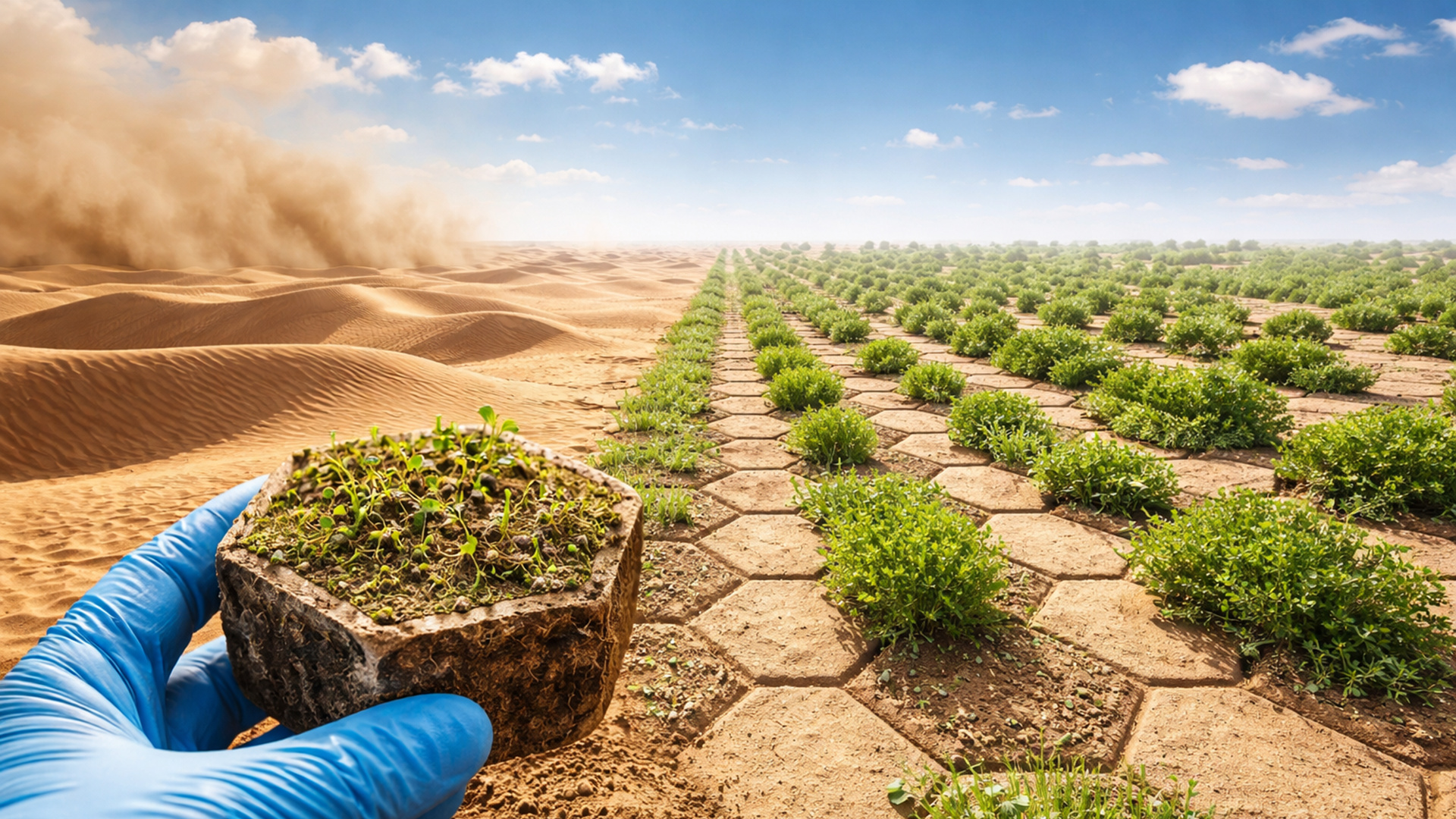
In the Tengger Desert, in China, a new soil treatment with cyanobacteria and hexagonal “soil seeds” transformed loose sand into a stable and fertile surface in less than a year, reducing erosion by more than 90% and accelerating a natural process that could take up to ten years
In the heart of the Tengger Desert, in China, a soil treatment technology is converting loose sand into a stable and fertile surface in less than a year. The result comes from the use of cyanobacteria organized into hexagonal “soil seeds,” developed to awaken with moisture, bind sand grains, and accelerate a natural process that previously could take up to a decade.
The initiative arises in a context of advancing desertification in northern China, where moving dunes have compromised infrastructure, restricted agricultural use, and increased the loss of land and ecosystems. In this scenario, traditional responses, such as tree planting and the installation of physical barriers, have been pointed out as slow, costly, and vulnerable to adverse weather conditions.
Instead of trying to plant directly on an unstable surface, researchers from the Shapotou Desert Experimental Research Station, affiliated with the Chinese Academy of Sciences, began to act on the sand itself. The proposal consists of first creating a living crust capable of stabilizing the surface and establishing the foundation for soil formation.
-
In a flooded well, archaeologists found a 1,700-year-old Roman egg that still contains clear and yolk intact inside the very thin shell.

-
Something is happening around the Earth: Inside the huge explosion of fireballs in 2026

-
A hot air bubble coming from Argentina expands over Brazil, causing thermometers to exceed 38 degrees with a thermal sensation of 40 degrees in late March, affecting 6 states at once.

-
The radish leaf that almost everyone throws away has more polyphenols, flavonoids, and fiber than the consumed root, and a 2025 study showed that the leaf contains compounds that protect the intestine, combat inflammation, and may inhibit the growth of cancer cells.

Cyanobacteria form the foundation of soil treatment
At the center of the project are cyanobacteria, photosynthetic microorganisms capable of surviving in extreme arid environments. When moisture is available, these organisms form the so-called biological soil crust, known as biocrust.
Cultivated in the laboratory, these cyanobacteria bind loose sand grains into a thin and cohesive layer, less susceptible to displacement by wind. Under the microscope, the structure appears as a network of bacterial filaments entwined with sand particles and held together by sticky sugars secreted by the cells themselves.
Once hardened, this crust becomes resistant to erosion and retains moisture for longer periods after rain. The effect is not limited to the physical containment of sand, as the living layer also helps to keep nutrients like nitrogen and phosphorus close to the surface.
This retention creates conditions for shrubs and grasses to take root, something that bare sand cannot support. Thus, the initial stabilization of the surface paves the way for a later stage of broader land recovery.
In controlled wind tests, surfaces with crust reduced soil loss caused by wind by more than 90%. In field trials conducted near the Taklamakan Desert in Xinjiang, teams from the Chinese Academy of Sciences observed that treated plots stabilized within a period of 10 to 16 months, even after seasonal dust storms.
From first attempts to hexagonal soil seeds
The current advances were preceded by years of attempts with limited results. In 2010, laboratory demonstrations had already shown that cyanobacteria could produce soil under controlled conditions, but transferring this method to open desert environments encountered difficulties.
According to the researchers, the survival rates of microorganisms in the field were too low to allow for large-scale application. A new attempt in 2016 raised survival to about 60% by applying pressure to push the cyanobacteria between sand grains.
Although this approach worked in small areas, it proved impractical for deployment in vast dunes. The turning point came with the development of the so-called “soil seeds,” created to facilitate transportation, distribution, and activation of the process directly on the desert surface.
To achieve this, the researchers selected seven strains of cyanobacteria and mixed them with organic matter. They then shaped the composition into solid hexagonal blocks, which can be spread over the sand and remain compact until they come into contact with moisture.
When it rains, these blocks are reactivated, begin to colonize the surrounding sand, and start to form a resilient biocrust. According to the described tests, this structure can withstand winds of up to 36 kilometers per hour.
With this system, a transformation that would naturally take between five and ten years is reduced to approximately one year. The change observed by scientists occurs in sequence: loose sand converts into a stable surface, and this stabilized surface becomes the foundation for cultivation.
59-year study shows acceleration of recovery
Recent results are supported by decades of observation on the evolution of biological soil crusts. In a study published in the journal Soil Biology and Biochemistry, researchers analyzed a succession process over 59 years in China, comparing natural crusts with induced biological crusts.
The data indicated a defined progression in the observed areas. Crusts dominated by cyanobacteria appear in the early stages, followed by lichen crusts and subsequently by moss crusts.
According to the authors, the induced strategy drastically shortened this timeline. The biological crusts induced by cyanobacteria showed total organic carbon accumulation rates about 3.2 times faster than natural crusts.
In the case of total nitrogen, the accumulation rate was approximately 15 times faster. These numbers reinforce the assessment that inoculation with cyanobacteria accelerates processes essential to reversing desertification and forming a more favorable environment for soil development.
In practical terms, the induced crusts with 13 years presented community diversity and nutrient levels comparable to those of natural crusts with 34 years.
For the authors, this indicates that the reversal of desertification can be accelerated from decades to years, while also fixing carbon and nitrogen and stabilizing soil particles.
Application in northern China and goals for the coming years
The work developed in the desert is integrated into a broader environmental protection initiative in northern China. This is the Three North Shelter Forest Program, also known as the Great Green Wall, launched in 1978 with the aim of reducing sandstorms and erosion.
In this context, the technique tested in Tengger emerges as a biological alternative for areas where conventional methods have faced limitations. By modifying the sand before any attempt at direct cultivation, researchers aim to create more stable conditions for land recovery.
The autonomous region of Ningxia Hui plans to treat between 5,333 and 6,667 hectares in the next five years. The goal indicates an attempt to expand the application of the technology on a territorial scale, based on the results observed in the field.
By transforming sand into a living and more stable platform, Chinese scientists are reducing the time needed to initiate the recovery of degraded areas. Thus, the soil treatment tested in the Tengger Desert is being presented as a tool capable of containing the advance of deserts by accelerating already existing biological processes.







Seja o primeiro a reagir!