





 Portuguese
  English
  Spanish
  4 min of reading
  3 comments


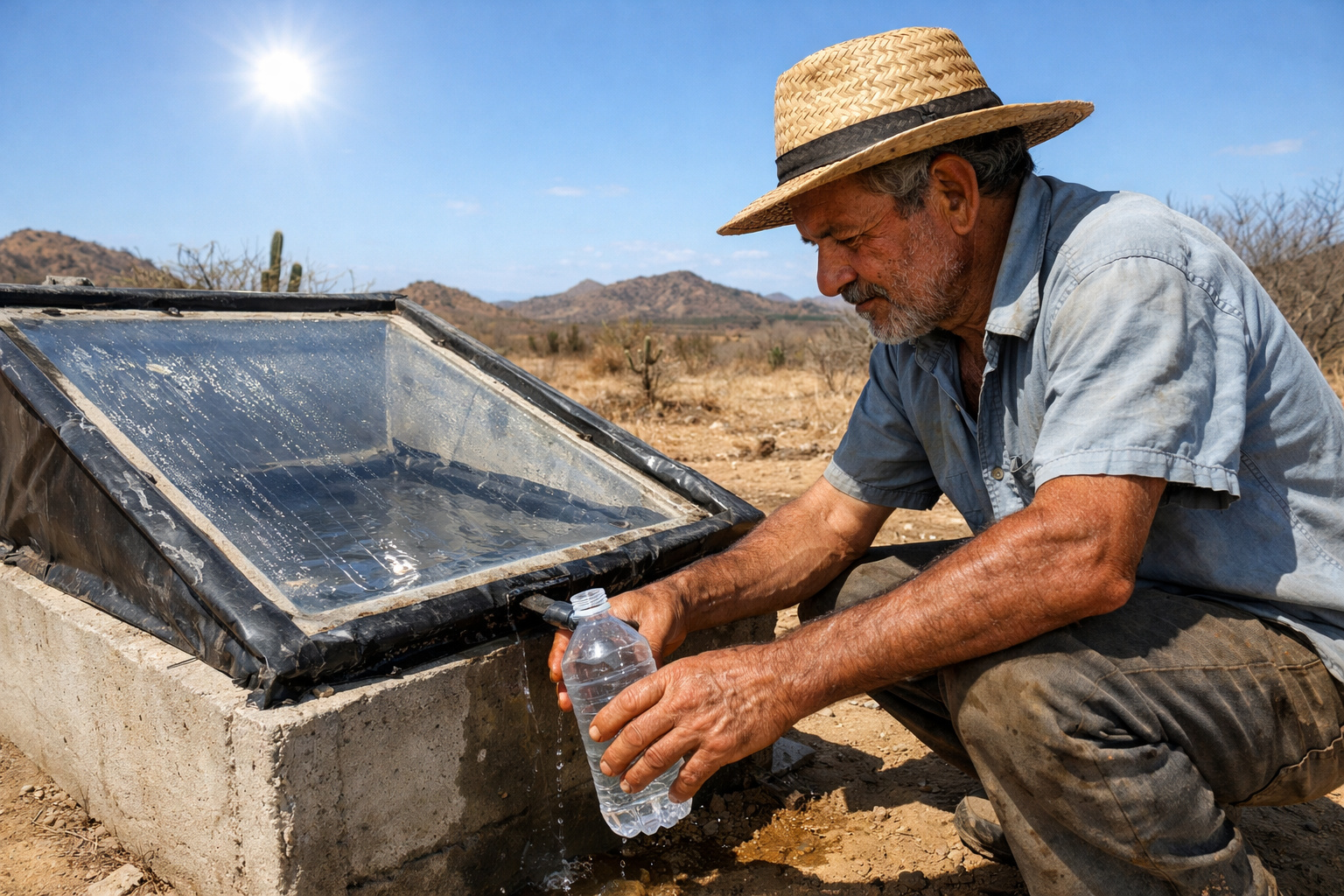


Sustainable Technology Developed In Paraíba Converts Brackish Water Into Potable Water, Starting At R$ 3 Thousand And Is Already Operating In More Than 13 Municipalities In The Northeast
The Brazilian semi-arid region has been grappling with a severe structural challenge for decades: limited access to potable water. However, a sustainable technology created within the State University of Paraíba (UEPB) has begun to change this reality in a concrete way. A simple, efficient, and low-cost solar desalination system already serves more than 100 families in the Northeast.
The information gained national prominence after a report aired on Bom Dia Brasil, during which the program showcased the work coordinated by Professor Francisco José Loureiro Marinho, a faculty member of the Center for Agricultural and Environmental Sciences (CCAA), campus II of UEPB, in Lagoa Seca.
Since 2010, when research began, the professor structured a project that evolved rapidly. Over the years, he installed desalination units in various municipalities in Paraíba, Pernambuco, and Ceará. Additionally, the project received financial support from the Ministry of the Environment, CNPq, UEPB, and Itaú Bank.
-
Embrapa’s discovery reveals an unexpected advancement by allowing the production of seedlings from the caatinga using brackish water, opening a new frontier for farmers to face drought more efficiently.
-
6 sources of free fertilizer that you are throwing away every day and can transform your garden without spending anything.
-
With a water crisis on the radar, Sabesp invests in reclaimed water for data centers and transforms sewage treatment into a solution that saves millions of liters and protects public supply.

-
Foresea achieves 100% offshore waste reuse in 2025, eliminates landfill disposal, and consolidates sustainable strategy with 1,500 tons recycled.

How The Solar Desalination System Removes Up To 7 Grams Of Salt Per Liter Of Water
In several regions of the semi-arid area, well water contains up to seven grams of salt per liter. However, the standard considered potable accepts only half a gram per liter. Given this alarming difference, the solar desalination system offers an accessible and efficient alternative.
The equipment uses glass, cement, and tarps in its structure. It works like a greenhouse filled with brackish water. As the sun heats the system, the temperature can reach up to 70 °C. Consequently, the water evaporates. Then, the steam rises, condenses on the glass, and flows through channels, forming potable water ready for consumption.
Meanwhile, the salt remains deposited on the tarp, as it does not evaporate. Later, families simply clean the surface to keep the system functioning normally. Therefore, maintenance requires little effort and virtually no additional cost.
Each unit produces up to 16 liters of potable water per day. Although the volume may seem modest, it ensures essential supply for domestic consumption. Moreover, it strengthens the water security of farming families.
Another relevant detail draws attention: families use the salt removed from the water as a supplement in animal feed. In fact, Embrapa Petrolina (PE) is studying this practice to assess its benefits.
Project Already Reaches 13 Municipalities And Exceeds 200 Installed Units

Currently, the solar desalination systems operate in:
- Remígio (10 units)
- São Vicente do Seridó (10)
- Cubatí (4)
- Pedra Lavrada (4)
- Caraúbas (70)
- Monteiro (10)
- Camalaú (30)
- Santa Luzia (24)
- Soledade (10)
- Cuité (20)
- Campina Grande (5)
- Caturité (5)
- Sanharó (PE) (5)
- Icapuí (CE) (5)
The professor began the first constructions outside of the academic environment in 2012. Shortly thereafter, he implemented the first large-scale trial at the Corredor Settlement in Remígio, where he installed ten units with resources from CNPq.
During development, the team faced technical challenges. Initially, they used aluminum and cement for the flooring. However, the salt corroded the materials. Then, a farmer suggested using tarp, arguing that salt is stored in plastic bags in commerce. The team adopted the idea, and the result worked.
The first model, built in Campina Grande, cost about R$ 3 thousand. In Icapuí (CE), the unit reached approximately R$ 4.5 thousand, as the community requested local procurement of all materials. This way, the residents monitored the entire process, from acquisition to assembly.
Social Technology Strengthens Autonomy And Water Security
In 2018, the professor encouraged his students to expand the project. Thus, the Association of Professionals in Agroecology (APA) emerged, which began replicating the technology in other regions of the Northeast.
According to Wanderley Feitosa Viana, president of APA, the system can be built with bricks or pre-cast slabs. The only difference lies in the execution time. Furthermore, although the channel and tray require greater attention, anyone can assemble the equipment without advanced technical training.
More than just equipment, the solar desalination system represents a true social technology. It does not rely on electricity, does not require expensive inputs, and does not demand complex technical knowledge. Therefore, rural communities can replicate it with autonomy.
Consequently, the technology improves the quality of life for families who depend on brackish sources. In addition to domestic supply, the treated water allows for the irrigation of small gardens and strengthens livestock farming. Thus, the impact extends beyond water: it also affects food security.
Therefore, by uniting applied science, low cost, and sustainability, the project demonstrates how simple solutions can generate profound transformations in the Brazilian semi-arid region.
Do you believe that simple and low-cost technologies like this could be the key to solving the water crisis in other regions of Brazil?









Parabéns!!!
Sou do cariri paraibano,pequeno produtor rural da cidade de assunção.inicistivas e tecnologia acessível para o nosso povo é a maior forma de exclusão social e êxodo rural, parabéns.
Yes