





 Portuguese
  English
  Spanish
  5 min of reading
  0 comments


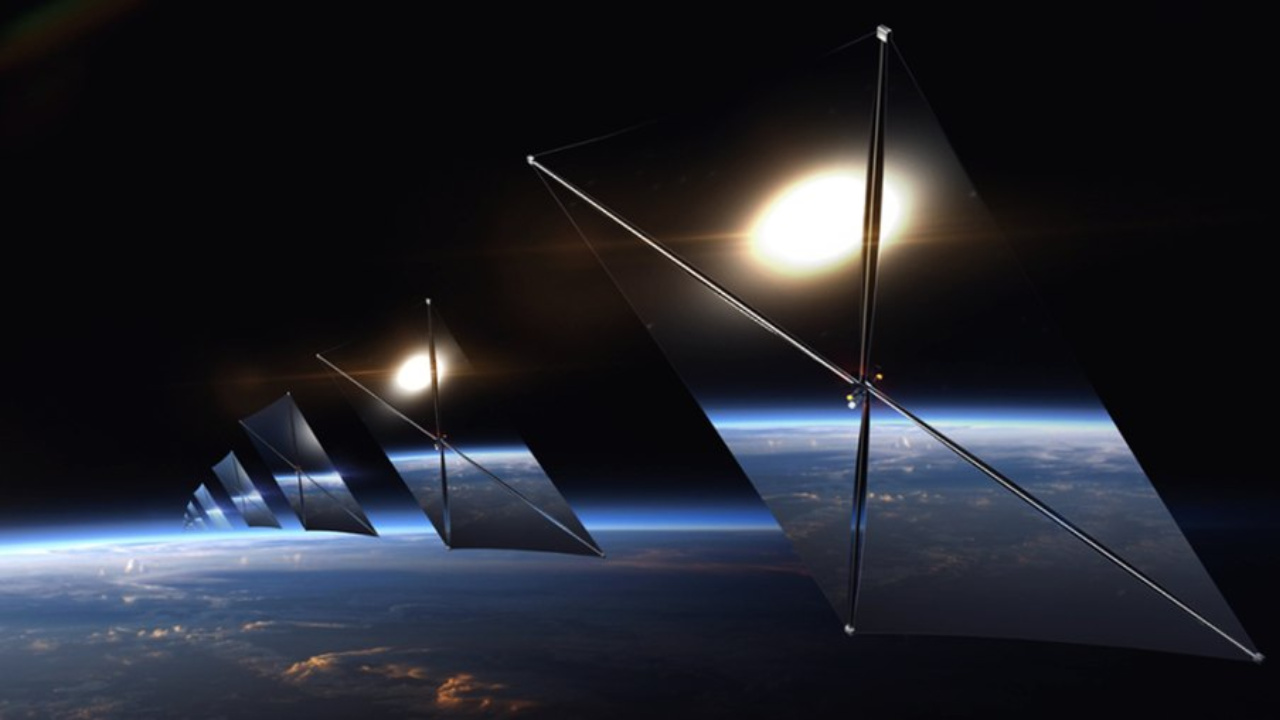
The American Company Reflect Orbital Promises to Bring Solar Light to Earth Even After Sunset, with Satellites That Reflect the Sun’s Energy. Experts Warn of Serious Risks of Light Pollution and Threats to Global Astronomy.
The promise seems straight out of a science fiction movie: providing solar energy at night through satellites orbiting Earth. The ambitious idea comes from the American startup Reflect Orbital, which intends to use giant space mirrors to redirect sunlight to solar power plants after sunset.
However, the proposal has divided opinions between innovation enthusiasts and astronomers concerned about the impact of what is called artificial light pollution. According to experts, the project could interfere with astronomical observations and even affect the behavior of nocturnal species.
Reflecting Satellites: How the Reflect Orbital Project Would Work
According to the company, the first phase of the project will be launched in 2026 with the test satellite Earendil-1, a reflector 18 meters in diameter. The goal is to evaluate the capability to redirect sunlight to specific points on Earth, allowing solar power plants to continue generating electricity even at night.
-
Seagri’s headquarters invests in solar energy with Neoenergia Coelba and promises to cut electricity costs, highlighting a strategic advance in sustainability and energy efficiency within state public administration.
-
Solar Pyramid draws attention by converting solar energy into million-dollar savings and repositioning the City Hall of Curitiba as an example of innovation, sustainability, and intelligent use of public resources.
-
Europe records strong euro economy with solar energy in March and sparks curiosity about which country leads growth that redefines the energy market and reduces costs.

-
Piauí reaches a historic milestone in energy transition: State records nearly 160,000 households powered by solar energy and leads growth in the Northeast.

The plan is bold: by 2030, Reflect Orbital hopes to place about 4,000 satellites in orbit. Each of them would be approximately 625 km from the Earth’s surface, equipped with mirrors capable of reflecting part of the solar radiation towards preselected regions.
However, initial calculations show that the light reflected by a single satellite would be 15,000 times weaker than noon sunlight, although still brighter than the light of a full moon. To achieve just 20% of solar intensity, around 3,000 satellites operating in sync would be necessary — an unprecedented technical and logistical challenge.
The Balloon Test: First Steps of a Gigantic Idea
Before taking the concept to space, the company’s founder, Ben Nowack, conducted a preliminary experiment. In a test with a hot air balloon, a flat mirror measuring 2.5 meters was used to reflect sunlight onto photovoltaic panels.
The result was impressive: the team measured 516 watts per square meter — about half of the power received under noon sunlight, which averages 1,000 watts per square meter.
But there is a problem: the scale. To replicate this performance in orbit, the mirror would need to be 6.5 km wide, covering 42 square kilometers. According to astronomers, it would be unfeasible to build something so gigantic in space with current technology.
Solar Energy at Night: Viable Promise or Too Expensive Dream?
Reflect Orbital argues that its goal is more modest: to generate 200 watts per square meter, equivalent to 20% of full solar energy. Even so, the challenge remains enormous.
A satellite at 625 km altitude moves at 7.5 km per second, remaining visible over the same region for only three and a half minutes. This means that to keep an area illuminated continuously for an hour, thousands of additional satellites would be needed, orbiting in perfect synchrony.
In a recent interview, Nowack suggested that the company intends to launch 250,000 satellites by the end of the decade. This constellation would be larger than the total number of satellites and space debris currently cataloged.
Astronomers Warn: The Price Could Be the Night Sky
The scientific community reacted with strong concern. Astronomers from several countries argue that the initiative threatens the observation of the Universe and could cause irreversible damage to optical astronomy.
“A constellation of mirrors like this would be devastating for astronomy,” specialists warn. The problem is that, even if the test satellite works as expected, it could be brighter than the full moon, interfering with astronomical observations and professional telescopes.
Moreover, the reflected light could pose safety risks to scientists. The surface of each mirror, researchers point out, “could be almost as bright as the Sun,” posing a risk of permanent eye damage to those using telescopes without proper filters.
Environmental and Biological Impacts Under Review
Light pollution does not only affect observatories. Various studies show that artificial light at night disrupts the biological rhythms of nocturnal animals, alters reproductive cycles, and interferes with bird migration.
Astronomers also highlight that, even if satellites were used only to illuminate solar power plants, their light beams would end up sweeping other areas of the planet as they move. The result would be a night sky constantly crossed by bright flashes, visible to the naked eye all over the world.
Reflect Orbital’s Response to Criticism
When questioned about environmental and scientific concerns, Reflect Orbital stated in a statement to Bloomberg that the satellites will reflect light in a “brief, predictable, and directed” manner, avoiding interference with astronomical observatories.
The company also committed to sharing the coordinates of its satellites so that scientists can adjust their observation schedules. Still, the scientific community remains cautious, arguing that the promise is difficult to fulfill given the number of satellites planned.
So far, the startup has not responded to requests for comments from other specialized publications.
The concept of night solar energy is enticing — especially in a world striving to accelerate the energy transition and reduce dependence on fossil fuels. However, the case of Reflect Orbital shows that innovation and sustainability need to go hand in hand.
Even if the project manages to demonstrate technical viability, there are practical and ethical obstacles to overcome. The launch costs, environmental impacts, and management of thousands of satellites in orbit represent challenges that go beyond engineering and enter the realm of global public policy.
Currently, light pollution is already a growing problem. It is estimated that the number of satellites visible in the night sky has increased exponentially over the past decade, mainly with the advancement of private communication constellations. If Reflect Orbital proceeds with its proposal, the number of objects reflecting light in space could multiply tenfold.









Seja o primeiro a reagir!