





 Portuguese
  English
  Spanish
  5 min of reading
  0 comments


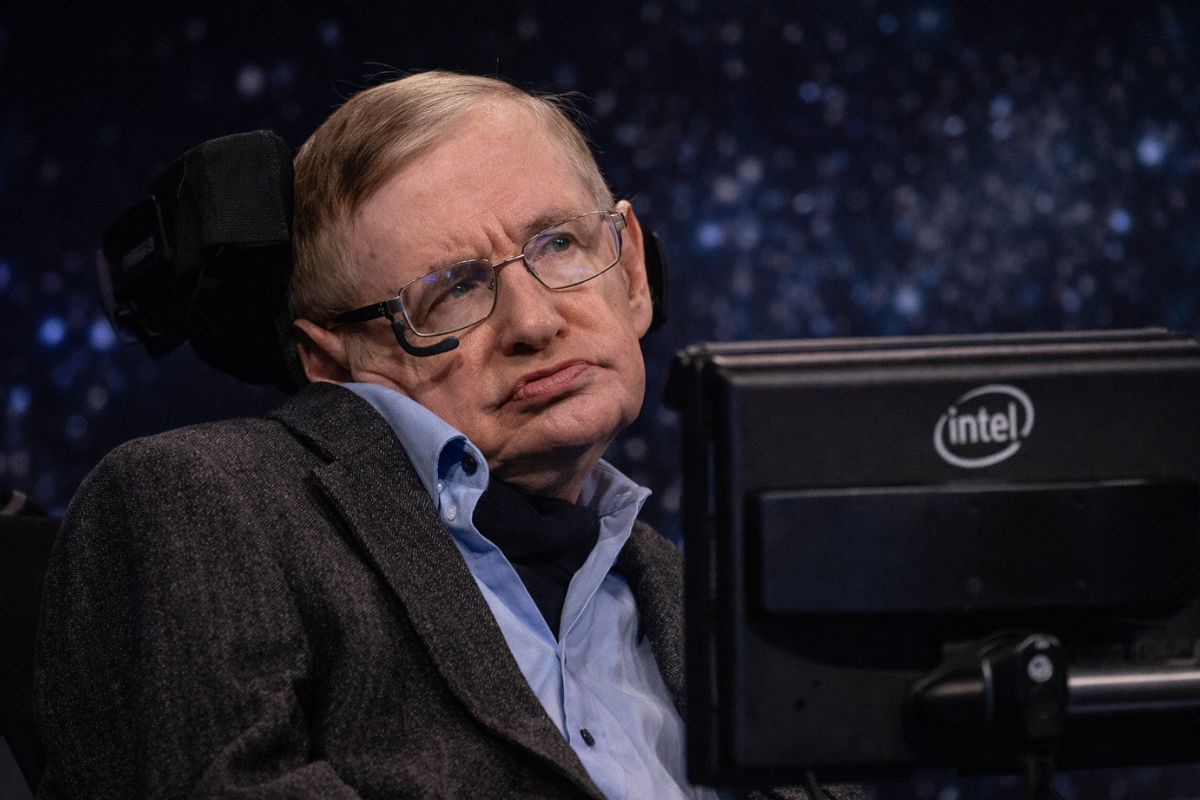
Stephen Hawking was born in Oxford in 1942, was diagnosed with ALS at 21, and nevertheless revolutionized cosmology by demonstrating that black holes emit radiation and that time had a beginning in the Big Bang, while devoting his career to combating false certainty and translating complex ideas about the universe for millions of readers in more than 40 languages
Stephen Hawking stated that the greatest enemy of knowledge is not ignorance, but the illusion of knowledge. This phrase encapsulates what set Stephen Hawking apart from other brilliant scientists: it was not just intellectual ability, but the dedication to combating false certainty. Stephen Hawking built an entire career proving that science advances when we question what seems obvious and stops advancing when people act as if they already know everything.
According to the family website of Stephen Hawking, born in Oxford on January 8, 1942, Stephen Hawking was not a brilliant student as a child, although his peers nicknamed him “Einstein.” He graduated from University College Oxford, went on to Cambridge, and became one of the most well-known scientists in the world. The diagnosis of ALS (Amyotrophic Lateral Sclerosis) at 21, which was supposed to end everything in a few years, did not prevent him from working for decades, marrying, having three children, and changing what humanity understands about black holes, the Big Bang, and the origin of time.
The diagnosis that should have ended Stephen Hawking’s career
Stephen Hawking was diagnosed around the age of 21 with ALS, a disease that progressively damages the nerve cells that control muscles. Doctors predicted that he would have little time to live.
-
A man gathered Styrofoam, PET bottles, sand, and cement to build a recycled block using a mold made from an old board and a 50mm pipe to easily raise walls.

-
Man uses technique to save plaster with 20mm polystyrene panels, promises efficient thermal insulation and impresses with low cost in the construction.

-
Man digs a pool in his backyard, finds bars and coins of gold hidden, and discovers a treasure of nearly R$ 4 million buried for years.

-
Material present in millions of kitchens raises global alarm after causing severe lung disease and leading to multimillion-dollar lawsuits in the United States.

But Stephen Hawking defied the prognosis in an almost unbelievable way: he continued working for decades, married Jane Wilde, had three children, and built a scientific career that changed what we know about the universe.
The disease was never the main focus of Stephen Hawking’s story, although it shaped the way he lived it. An episode of pneumonia in 1985 took away his natural voice and led to the adoption of the computerized voice that millions of people came to recognize.
Even confined to a wheelchair and communicating through a computer, Stephen Hawking continued to publish, lecture to large audiences, and prove that physical limitation does not limit thought.
The discoveries of Stephen Hawking that changed what we know about the universe
Working with Roger Penrose at the University of Cambridge, Stephen Hawking helped demonstrate that Einstein’s theory of gravity points to a beginning of time in the Big Bang and to extreme conditions inside black holes called singularities.
A singularity is, in simple terms, a place where matter is compressed so intensely that known physics can no longer describe what happens next. Stephen Hawking also explored the possibility that tiny black holes formed in the early universe.
But Stephen Hawking’s most famous discovery came in 1974 when he argued that black holes are not completely black: they can release energy over time. This idea, called Hawking radiation, transformed black holes from distant science fiction into objects governed by real physical rules.
Stephen Hawking proved that even what seemed absolutely certain about black holes (that nothing escapes from them) needed to be questioned, and it was exactly this questioning that led to one of the most important discoveries in theoretical physics of the 20th century.
How Stephen Hawking translated the universe for common people
Stephen Hawking knew that not everyone reads physics articles for breakfast. That’s why he wrote “A Brief History of Time,” a book that attempted to translate ideas about space, time, and the origin of the universe into accessible language.
The book reached readers in over 40 languages and became one of the best-selling science popularization texts in history, proving that cosmology does not need to be something inaccessible reserved for specialists.
Stephen Hawking’s life also reached the cinema with “The Theory of Everything.” Tributes came from institutions on both sides of the Atlantic: Order of the British Empire (CBE), election to the Royal Society, and membership in the National Academy of Sciences of the USA.
But for most people, Stephen Hawking’s most enduring message was simpler than any equation: stay curious, look up, and keep questioning easy answers.
Why Stephen Hawking’s quote about the illusion of knowledge is more relevant than ever
The statement that the greatest enemy of knowledge is not ignorance but the illusion of knowledge takes on special weight in an age of viral misinformation and instant answers. Stephen Hawking lived in a world where science advanced through doubts, not certainties.
The scientific method that Stephen Hawking practiced his whole life works precisely because it forces the researcher to test their ideas against reality and accept that they may be wrong.
When Stephen Hawking proposed that black holes emit radiation, he was contradicting what the entire scientific community accepted as truth. If he had succumbed to the illusion that existing knowledge was sufficient, Hawking radiation would never have been discovered.
The entire career of Stephen Hawking is living proof that science advances when someone has the courage to say that accepted answers may be incomplete, and that stopping questioning is the true end of knowledge.
The scientist who proved that doubting is more valuable than having certainty
Stephen Hawking was born in 1942, was diagnosed with a terminal illness at 21, revolutionized cosmology, sold millions of books, and became the most recognizable voice of science in the world. But perhaps his most important contribution was the simplest:
Stephen Hawking taught that science is not a set of ready-made truths, it is a process of ongoing questioning, and that the moment someone believes they know everything is the moment they stop learning.
The greatest enemy of knowledge is not ignorance. It is the illusion of knowledge.
Do you agree with Stephen Hawking that the illusion of knowledge is more dangerous than ignorance? Have you ever felt that you stopped learning because you thought you knew enough? What discovery of Hawking impresses you the most? Leave your comments and share this article with those who need to remember that questioning is the foundation of everything.









Seja o primeiro a reagir!