





 Portuguese
  English
  Spanish
  4 min of reading
  5 comments


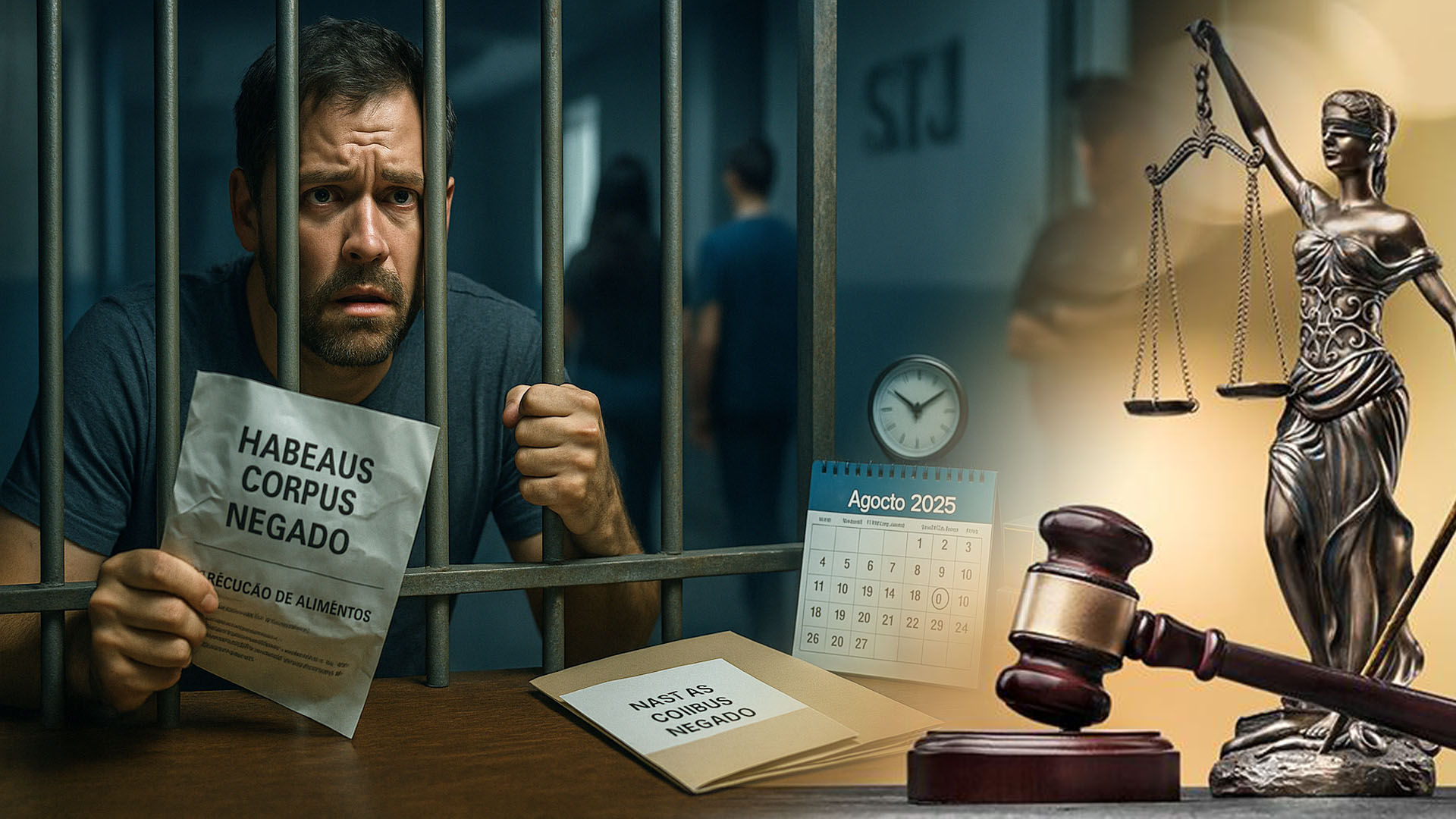


Third Panel of STJ Denied Habeas Corpus and Reaffirmed That Majority Does Not Prevent Civil Imprisonment for Child Support Debt. Understand the Legal Basis and Practical Effects.
The Third Panel of the Superior Court of Justice (STJ) denied habeas corpus to a father with accumulated child support debt and stated that the fact that the child has reached the age of majority does not prevent civil imprisonment in the enforcement of alimony.
The decision, judged on August 6, 2025, consolidated an understanding already present in the Court’s jurisprudence and raised an alert for debtors who bet on turning 18 as a “get-out-of-jail-free card.”
According to reports, the debt referred to payments established when the recipient was a teenager, and the appellate court understood that personal coercion remains applicable to enforce payment. Similarly, the STJ had decided, in 2019, that the majority of the daughter does not remove the obligation, unless there is proof of necessity or judicial exemption.
-
The Chamber opens a debate on driver’s licenses at 16 years old as part of a reform that includes around 270 proposals to change the Brazilian Traffic Code and may redesign rules for licensing, enforcement, and circulation in the country.

-
The new Civil Code could revolutionize marriages in Brazil with “express divorce” and changes that could exclude spouses from inheritance.

-
Banco do Brasil sues famous influencer for million-dollar debt and intensifies debate on delinquency, risks of seizure, and direct impact on Gkay’s credibility.

-
The Senate approves a bill that criminalizes misogyny, hatred, or aversion towards women, and includes the crime in the Racism Law with a penalty of up to 5 years.


Thousands of ongoing child support enforcement actions may adopt the extreme measure when other avenues fail, enhancing the effectiveness of collection in favor of children and creditor ex-spouses.
What the Civil Procedure Code and STJ Summaries Say About Civil Imprisonment for Child Support


The article 528 of the Civil Procedure Code establishes the procedure: the debtor is personally notified to, within three days, pay, prove clearance, or justify the impossibility. If they fail to do so, the judge may decree civil imprisonment for up to three months, a measure aimed at compelling compliance. In 2024, the STJ reinforced, in its “Quick Research,” the necessity of personal notification before segregation.
The Summary 309 of the STJ defines the scope: civil imprisonment is only legitimized for the three last overdue installments prior to the filing of the enforcement and those that become due during the process. In other words, current debt and of short duration, not old debts.
Moreover, the Summary 358 of the STJ establishes that the age of majority does not automatically extinguish alimony: exemption requires a judicial decision, considering necessity and ability. Therefore, even after reaching 18 years, the alimony may continue, and personal coercion may be applied, respecting the criteria of the law.
What the Decision Changes in the Practice of Child Support Enforcement
The denial of habeas corpus in 2025 aligns recent jurisprudence and signals to state courts that majority, by itself, does not exclude civil imprisonment when there is current debt. The decision also relates to a judgment from August 2023, where the STJ confirmed that the three-month imprisonment period provided in the CPC/2015 prevails and is constitutional as an instrument of effectiveness.
For creditors, it is possible to expedite the enforcement, including using measures such as Sisbajud (online blocking) combined with personal coercion when necessary, always respecting notification and the scope of Summary 309. For debtors, the defensive strategy is to prove real impossibility within the legal deadline and, if necessary, propose revisionary or exemption actions with evidence that the recipient no longer needs the resources.
It’s important to remember that civil imprisonment does not settle the debt; it pressures for payment. The release from the measure generally requires settlement of the owed installments as per established jurisprudence.
What Can and Cannot Be Claimed About the Child’s Majority
The thesis rejected by the STJ is that the age of majority automatically frees the debtor from civil imprisonment. The correct approach, according to Summary 358, is to discuss the necessity of alimony in a proper action and, until there is a decision, the obligation remains enforceable.
In previous cases, the Court has already denied habeas corpus when the debtor did not prove that the older daughter no longer needed alimony. Without robust proof or an exemption decision, the procedure of article 528 remains valid, with the possibility of imprisonment.
An effective defense, therefore, moves through two fronts: proving momentary inability to pay within three days and filing a revisionary/exemption action with concrete elements (the recipient’s employment, own income, financial autonomy). Without this, the enforcement continues with typical means, including civil imprisonment.
Do you think that civil imprisonment for child support debt after reaching majority is necessary to ensure maintenance or exaggerates by restricting the debtor’s freedom when there are other means of collection?










Então, se o alimentado atingir a maior idade e resolver que não vai trabalhar nem estudar o alimentando deve continuar bancando enquanto este curte a vida?
Se o alimentado querer bancar o “nem nem”(nem estuda nem quer trabalhar), é possível cessar o pagamento mas, não de forma automática, é preciso primeiro entrar com ação de exoneração e aguardar a sentença judicial e só depois da mesma, é que pode deixar de pagar. Uma vez que o juiz decidir pela exoneração, não será mais possível pedir pensão novamente.
Eu sou PCD e possuo invalidez. A questão é que a pensão possui um valor baixo apenas para garantir alimentação e, em casos específicos, gastos hospitalares, de saúde. O valor pode depender do nível de invalidez. Nem ao menos possuímos a capacidde de “curtir” a vida pois nossas condições fazem com que até mesmo a vida social seja afetada. Precisamos de um responsável legal que se responsabiliza por nossa segurança. É um valor de um salário mínimo para garantir o básico para possuirmos uma vida digna. Em meu caso, eu necessito de apoio para mobilidade básica. Como você acha que eu conseguiria “curtir a vida” se preciso.dr.suporte constante?
Você acha que a prisão civil por dívida de alimentos após a maioridade é necessária para garantir o sustento ou exagera ao restringir a liberdade do devedor quando existem outros meios de cobrança?
Resp:Totalmente exagerado,pois se não teve condições de pagar na menor idade vai pagar como na maior.
Porém as genitoras vibram com certas decisões judiciais.
E aplaudem por intenção de vingança e despeito.
Comecei a trabalhar desde os meus 12 anos se queria um caderno tinha que ir ajudar a minha irmã na roça hoje tem que bancar um adulto ater saber lar quando anos o justiça d