





 Portuguese
  English
  Spanish
  4 min of reading
  0 comments


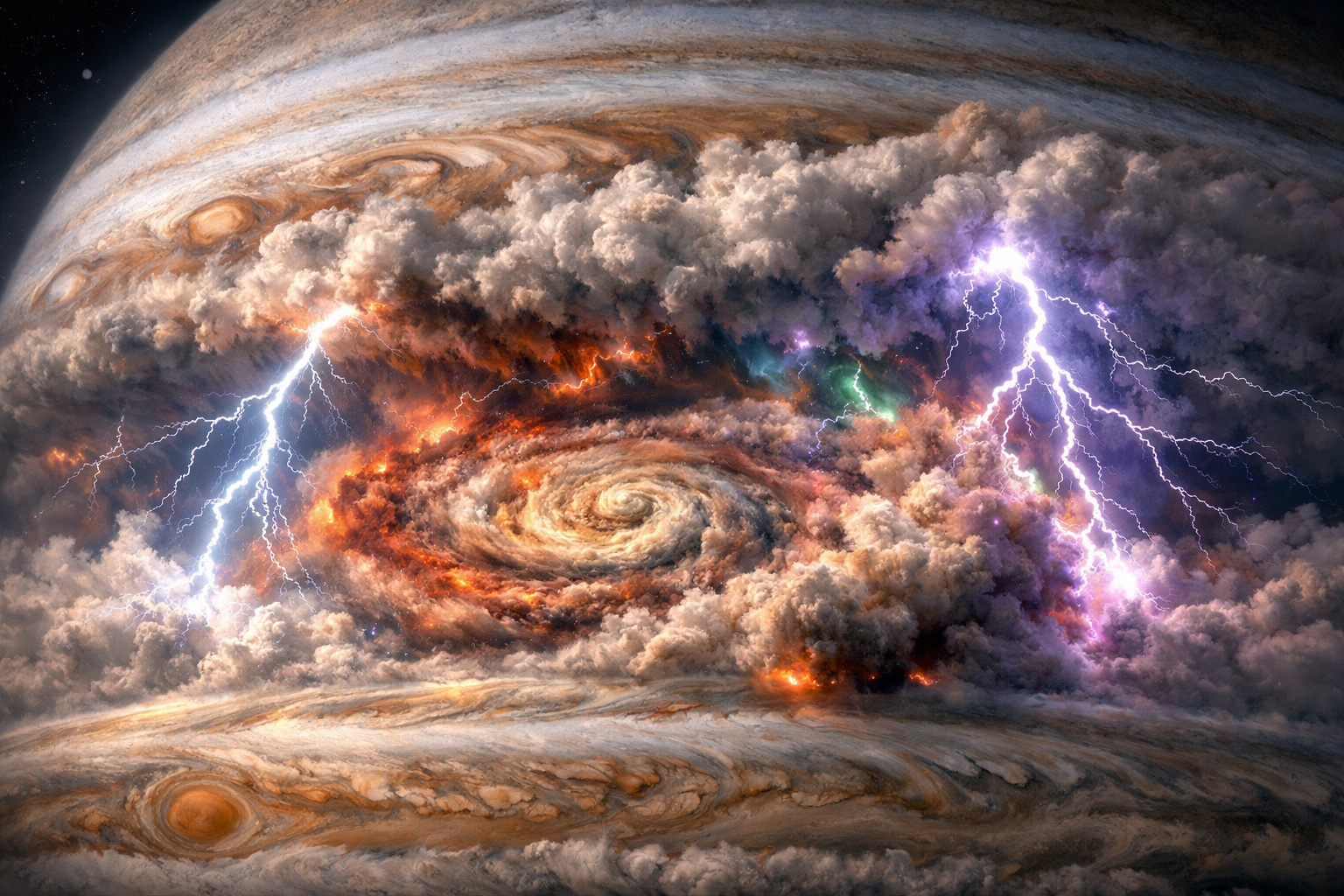
Juno probe data show giant electric discharges, deep atmospheric dynamics, and a climate system much more complex than any model has ever imagined
In one of the most extreme scenarios ever observed in the solar system, scientists have discovered that storms on Jupiter reach energy levels far beyond what we know on Earth. With lightning up to 100 times more powerful, the gas giant has become a true natural laboratory for the study of electrical and climatic phenomena on a cosmic scale.
The information was released based on data collected by NASA’s Juno probe, which has been orbiting Jupiter since 2016 and revealing unprecedented details about the planet’s atmosphere.
How lightning forms on Earth and why it is much more intense on Jupiter

On Earth, lightning formation begins with solar heating, which evaporates water and forms storm clouds known as cumulonimbus. Within these clouds, ice particles and water droplets constantly collide, generating a separation of electric charges.
-
With five floors, the building made of red sandstone, marble, and limestone surprises with its strength, appears to float, and remains stable even when submerged in water, thanks to its hydraulic engineering.

-
Brazilians are no longer welcome in these countries, even with valid passports.

-
Nothing from Switzerland or the USA: the first city in the world to reach the highest standard of quality of life is in Brazil.

-
Mega tsunami in Greenland causes Earth to vibrate for 9 days and reveals extreme effects of global warming that worry scientists worldwide.
When this charge difference reaches a critical limit, an electric discharge occurs—the lightning that seeks to restore balance.
On Jupiter, the principle is similar, but the factors involved are much more intense. Unlike Earth, the planet has no solid surface and features an extremely deep atmosphere, composed of different layers.
The upper layer contains ammonia ice. Just below it is a layer of ammonium hydrosulfide. In the deeper regions, where the greatest electrical activity occurs, there are clouds of water ice.
Moreover, while on Earth the energy primarily comes from the Sun, on Jupiter a large part of the heat arises from the planet’s interior. This internal heat generates extremely powerful convection currents capable of transporting water vapor from the depths to high altitudes.
What the Juno probe revealed about storms on the gas giant
The Juno mission has brought significant advancements to planetary science. Instruments like the microwave radiometer have allowed scientists to investigate Jupiter’s atmosphere hundreds of kilometers deep.
Additionally, instruments like Waves detected radio and plasma signals, enabling the identification of electric discharges and their intensity.
One of the most impressive discoveries was that lightning on Jupiter can be up to 100 times more powerful than the strongest recorded on Earth. These are energy discharges on a colossal scale.
Another relevant point is that many of these lightning strikes occur at higher altitudes than previously thought, while others form in deep regions of the atmosphere, in pockets of liquid water.
This indicates that the planet’s climate system is much more complex and profound than previous models suggested.
Why lightning on Jupiter is more frequent at the poles
On Earth, most electrical activity occurs in equatorial regions, where solar heating is more intense.
However, on Jupiter, the pattern is completely different. Scientists have observed that lightning is more frequent near the poles.
This difference occurs due to the distribution of heat in the atmosphere. At Jupiter’s equator, even with lower solar intensity, heating creates a stable layer that prevents the rise of air masses.
On the other hand, at the poles, this barrier does not exist. Thus, internal heat rises freely, forming much more intense convection currents.
Consequently, these currents create ideal conditions forgiant electric storms.
Unique phenomena like “mushballs” help explain the planet’s dynamics
Another intriguing concept revealed by scientists involves the so-called mushballs. These structures would be a type of hail composed of water and ammonia.
Intense storms launch ice crystals to higher layers of the atmosphere, where they come into contact with ammonia vapor. This contact partially melts the ice and creates a mushy mixture.
Subsequently, these masses become heavier and return to the deeper layers, transporting chemical elements and influencing the atmospheric composition.
This process helps explain the irregular distribution of ammonia detected by the Juno probe in different regions of the planet.
Comparison with Earth shows the impressive scale of Jupiter
To understand the difference in scale, just compare some data.
On Earth, there are about 44 lightning strikes per second, mainly in the equatorial region. On Jupiter, although the frequency is lower, the intensity is much greater.
A single storm system on Jupiter can exceed the size of the European continent. Moreover, while an average terrestrial lightning strike has about 300 million volts and tens of thousands of amperes, Jovian lightning exceeds these values by orders of magnitude.
Why studying Jupiter helps understand other planets
The study of storms on Jupiter goes beyond scientific curiosity. It allows us to understand how the atmospheres of gas giants function in general.
Additionally, this data aids in the analysis of exoplanets—worlds located outside the solar system. The presence of lightning can indicate convection processes and internal dynamics.
Therefore, each new discovery expands our knowledge of the formation and evolution of planets.
A reminder of the extreme power of the universe
Jupiter continues to reveal that the universe is much more dynamic and violent than we imagined. Its giant storms, extreme electric discharges, and complex atmospheric phenomena show that there is still much to be discovered.
Thus, each scientific advancement represents an important step toward understanding not only the solar system but also the mechanisms that govern the cosmos.
Did you imagine that a planet could have such extreme storms?
Source: Curiosities with VDZ







Seja o primeiro a reagir!