





 Portuguese
  English
  Spanish
  4 min of reading
  0 comments


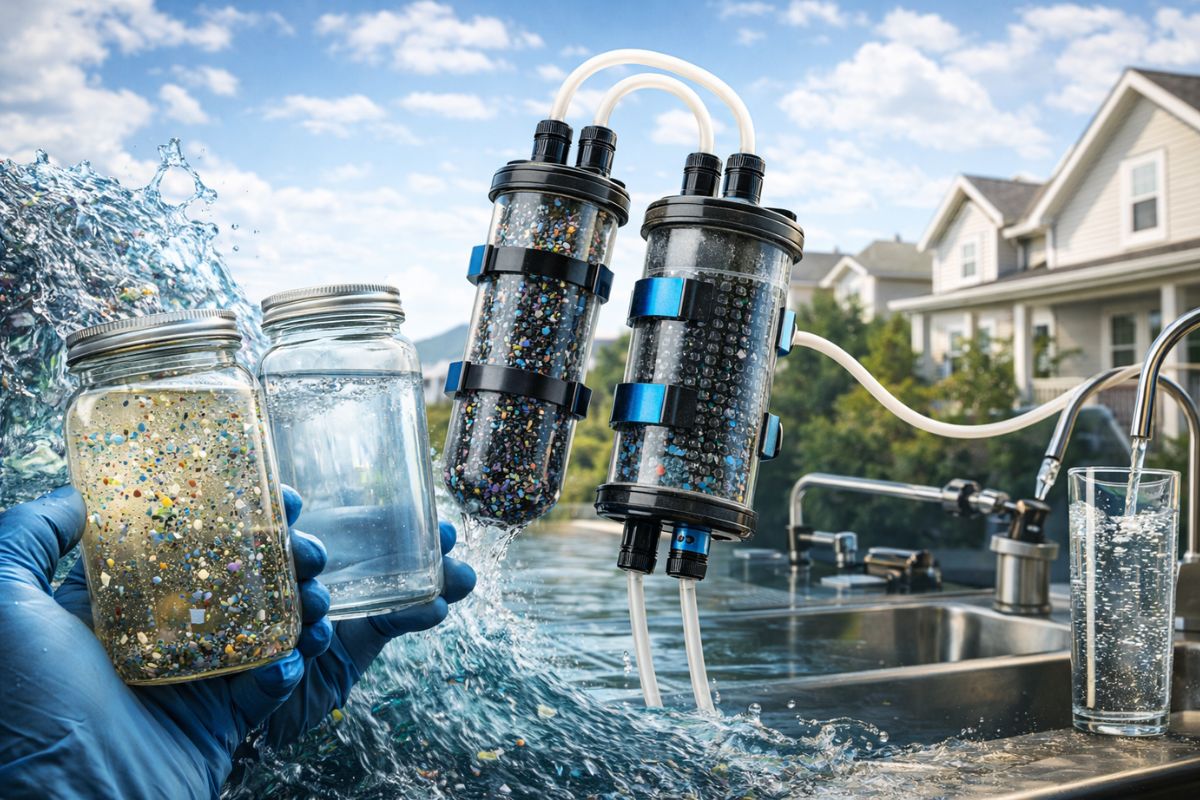
Contaminated water by microplastics gains a new solution with accessible magnetic technology that promises to reduce costs and improve home filtration
Drinking water is at the center of a new solution that could change the way we deal with microplastics in our daily lives. A student has developed an innovative system that uses magnetism to remove invisible particles that have even been found in the human body.
The most impressive thing is that this technology aimed at water does not rely on expensive or complex traditional methods. The proposal bets on a simpler, reusable model with potential for domestic application, something that can facilitate access to quality filtration.
The invisible problem that is in the water
Microplastics have become an increasing concern because they are present in virtually all environments. They reach the water we consume and end up entering the human body and animals as well.
-
Scientists create a new propulsion system that allows satellites to use the air from Earth’s atmosphere as fuel to operate in space with lower costs and longer operational time.

-
Scientists have excavated a giant cave beneath the snow of Antarctica to create a natural refrigerator at minus 50 degrees that operates without electricity and can preserve the Earth’s climate memory for entire centuries.

-
Radio has been in more than half of Brazilian households for decades, and in 2024, for the first time in history, the number of households without a device surpassed those with a device, with a decrease of 2.3 million in a single year.

-
Scientists detect a rare and frightening phenomenon in the Pacific Ocean that could trigger a devastating Super El Niño as early as 2026, and American experts say it is one of the strongest ever recorded in history.

These particles are extremely small, making their complete removal by conventional systems difficult. The constant presence of microplastics in water raises questions about health impacts, even though many effects are still being studied.
Moreover, the increase in plastic production over the years has exacerbated this problem. This makes the search for more efficient water filtration solutions increasingly urgent.
How the filter that removes microplastics from water works
The created solution uses a magnetic fluid called ferrofluid, which has the ability to bind to microplastic particles present in the water. This is the key point of the technology.
When water passes through the system, the ferrofluid captures the microplastics. Then, a magnetic field comes into play to separate this material from the liquid. The result is water with a significantly lower amount of these particles.
Another important differential is that the system was designed to reuse the ferrofluid, reducing waste and the need for constant replacement.
Efficiency surprises even specialists
The tests conducted with the prototype showed impressive results. The system managed to remove about 95% of the microplastics present in the water, a number that stands out within this type of solution.
This performance places the technology at a competitive level compared to traditional water filtration methods. The difference lies in the potentially lower cost and the simplicity of the process.
Additionally, the system also managed to recover a large part of the magnetic material used, reinforcing its sustainable proposal.
A system designed for domestic use
Unlike complex technologies used on a large scale, this filter was designed to work within the home. The goal is to allow the water consumed daily to go through a more efficient process without requiring large structures.
The prototype has a compact size and operates in simple stages. Water enters, goes through the magnetic separation process, and exits with fewer contaminants.
This approach can facilitate access to advanced water filtration, especially for those who cannot invest in expensive or frequently maintained systems.
The challenges that still need to be resolved
Despite the positive results, there are still important points to be evaluated. One of them is to ensure that the process does not leave unwanted residues after the removal of microplastics.
Another challenge is scalability. Although it works well on a small scale, it is necessary to understand how the system would behave in larger applications, such as public water supply networks.
The evolution of the technology now depends on broader tests and validations in different environments, which could pave the way for its future adoption.
Why this solution could change the future of water
The great differential lies in the combination of efficiency, simplicity, and potential for reduced cost. Instead of relying solely on industrial systems, the proposal allows for water filtration to occur in a more accessible manner.
This could represent an important change, especially in places where water quality is a constant concern and resources are limited.
If improved, this technology could help transform the way we deal with drinking water at home, bringing more safety for daily consumption.
What this innovation reveals
More than an isolated project, this idea shows how simple solutions can arise from real problems. The search for improving the quality of water led to the development of a system that combines science, practicality, and innovation.
The presence of microplastics in the environment is already a global challenge. Finding more efficient ways to remove them from water can be an important step towards reducing long-term impacts.
The most relevant thing is that this solution originates outside of large industries, showing that innovation can arise anywhere when there is need and creativity.
Do you believe that technologies like this can become common in homes in the future and change the way we consume water?





Seja o primeiro a reagir!