





 Português
  Inglês
  Espanhol
  3 min de leitura
  0 comentários


Crime Submarines Reveal The Clandestine Engineering That Moves Millions And Transforms Drug Trafficking Into An Invisible Naval Power
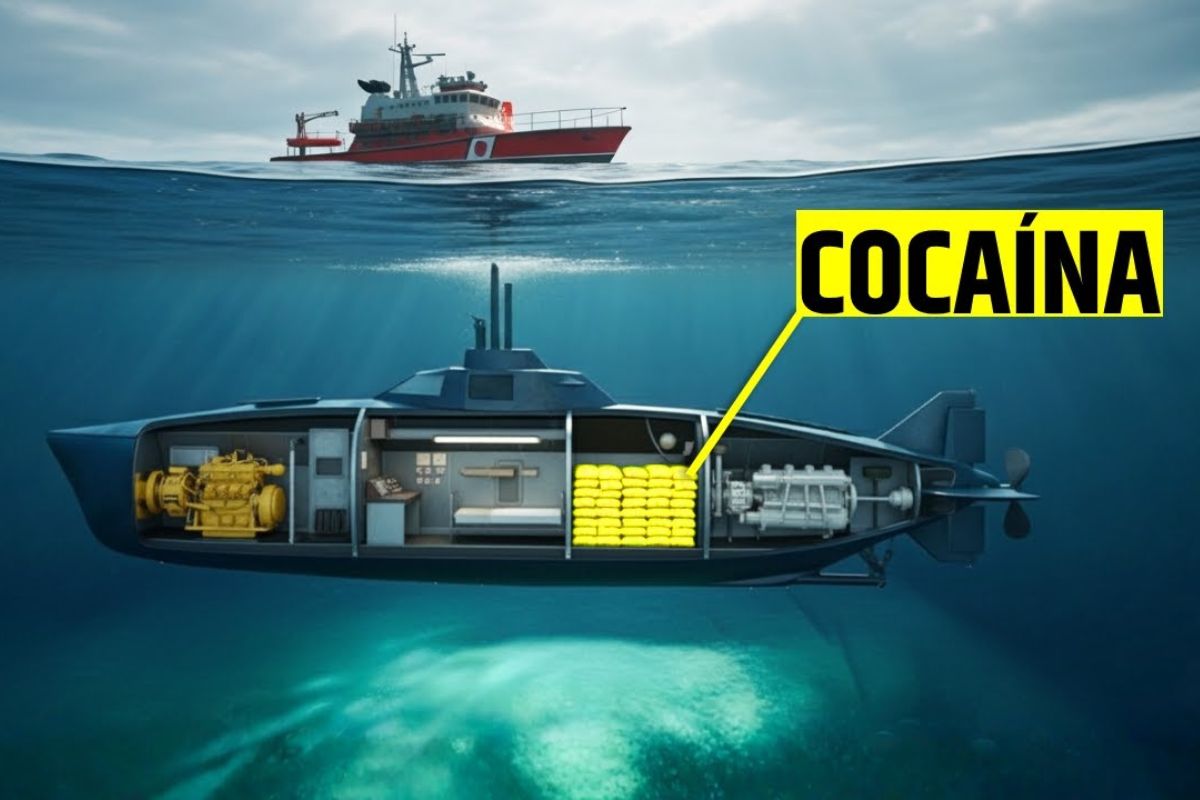
The crime submarines have become an extreme symbol of the adaptability of international trafficking. In warehouses covered by tarps, deep in the Colombian jungle, true clandestine naval assembly lines have emerged, where improvised engineers design high-efficiency vessels, powered by diesel or electricity, capable of crossing entire oceans without leaving traces. Each unit costs around 1.5 million dollars, but can carry up to 200 million in cocaine, a profit margin that sustains the technological escalation of these operations.
With reinforced fiberglass hulls, large fuel tanks and snorkel ventilation systems, the crime submarines operate almost entirely submerged, invisible to radars and satellites. In two decades, they evolved from simple low-profile boats to electric models with silent engines and multi-day autonomy. The jungle has become a shipyard, and the sea has turned into the stage of an invisible war that challenges borders and military budgets.
The Origin of Crime Submarines

In the 2000s, the old escape boats known as go-fast boats began to lose their edge.
-
The world’s first octopus farm wants to open in the Canary Islands and is already provoking an international reaction: the plan aims to produce 3,000 tons per year.

-
Drought may be creating stronger superbugs in the soil and helping antibiotic resistance reach hospitals, warns a study highlighting a problem that could grow alongside extreme weather.

-
The biggest scam in history: Napoleon’s France deceived the United States by selling them a territory that was Spanish.

-
Why is the Danakil Desert so dangerous? It has unstable terrain and how extreme temperatures and toxic gases turn the region into one of the most hostile environments on Earth.


The increase in aerial surveillance forced cartels to seek a submerged alternative. Thus, the first crime submarines emerged, vessels with no official signatures, designed for anonymity.
The structure was lightweight, built with local materials and repurposed engines, but the performance was surprising.
Capable of crossing the Pacific, they transported tons of cargo in complete silence.
Each clandestine workshop operated under total isolation, with workers confined for weeks and monitored by armed men.
The goal was simple: deliver the ship ready before the Armed Forces arrived.
The techniques were passed down orally, creating a generation of builders who mastered welding, hull curves, and balance with artisan precision.
From Jungle to Atlantic: The Transcontinental Leap

The sophistication of crime submarines grew along with profits. Larger and more robust models began operating on transatlantic routes, departing from the Amazon and arriving in Europe.
An emblematic case involved a sub built deep in Brazil that crossed the ocean to Spain, facing storms and adverse currents.
Inside, there were three crew members and three tons of cocaine, valued at around 100 million dollars.
The crossing proved that clandestine engineering had already mastered concepts of stability, ballast, and energy consumption.
Improvisation gave way to precision, and new designs began to include sensors, cameras, and automatic self-destruction valves.
Each interception generated technical learning, and in the jungle, the next prototype emerged even more efficiently.
The Era of Electric and Invisible Models
The discovery of an electric submarine in 2020 marked the most advanced point of this evolution.
Measuring 12 meters in length and weighing 10 tons of batteries, it eliminated combustion engines and navigated without thermal noise or smoke emissions.
Its autonomy was limited, but sufficient for the final delivery leg, the most critical part to escape detection.
The model represented the arrival of clean engineering in the underworld of drug trafficking, a technological irony amid illegality.
These advances made combat even more challenging. Authorities admit that only 14% of crime submarines are intercepted.
The rest complete their mission and are sunk afterward, leaving no traces, no evidence, and no chance of tracing the funding.
The Silent War Under the Sea
As the crime submarines evolve, security forces are chasing an enemy that never reappears twice in the same format.
Satellites, drones, and thermal sensors try to detect small anomalies in maritime routes, but builders are already working on autonomous versions, uncrewed, programmed to self-destruct after delivery.
The jungle and the ocean have become logistical allies of an invisible global system, where each vessel is disposable and each trip is a calculated risk.
The future of this war depends less on technology and more on economics.
As long as a sub costs little and brings in hundreds of millions, new clandestine shipyards will continue to emerge, driven by the relentless math of maritime trafficking.
Do you believe that crime submarines will evolve into fully autonomous models, or will international repression manage to curb this clandestine engineering before that happens?








-

-

2 pessoas reagiram a isso.