





 Portuguese
  English
  Spanish
  5 min of reading
  0 comments


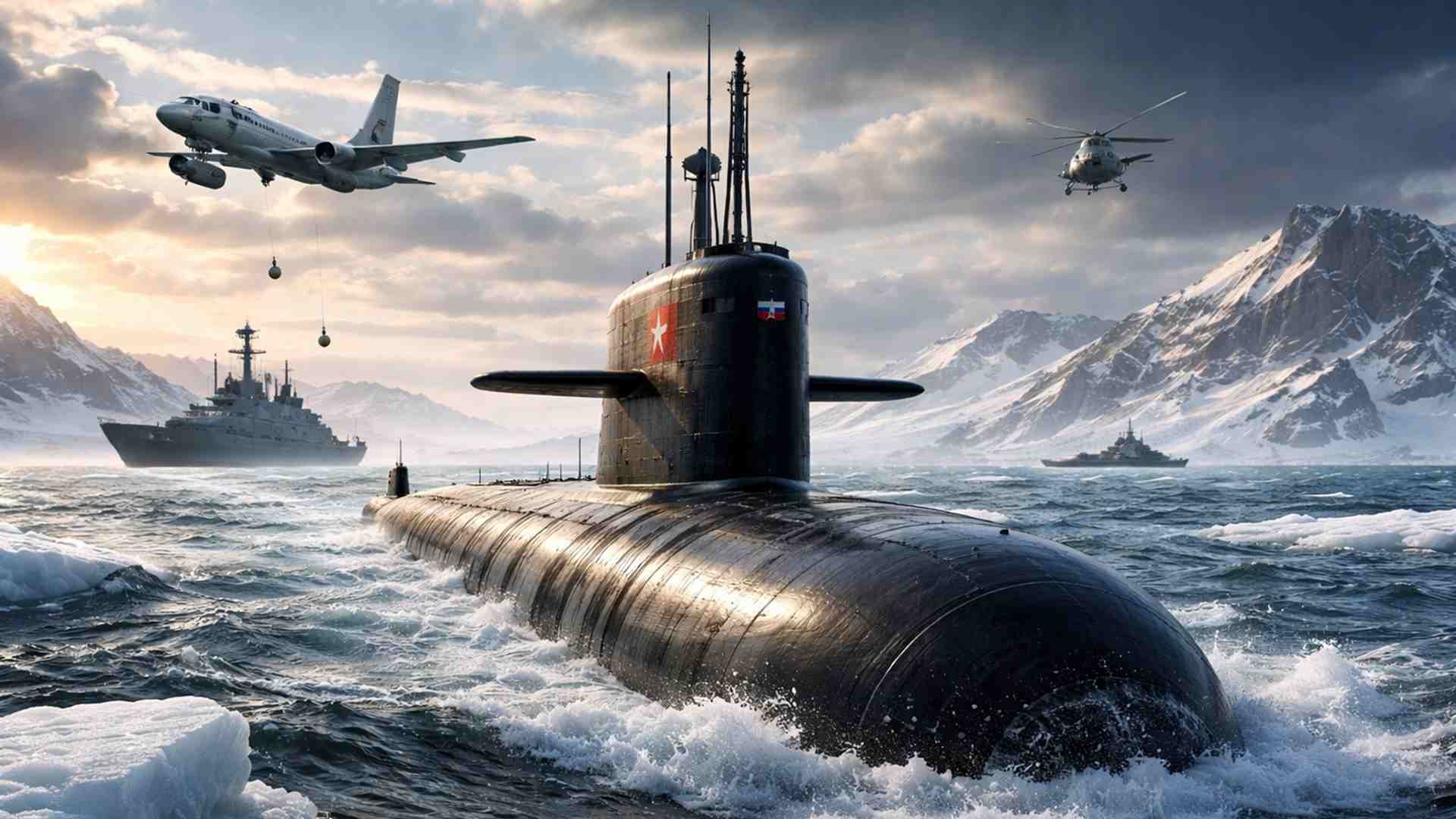
As Naval Exercises Intensify In Northern Europe, NATO Allies Conduct Coordinated Operations In Surveillance, Tracking, And Containment Of Russian Nuclear Submarines Leaving The Kola Peninsula Heading For The North Atlantic In A Scenario Marked By Political Tensions, Strategic Disputes, And Direct Risks To Transatlantic Security
NATO allies are conducting military operations in the Arctic aimed at detecting and tracking Russian nuclear submarines that regularly leave the naval base on the Kola Peninsula in northern Russia, heading towards the North Atlantic, in an area considered strategic for European and North American security.
In the icy waters off the coast of Norway, NATO naval forces are scouring the ocean floor for signs of Russian submarine activity. The region serves as a gateway to the Arctic, connecting the far north of Europe to the far north of Russia, where the Kremlin’s Northern Fleet is based.
Russian submarines armed with nuclear weapons frequently depart from the extensive naval base located in the Kola Peninsula. These vessels glide silently beneath the ice and open sea before heading towards the North Atlantic, crossing routes closely monitored by Western allies.
-
The lost continent beneath Europe: separated from North Africa about 240 million years ago, comparable in size to Greenland, Greater Adria was crushed over 40 million years and left geological marks from the Alps to the Balkans.

-
A cold front advances through the South this Saturday and reaches the Southeast on Easter Sunday with heavy rain and a drop in temperature, while the North and Northeast face the risk of storms and flooding throughout the holiday.

-
Brazil is about to inaugurate the largest maritime surveillance system in its history, with radars, infrared cameras, and autonomous sensors installed on Ilha Grande to monitor the entire Brazilian coast in real time.
-
Archaeologists discover in China a 5,000-year-old tomb with over 350 artifacts, nearly 200 jades, and signs of intentional destruction, in a discovery that could be the gateway to a lost prehistoric kingdom.


CBS News followed the crew of a NATO warship during exercises designed to detect, track, and, if necessary, destroy these submarines before they cross the narrow maritime corridor between Greenland, Iceland, and the United Kingdom, known as a critical chokepoint.
Should an armed conflict erupt between Russia and the United States, with direct NATO involvement, this area would become an essential strategic choke point to prevent Russian submarine forces from approaching the U.S. East Coast.
Arctic Dolphin Operation And NATO’s Role In The Far North
Allied commanders describe the Arctic Dolphin Operation as a fundamental exercise to maintain the cohesion of a military alliance that has lasted 75 years. The operation brings together ships, submarines, and aircraft from countries such as Spain, Germany, France, the United Kingdom, and other NATO member nations.
According to Commodore Kyrre Haugen, commander of the Norwegian Fleet responsible for the operation, Norway directly benefits from being part of a broad and multinational alliance. He emphasized that all participating nations gain by operating within a collective framework.
Haugen stated that Norway has operated in the Arctic since the Cold War and that the renewed focus on the region highlights its growing importance for the security of Europe and the United States. For him, NATO’s continuous presence in the far north is a stabilizing factor.
The commander also pointed to the Russian arsenal. According to him, missiles carried by Russian nuclear submarines can reach both Europe and the United States, being launched from mobile positions in the open sea along the Atlantic.
Nuclear Submarines, Missiles, And The Strategic Dispute In The Arctic
The exercise followed by CBS News is just one element of a wider dispute over Arctic security, a region described as a frontline in global strategic competition. This assessment was made by U.S. Air Force General Alexus Grynkewich, Supreme Allied Commander in Europe.
Russia is already using the Arctic as a testing ground for hypersonic missiles designed to bypass U.S. air defense systems. These tests raise allies’ concerns about Russia’s offensive capabilities in the region.
In addition to external threats, political tensions are also affecting the regional dynamics. President Donald Trump irritated NATO partners by insisting that the United States should take possession of Greenland and threatening to impose trade tariffs if allies did not meet the demand.
Trump later backed down from the threat, announcing a long-term agreement, still vague, with American NATO allies regarding Greenland. Nevertheless, he continues to regularly criticize these countries, accusing them of investing little in their own defense.
Despite this, military analysts indicate that the alliance seeks to regain ground in the Arctic and the far northern Europe. Seven of the eight Arctic states are part of NATO, but Russia, which holds more than half of the Arctic coastline, maintains nearly as many permanent military bases as all alliance members combined.
National Contributions And NATO’s Collective Defense
During the operation, CBS News was on board the Spanish frigate ESPS Almirante Juan de Borbon. On the command bridge, Rear Admiral Joaquín Ruiz Escagedo defended Spain’s participation in NATO, following recent criticisms made by Donald Trump towards the country.
Escagedo avoided directly commenting on the political dynamics, but pointed to Spanish officials working on maps and radar screens as concrete proof of the country’s commitment. He stated that Spain possesses multiple capabilities and remains committed to the principle of collective defense.
For the rear admiral, NATO’s strength lies in the unity among its members. He emphasized that the alliance cannot operate in isolation and that continuous cooperation is the key to success over the decades.
This unity, however, is set to be put to the test soon with the launch of a new military initiative in the far north aimed at the permanent surveillance of the Arctic region.
Arctic Sentry And The Reinforcement Of Surveillance In The Far North
NATO plans a new mission called Arctic Sentry, aimed at reinforcing surveillance and increasing military presence in the Arctic and High North. A spokesperson for General Alexus Grynkewich confirmed to CBS News that the planning for the mission is already underway.
According to the spokesperson, Arctic Sentry will be an enhanced surveillance activity, with the goal of consolidating NATO’s operations in the region. He emphasized that planning is still in its early stages and that additional details will be released in the future.
The possibility of the new mission was mentioned for the first time last month by the British chief diplomat during negotiations that helped resolve the impasse between Trump and European allies regarding the future of Greenland.
UK Foreign Secretary Yvette Cooper stated that London proposed working within NATO on a new Arctic sentinel, similar to existing missions in the Baltic and Eastern Europe.
According to Cooper, the initiative will bring together Arctic countries with the support of other NATO members to define how shared security in the region will be conducted. She made the statement to BBC News on January 22, a partner network of CBS News.






-

-

3 pessoas reagiram a isso.