





 Portuguese
  English
  Spanish
  3 min of reading
  0 comments


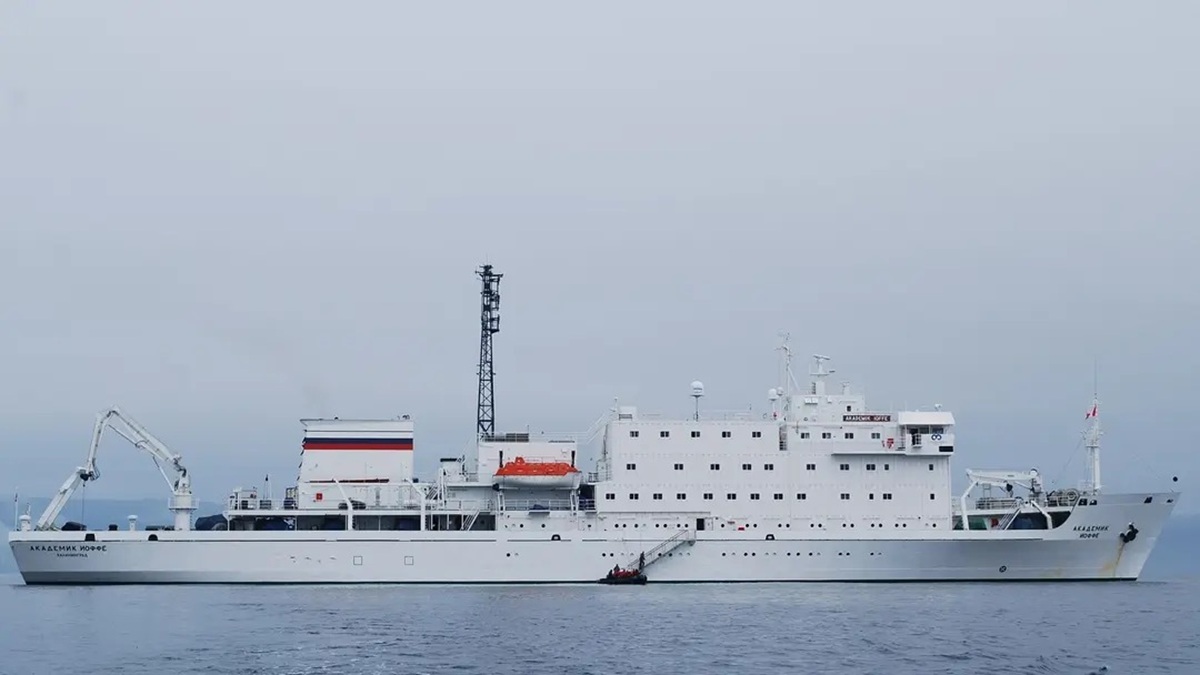
Expedition in the Barents Sea Located Undocumented Nuclear Site, Mapped Likhter-4 Sunk in 1988, Confirmed 580 Tons of Waste and Assessed Radiological Safety of Soviet Submarines in the Arctic
The Russian research vessel Akademik Ioffe located an undocumented nuclear site in the Barents Sea during a recent expedition in the Arctic, identifying sunken vessels with radioactive waste and confirming current radiological conditions, directly impacting environmental monitoring of the region.
The discovery occurred in the Bay of Currents, an area not listed in public inventories from the Soviet era, during a mission dedicated to the environmental recovery of the Arctic affected by submerged objects containing irradiated nuclear fuel.
Search for Likhter-4 and Waste from the 1980s
One of the main objectives of the expedition was to locate the Likhter-4 ship, sunk in 1988, according to archive records about the disposal of radioactive waste in the Arctic during the 1980s.
-
Motorola launched the Signature with a gold seal from DxOMark, tying with the iPhone 17 Pro in camera performance, Snapdragon 8 Gen 5 that surpassed 3 million in benchmarks, and a zoom that impresses even at night.

-
Satellites reveal beneath the Sahara a giant river buried for thousands of kilometers: study shows that the largest hot desert on the planet was once traversed by a river system comparable to the largest on Earth.

-
Scientists have captured something never seen in space: newly born stars are creating gigantic rings of light a thousand times larger than the distance between the Earth and the Sun, and this changes everything we knew about stellar birth.

-
Geologists find traces of a continent that disappeared 155 million years ago after separating from Australia and reveal that it did not sink, but broke into fragments scattered across Southeast Asia.

According to this data, the vessel was dumped together with 146 containers of solid radioactive waste generated during the operation of nuclear submarine power plants active at that time.
The Likhter-4 houses two reactors belonging to the K-22 submarine, encased in lead and devoid of nuclear fuel, a configuration adopted at the time to reduce radiological risks during disposal.
Previous attempts to locate the ship occurred in 2007, 2023, and 2024, during expeditions aboard the Akademik Mstislav Keldysh, but time limitations and adverse weather conditions prevented definitive identification.
Submersibles, New Bathymetry, and Accurate Location
The Akademik Ioffe team succeeded in employing remotely operated submersibles GNOM “X”, GNOM “Vector”, and “Argus”, taking advantage of favorable weather conditions recorded during the mission.
The equipment was equipped with gamma spectrometers developed by the National Research Center of the Kurchatov Institute, allowing for detailed radiological and bathymetric surveys of the investigated area.
The measurements indicated that the Likhter-4 was not at the archived coordinates, near the Roze glacier, but rather in a local depression with a depth exceeding 100 meters.
The team managed to map the exact position of the wreck and conducted partial radiation surveys both on the hull and on the surrounding seabed, confirming the lost location.
Barge Nikel and Solid Waste in the Barents Sea
In addition to the Likhter-4, the expedition confirmed for the first time in two decades the exact coordinates of the Barge Nikel, located near Kolguyev Island.
The vessel contains approximately 580 tons of solid radioactive waste and, until then, its position was known only approximately, without precise mapping on a metric level.
Inspection of the K-27 Submarine and Continuous Monitoring
The mission also inspected the K-27 nuclear submarine, sunk in 1981 in the Stepovoy Bay, near Novaya Zemlya, which contains two reactors with lead-bismuth liquid metal coolant.
After an accident in 1968 and 13 years in reserve, the K-27 was sunk with intact irradiated nuclear fuel, being considered potentially the most dangerous object in nuclear terms in the oceans.
Measurements taken with the REM-4-50 spectrometer indicated that the protective barriers remain effective, with no detection of radioactive leakage to the surrounding marine environment of the reactor compartment.
The presence of Cesium-137 was attributed only to superficial contamination of the hull, while experts pointed other sunken containers as the likely dominant source of radiation in the area.
Based on the results, a coastal area was selected for the future installation of an underwater station, aimed at continuous monitoring of radiation from the K-27 reactors, operating 24 hours a day, seven days a week.








Seja o primeiro a reagir!