





 Portuguese
  English
  Spanish
  3 min of reading
  0 comments


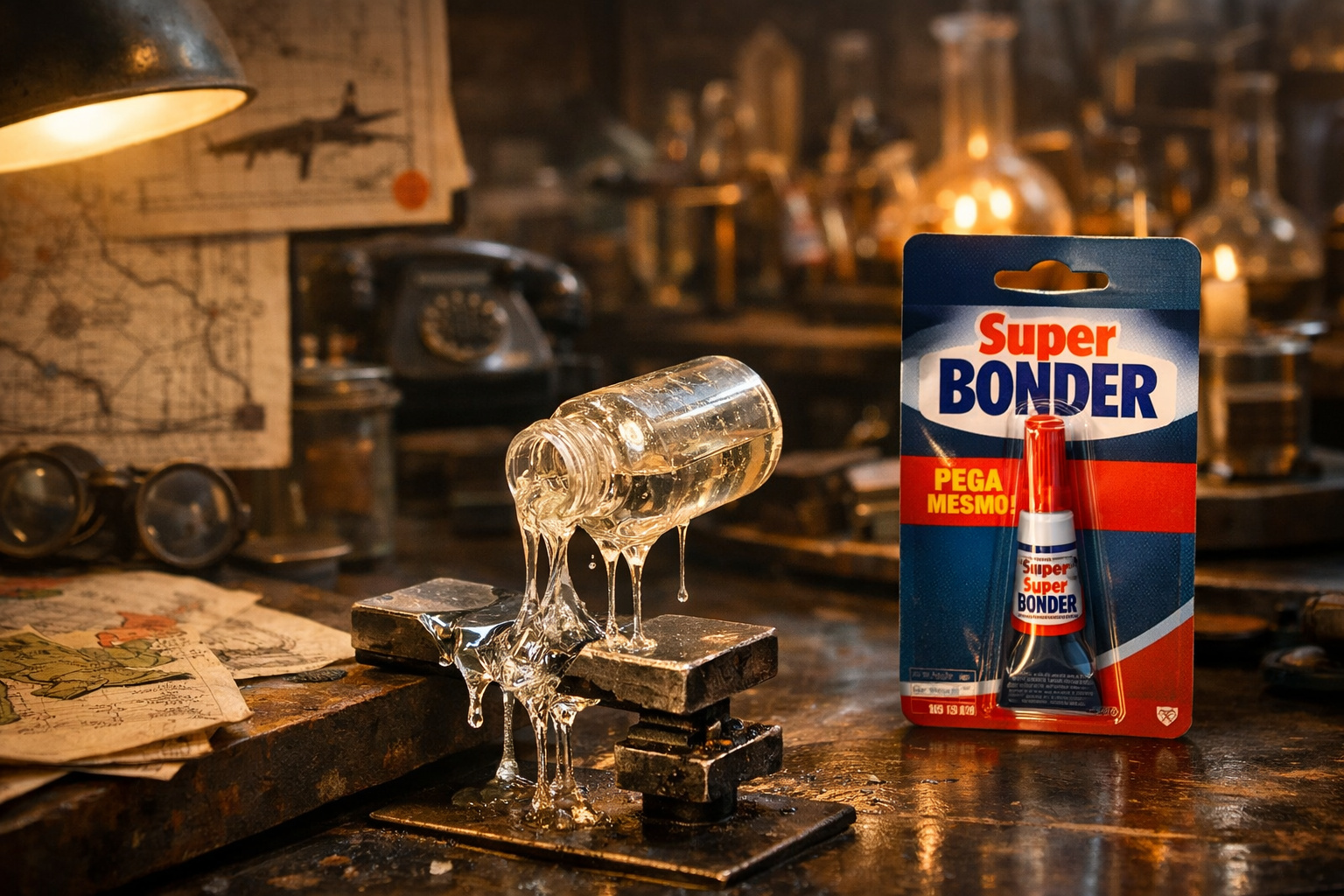
Accidental Discovery in 1942 During Military Research Led to the Creation of Cyanoacrylate, the Base of Super Glue, One of the Most Used Adhesives in the World.
The history of the instant glue known in Brazil as Super Glue begins in a military laboratory during World War II. What few people know is that the product was not created with the intention of bonding objects — quite the opposite. It emerged as an error during the attempt to develop transparent plastic materials for military use.
The person responsible for the discovery was the American chemist Harry Wesley Coover Jr., who in 1942 worked at Eastman Kodak on a project aimed at producing special plastics for weapon sights.
The Military Research That Led to the Accidental Discovery
During World War II, there was great interest in developing durable and transparent plastic materials that could be used in military optical equipment, such as precision sights.
-
Friends have been building a small “town” for 30 years to grow old together, with compact houses, a common area, nature surrounding it, and a collective life project designed for friendship, coexistence, and simplicity.

-
This small town in Germany created its own currency 24 years ago, today it circulates millions per year, is accepted in over 300 stores, and the German government allowed all of this to happen under one condition.

-
Curitiba is shrinking and is expected to lose 97,000 residents by 2050, while inland cities in Paraná such as Sarandi, Araucária, and Toledo are experiencing accelerated growth that is changing the entire state’s map.

-
Tourists were poisoned on Everest in a million-dollar fraud scheme involving helicopters that diverted over $19 million and shocked international authorities.


While testing chemical compounds called cyanoacrylates, Coover noticed that the material produced had an unexpected characteristic: it instantly stuck to practically any surface it touched.

This extreme adhesion property made the material impractical for the initial goal of the project. Instead of serving as structural plastic, the compound acted like a highly reactive adhesive substance. Therefore, it was initially discarded.
What Are Cyanoacrylates and Why Do They Stick So Fast
Cyanoacrylate is a chemical compound that polymerizes rapidly in the presence of moisture — including the natural moisture present in the air or on the surfaces of materials.
When it comes into contact with small amounts of water, the liquid quickly turns into a solid polymer, creating a strong bond between two surfaces. This extremely fast reaction explains why instant glue:
- Adheres in seconds
- Works on various materials
- Can bond human skin almost immediately
In the 1940s, this property was seen as a problem for the military project. Only years later would its commercial potential be recognized.
The Rediscovery and the Birth of Instant Glue
In 1951, nearly a decade after the initial discovery, Harry Coover revisited cyanoacrylates. This time, he realized that the extreme adhesion was not a defect — it was precisely what made the material revolutionary as an adhesive.
The product was commercially developed and launched in 1958 under the name Eastman 910, being introduced to the public as an adhesive that required no heat or pressure to work.
From that moment on, instant glue began to gain worldwide popularity, giving rise to several commercial brands, including Super Glue and, later, Super Bonder.
Unexpected Use in Medicine and War
Interestingly, the compound also found medical applications. During conflicts such as the Vietnam War, versions of cyanoacrylate were used to temporarily stop bleeding in the field, helping to stabilize injuries until the patient received hospital care.

Today, medical variations of cyanoacrylate are used as surgical adhesives for wound closure, replacing stitches in some cases.
From Chemical Error to Billion-Dollar Industry
What began as a failed experiment in search of military plastic has transformed into one of the most important adhesive technologies of the 20th century. Currently, cyanoacrylates are used in:
- Home repairs
- Electronics industry
- Automotive sector
- Medical applications
- Equipment manufacturing
The global instant adhesive industry generates billions of dollars each year, with a presence in nearly every country.
Why the Discovery Is Considered a Classic of Accidental Science
The history of Super Glue is often cited as an example of scientific serendipity — when an important discovery occurs unexpectedly during the search for another goal. If Harry Coover had simply ignored the unusual behavior of the compound, cyanoacrylate could have remained a discarded experiment.


The difference was the ability to recognize the potential of a characteristic initially seen as a flaw. The story reinforces how scientific discoveries can arise from the most unexpected places — even from an experiment that seemed to have gone wrong.










Seja o primeiro a reagir!