





 Portuguese
  English
  Spanish
  5 min of reading
  0 comments


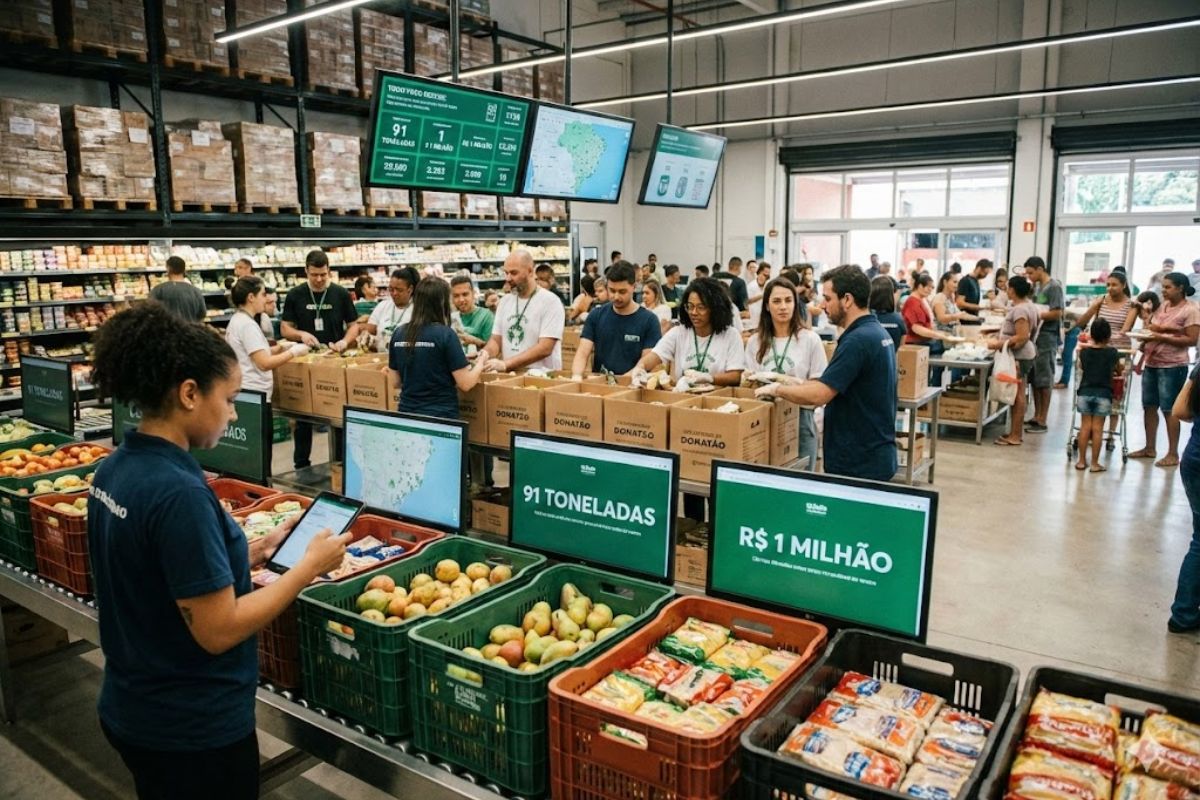
In 14 Months, Bistek Supermarkets in Santa Catarina Used Infineat Technology to Map Surpluses, Redirect 91 Tons of Own Food to Consumption, Avoid R$ 1 Million in Waste, and Transform What Would Go to Waste into 150 Thousand Meals for Families Served by Social Organizations Throughout Santa Catarina.
In 14 months of operation, until 2025, the Bistek supermarket chain structured a technological system capable of tracking waste within stores, separating what is still suitable for consumption, and redirecting these items for donation. As a result, 91 tons of food that would have gone to waste were repurposed, equivalent to R$ 1 million in products that turned into about 150 thousand meals served to families in vulnerable situations.
The project, developed in partnership with the startup Infineat, also had a direct environmental impact: 84 thousand kilograms of CO₂ were avoided during this period. The initiative began in a pilot phase at three stores and, after the results, expanded rapidly. By 2025, it will already be structured in 14 supermarkets and is expected to reach 20 units by the end of the year, consolidating a new standard of waste management in the retail sector of Santa Catarina.
Technology Changes the Logic of Waste in Supermarkets
Infineat’s technology allows Bistek supermarkets to identify, classify, and redirect products that have lost commercial value but remain fit for consumption.
-
Larger than entire cities in Brazil: BYD is building a 4.6 km² complex in Bahia with a capacity for 600,000 vehicles per year, but the discovery of 163 workers in conditions analogous to slavery has shaken the entire project.

-
With an investment of R$ 612 million, a capacity to process 1.2 million liters of milk per day, Piracanjuba inaugurates a mega cheese factory that increases national production, reduces dependence on imports, and repositions Brazil on the global dairy map.
-
Brazilian city gains industrial hub for 85 companies that is equivalent to 55 football fields.

-
Peugeot and Citroën factory in Argentina cuts production by half and opens a layoff program for more than 2,000 employees after Brazil drastically reduced purchases of Argentine vehicles.


This includes fruits and vegetables, dairy products, grains, bread, and even meats that are nearing their expiration date or do not meet the aesthetic standards required for the shelves.
Instead of being discarded, these items are managed within a digital post-loss flow.
Waste ceases to be a generic number and becomes an operational data, with records in the platform and real-time monitoring.
This change allows for a precise view of costs, volumes, and repurposing opportunities, bringing the logic of supermarkets closer to industrial management.
From Pilot Initiative to Routine of 14 Stores
Before the project, donation and repurposing actions existed in a fragmented way across the supermarket chain.
With the technological partnership, Bistek standardized the process. The collection began to follow specific rules, with schedules, defined responsibilities, and logistical integrations with social organizations that receive the food.
Today, 14 supermarkets in the chain already operate under this structured model, and the goal is to reach 20 units by the end of 2025.
The scale brought a positive side effect: the creation of clear indicators on avoided waste, reduced environmental impact, and the number of meals supplemented, strengthening operational efficiency goals and the company’s ESG metrics.
Direct Connection with Social Organizations and Total Traceability
A central point of the project is the connection between supermarkets and partner social organizations. Infineat’s platform records each step of the journey of repurposed foods, from separation in stores to arrival at institutions.
As a result, Bistek gained complete traceability about the destination of each kilogram of redirected food, ensuring security, control, and transparency for internal and external audits.
For social entities, the benefit appears in the form of reduced costs for purchases and increased predictability in supplying meals offered to families served.
Internal Culture: From Inevitable Discard to Managed Process
Within the supermarket operation, the impact is also cultural. Bistek’s Loss Prevention area began to treat discarding as a process to be managed, rather than an inevitable consequence of retail activity.
Store teams were trained to correctly identify repurposable products, follow food safety protocols, and record everything in the system.
The fight against waste becomes part of the daily operation, with goals, indicators, and management monitoring, moving away from being merely a one-off action on specific dates or isolated campaigns.
Brand Positioning and Strengthened ESG Metrics
From an institutional perspective, the initiative reinforces the Bistek supermarket chain’s positioning on issues such as sustainability, social responsibility, and innovation in food retail.
The company can demonstrate, with numbers, how combating waste generates measurable impact: 91 tons of repurposed food, R$ 1 million in redirected products, 150 thousand supplemented meals, and 84 thousand kilograms of CO₂ avoided.
This data is added to other operational indicators of the company, which operates in Santa Catarina and Rio Grande do Sul and plans to close 2025 with revenues close to R$ 3 billion.
With more than 20 stores, about 5,000 employees, a distribution center of 23,000 square meters along BR 101, its own slaughterhouse, and centralized administrative structure, Bistek uses the project as an example of how supermarkets can integrate social impact, logistical efficiency, and waste reduction into the same management model.
Infineat Turns Invisible Waste into Strategic Data
Infineat, responsible for the technology used in Bistek supermarkets, is a Brazilian startup specialized in operational intelligence for food retail, focusing on post-loss.
Present in 19 states and in more than 260 stores, the company has already redirected the equivalent of R$ 80 million in food, complementing more than 12 million meals.
The startup created the Avoided Waste Index, the IDE, which transforms what was previously considered invisible breakage into structured information for the business.
With this indicator, supermarkets can see value where there was once only cost, connecting financial, environmental, and social goals into a single management dashboard.
Trend: Post-Loss Permanently Enters the Agenda of Food Retail
The experience of Bistek supermarkets with Infineat reinforces a trend gaining strength in Brazilian food retail: treating post-loss as a strategic operation phase.
By consolidating data on repurposing, environmental impact, and logistical efficiency, the sector begins to operate with a full-cycle logic, where what leaves the shelf does not necessarily leave the value chain.
In practice, this means less waste, more efficiency, and more meals for those in need, in a model where technology, inventory management, and social responsibility go hand in hand.
The way supermarket chains incorporate this type of solution in the coming years may redefine the standard of acceptable waste in the country.
And you, do you believe that all supermarkets should have a structured system to transform surpluses into meals instead of discarding food?






-

-

-

-

-

51 pessoas reagiram a isso.