





 Portuguese
  English
  Spanish
  5 min of reading
  0 comments


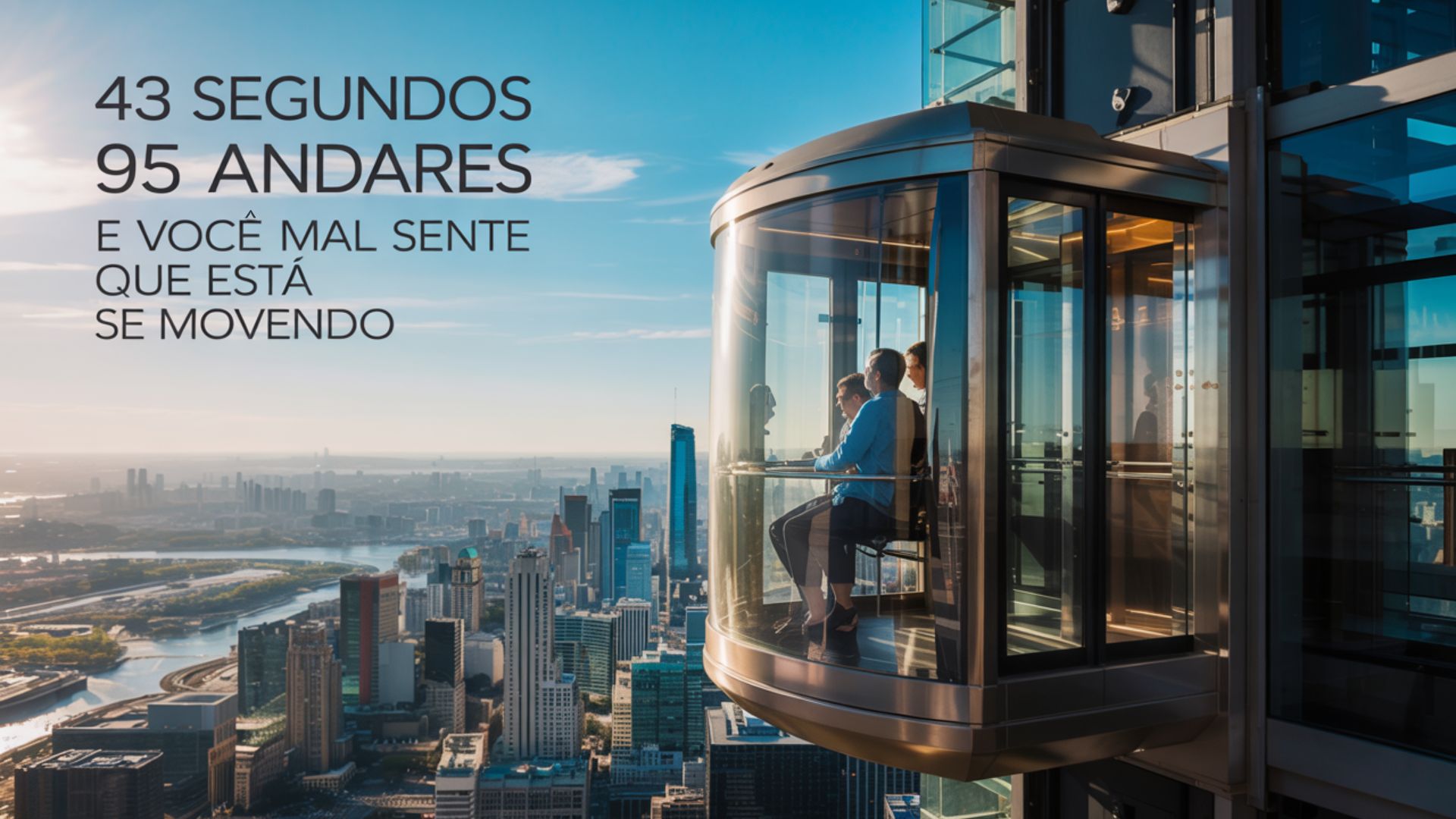
Imagine entering an elevator, pressing the button for the 95th floor, feeling a slight thrust, and before you realize it, the doors are already opening up there at the top. This is the experience offered by the fastest elevator in the world — a marvel of modern engineering that combines extreme speed with absolute comfort.
The title of fastest elevator in the world currently belongs to the ultra-fast elevator from Mitsubishi Electric, installed at the CTF Finance Centre in Guangzhou, China. This imposing skyscraper, standing at 530 meters tall, houses offices, a luxury hotel, shopping, and residences, and serves as a true vertical laboratory for elevator transport solutions. The specific model, custom-made for the building, reaches an impressive speed of 21 meters per second, equivalent to 75.6 km/h. With this performance, it can ascend 95 floors in just 43 seconds, a feat that challenges the limits of what was once considered possible in elevator engineering with ultrasonic elevators.
What Is an Ultrasonic Elevator?
Although the term “ultrasonic” is more commonly known in medical and acoustic applications, it is often used informally to describe elevators that operate at extremely high speeds, typically above 10 meters per second. In the case of the Mitsubishi model, the term gained popularity due to media impact, even without direct involvement with high-frequency sound technology.
The term reflects the almost imperceptible feeling of displacement experienced by users — as if the movement were so fast and smooth that it barely registers.
-
Motorola launched the Signature with a gold seal from DxOMark, tying with the iPhone 17 Pro in camera performance, Snapdragon 8 Gen 5 that surpassed 3 million in benchmarks, and a zoom that impresses even at night.

-
Satellites reveal beneath the Sahara a giant river buried for thousands of kilometers: study shows that the largest hot desert on the planet was once traversed by a river system comparable to the largest on Earth.

-
Scientists have captured something never seen in space: newly born stars are creating gigantic rings of light a thousand times larger than the distance between the Earth and the Sun, and this changes everything we knew about stellar birth.

-
Geologists find traces of a continent that disappeared 155 million years ago after separating from Australia and reveal that it did not sink, but broke into fragments scattered across Southeast Asia.

How Does the Fastest Elevator in the World Work?


To achieve such performance, engineers from Mitsubishi Electric developed a complex system of:
- High-power motors with passive magnetic levitation technology
- Ultralight braided carbon cables, more resistant than steel
- Pressurized ceramic brake systems
- Aerodynamic control technology that reduces air resistance in the vertical shaft
- Pressure and altitude compensation sensors, which regulate the internal environment
All of this is controlled by an artificial intelligence center that monitors vibration, pressure, temperature, acceleration, and passenger comfort in real-time.
Speed with Comfort: Is It Possible?
Yes — and this is one of the biggest achievements of the project. At such high speeds, it was expected that passengers would feel nausea, pressure in their ears, dizziness, or discomfort. To avoid this, Mitsubishi created a set of innovations that transformed the journey into an almost imperceptible experience.
Among the solutions are:
- Atmospheric pressure control inside the cabin, which simulates a stable altitude
- Lateral stabilizers, which absorb micro-vibrations from the structure
- Triple acoustic insulation, which reduces internal noise to minimal levels
- Anti-sway system, which corrects tilts and lateral movements in real-time
These elements make the trip not only fast but surprisingly smooth, even when ascending almost half a kilometer vertically in less than a minute.
Why Build Such a Fast Elevator?
The answer lies in vertical urbanization. Cities like Guangzhou, Tokyo, Dubai, and New York are building increasingly taller buildings, and efficiency in vertical transport has become a logistics and productivity issue.
Direct Benefits of the Fastest Elevator in the World Include:
- Reduction of waiting and travel time in skyscrapers
- Better use of vertical space in multi-functional buildings
- Increased transport capacity during peak hours
- Reduction in operational costs due to energy efficiency
In the case of the CTF Finance Centre, which has over 100 elevators, smart distribution and the use of ultra-fast models make movement as efficient as in smaller buildings.
The Global Race for Speed
In recent years, the race for the fastest elevator in the world has become a chapter apart in urban engineering. Here are some of the main competitors:
| Elevator | Location | Speed (m/s) | Manufacturer |
|---|---|---|---|
| Mitsubishi CTF Finance Centre | Guangzhou, China | 21 | Mitsubishi Electric |
| Shanghai Tower | Shanghai, China | 20.5 | Hitachi |
| Taipei 101 | Taipei, Taiwan | 16.8 | Toshiba |
| Burj Khalifa | Dubai, United Arab Emirates | 10 | Otis |
While the CTF Finance Centre holds the speed record, other buildings are also innovating in technologies such as capacity, safety redundancy, and smart automation.
In structures with ultra-fast elevators, safety is of utmost priority. The Mitsubishi model includes a series of redundant systems and automatic protocols in case of failure:
- Emergency magnetic brakes
- Independent generators in case of power outages
- Smooth stop system in emergencies
- Constant communication with operations center
- 24/7 remote monitoring with predictive AI
Moreover, elevators undergo extreme tests for endurance, vibration, and simulations of earthquakes or abrupt power cuts, following ISO and CTBUH standards.
The Impact on Modern Architecture
The creation of ultra-fast elevators like the one at the CTF Finance Centre also changes how architects design buildings. Today, there is a focus on:
- “Vertical cities”, with commercial, residential, and business areas in specific zones connected by express elevators
- Vertical transfer zones, where passengers switch elevators as in a metro system
- Integration of AI and urban sensors, which adjust vertical transport based on real-time people flow
These advances make it possible to create smart, efficient, and environmentally sustainable buildings, which challenge the traditional logic of cities.
A Step Toward the Future: What Comes Next?
Mitsubishi Electric has already announced that it is working on models exceeding 25 meters per second, focusing on new projects in Asia and the Middle East.
Additionally, companies like Thyssenkrupp are developing horizontal and vertical elevators simultaneously, using magnetic levitation — a technology similar to that of maglev trains.
The future of elevators, therefore, may include:
- Movements in multiple directions (X, Y, and Z)
- Autonomous cabins that learn traffic patterns of people
- Zero cables and zero friction with magnetic technologies
All this while maintaining a focus on comfort, energy efficiency, and connectivity.
Despite its complexity, the ultrasonic elevator at the CTF Finance Centre is used by thousands of people daily — executives, visitors, guests, and residents.
Reports indicate that the feeling is of a smooth takeoff, similar to that of a first-class airplane. The noises are nearly imperceptible, and the journey is so fast that many do not even have time to check their phones before reaching their destination.
This experience has already become part of the building’s identity and has even turned into a tourist attraction — those who visit Guangzhou and are passionate about architecture or technology often add the CTF to their list of places to visit.
Ascending 95 Floors in 43 Seconds is More Than Speed — It’s Evolution
The fastest elevator in the world represents more than a technical record. It demonstrates how engineering, design, and artificial intelligence can work together to make the impossible possible.
The era of ultrasonic elevators has already begun. And with it, the way we think about buildings, cities, and even time is changing. After all, when it is possible to ascend 95 floors in less than 45 seconds with comfort, precision, and silence, the sky ceases to be the limit — and becomes just another floor.








Seja o primeiro a reagir!