





 Portuguese
  English
  Spanish
  4 min of reading
  1 comment


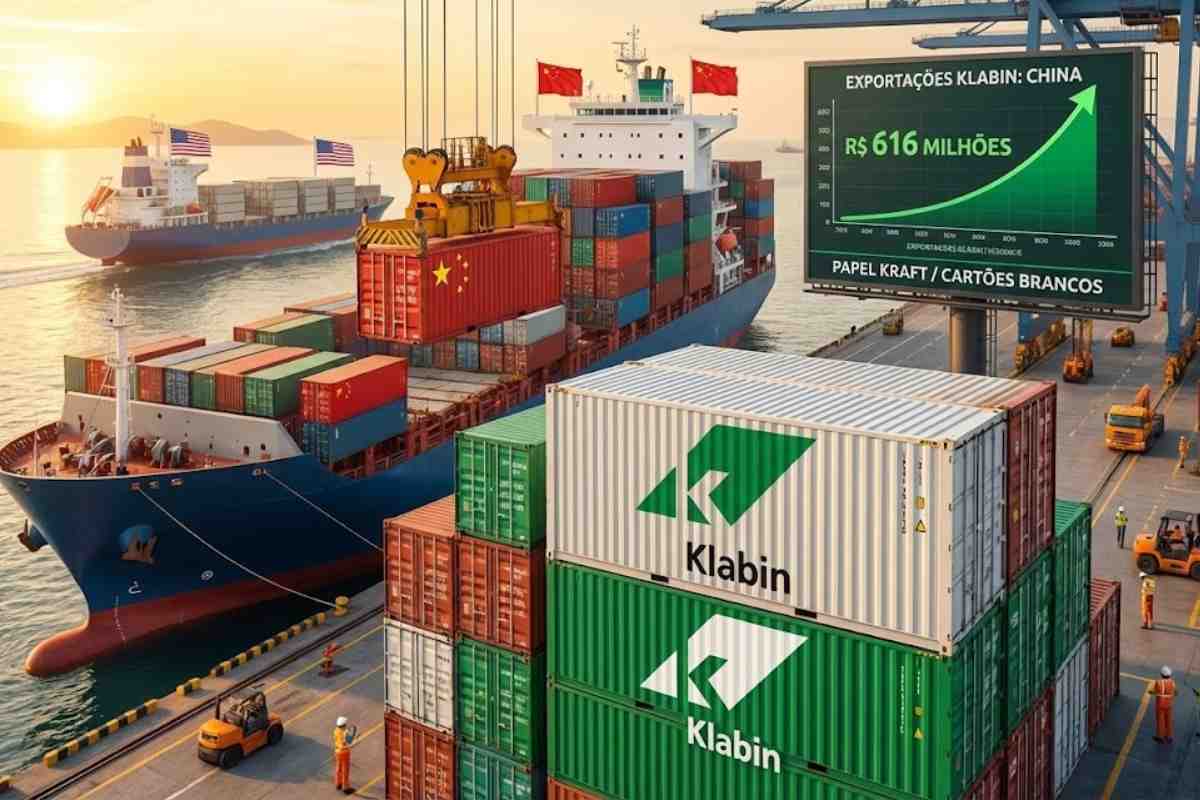


The Trade War Between China and the US and the American Tariff Pushed Asian Buyers to Seek Alternatives. Klabin Claims to Have Multiplied Exports by Almost 10 Times in the Last Five Months, with Price Gains. In the Third Quarter, Revenue in China Reached R$ 616 Million, 4% of the Total.
During a presentation to investors, Klabin stated that China has become one of its largest markets after accelerating exports in the last five months. The commercial director of paper, José Soares, said that the volume was multiplied by almost 10, “with price,” reinforcing the traction jump in the Asian country.
In the third quarter of this year, revenue from China reached R$ 616 million, equivalent to 4% of the company’s global income, and Klabin indicates that the volume has continued to advance at the end of the year. The internal reading is that the tariff and the trade war opened space, combined with movements to divest from major North American competitors in the sector.
The Vacuum Left by American Rivals Drives Opportunities
Klabin attributes part of the growth window to the repositioning of United States multinationals.
-
Brazilian city bets on the business environment to generate jobs and attract investments in the energy sector — secretary reveals strategy at Macaé Energy 2026.

-
50 viaducts, 4 tunnels, 28 bridges, and 40 kilometers of bike paths: BR-262 in Espírito Santo will receive 8.6 billion reais for the largest engineering project in the state’s history, inspired by the Immigrant Highway in São Paulo.

-
Brazil produces too much clean energy and doesn’t know what to do with it: over 20% of solar and wind capacity was wasted in 2025 while investors flee and 509 renewable generation projects were abandoned in the last year.

-
Piauí will produce a new fuel that replaces diesel without needing to change anything in the truck’s engine and reduces pollutant gas emissions by half: truck drivers from all over the Northeast are already celebrating the news that will arrive later this decade.

Georgia-Pacific announced the permanent closure of its technology and innovation center and its pulp mill in Memphis, Tennessee, citing challenging market conditions.
Meanwhile, International Paper reported that it is divesting its global pulp fiber division to focus efforts on the core sustainable packaging business, with an agreement to sell the division to American Industrial Partners for about US$ 1.5 billion.
For CEO Cristiano Teixeira, “the tariff has made partners and customers seek alternatives,” creating space for suppliers with a competitive portfolio outside the priority focus of American companies.
Strategy: Compete Outside the US Priority Axis
According to Teixeira, Klabin has been gaining ground by competing in geographies where US players are not prioritizing investments.
In a nearshoring context, he points out that American paper and pulp companies have been investing mainly in Mexico, while the Brazilian company prefers to expand its presence in other regions to protect its portfolio and reduce risks.
The CEO also describes the company as a sort of South American “copy-paste” of a North American company, due to its presence in long fiber and packaging.
The practical consequence, according to him, is direct: Klabin exports little to the US, but competes with the US globally.
MP28, Kraft, and White Boards: Portfolio Adjusts to the Market
In addition to the jump in exports to China, Klabin highlights the use of paper machine 28 (MP28) at its Ortigueira (PR) facility to increase the production of kraft paper. In parallel, the company has begun investing in white boards, targeting higher value-added demands.
The company states that this move has gained strength in a more challenging scenario for the traditional paperboard market.
With white boards, Klabin aims to serve segments such as pharmaceuticals, cosmetics, and publishing, including applications like book covers.
Pharmaceutical and Value Added with “Slimming Pens”
When discussing pharmaceutical packaging, Teixeira points to a growth avenue linked to the increasing use of weight-loss medications, citing the so-called “slimming pens,” such as Ozempic.
The thesis is that this type of product, because it comes in cardboard boxes, opens up space for high-value-added packaging, potentially increasing operational profitability.
Consolidation in the Sector: Potential Exists, but Not in the Short Term
Teixeira sees space for consolidation in the paper and pulp market, especially through the logic of combining a large player in South America, where companies have strong positions in cash cost, with an integrated player from the Northern Hemisphere.
In his view, factories are likely to close in North America, increasing the need for fiber that could be supplied by South America.
Despite this, the executive emphasizes that Klabin has completed a cycle of investments and needs to contain its debt, which limits acquisitions in the short term.
He also states that the company considers itself protected against hostile offers, citing the structure with two classes of shares and control of nearly 55% of the voting shares by the controllers.
So far this year, preferred shares have fallen more than 15%, while common stocks have decreased more than 20%, according to the company.
Investments: After R$ 30 Billion, Focus Turns to Cash and Modernization
With the completion of the R$ 30 billion investment cycle, Klabin reported that planned contributions for this year total R$ 2.9 billion, below the previous estimate of R$ 3.3 billion.
For 2026, the projection is R$ 3.3 billion, and for 2027, R$ 2.8 billion, with most directed towards operational continuity and modernization of the Monte Alegre plant in Paraná.
Net debt is around R$ 26 billion, down from R$ 29.5 billion a year ago. The net debt to Ebitda ratio is at 3.3 times, after reaching 4.1 times last year, according to analyst João Abdouni from Levante Inside Corp.
For him, Klabin’s strategy reduces cellulose volatility by adding machinery and tends to sustain better results as economic cycles evolve.
Dividends and Bonuses: Payment Throughout 2026 with Defined Record Date
Last Monday, Klabin announced a distribution of R$ 1.11 billion in interim dividends, in addition to a capital increase with a stock bonus.
The amount corresponds to R$ 0.18 per share and will be paid in four installments throughout 2026, based on the shareholding position as of December 15, 2025.
In your view, is Klabin just taking advantage of a temporary gap from the tariff, or has China become a structural engine for growth for the company?









Ora, se existe comprador e o preço cobre custos e magem de lucro, a Klabin deve atender a demanda.