





 Portuguese
  English
  Spanish
  4 min of reading
  67 comments


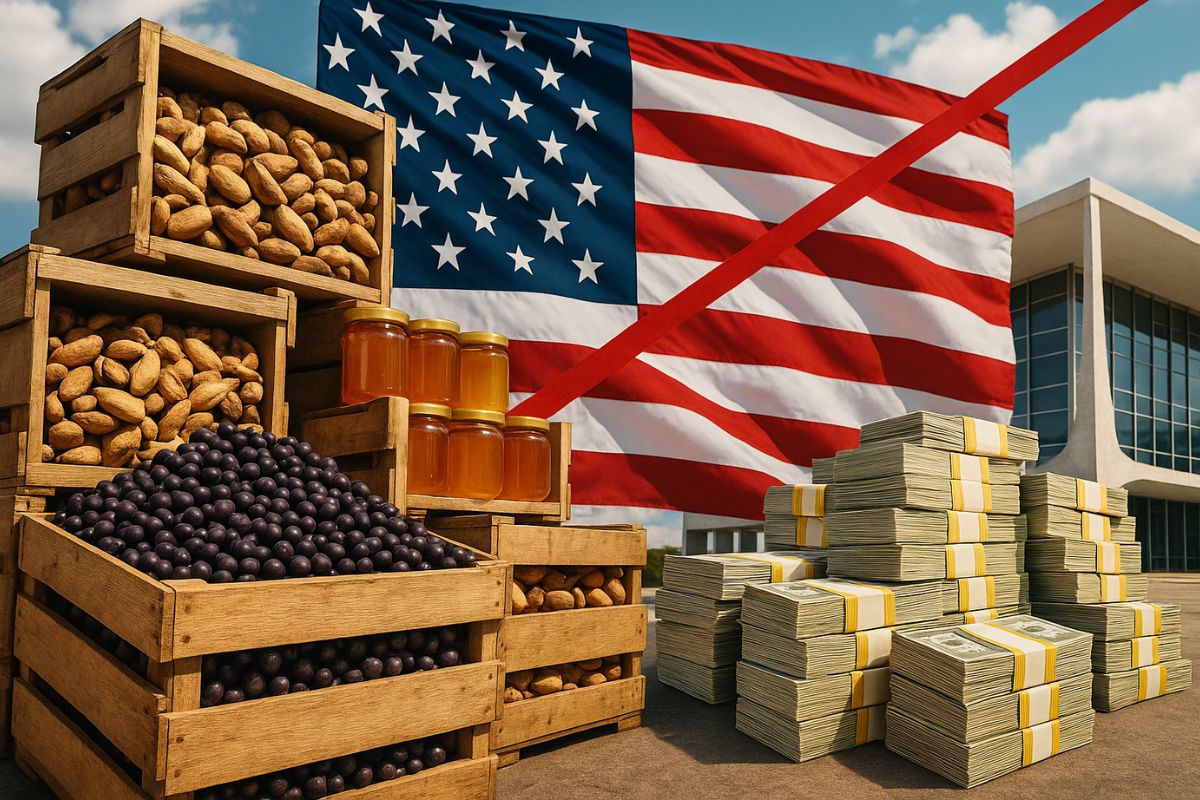


Government Purchases Açaí, Nuts, and Honey After U.S. Tariff Hike; See Full List. Acquisition Without Bidding Aims to Protect Brazilian Producers Affected by the U.S. Tariff Hike, Focusing on Schools and Public Stocks
The federal government announced that açaí, nuts, and honey are among the foods to be purchased directly after the U.S. tariff hike, a measure that impacts Brazilian exporters with tariffs of up to 50%. The strategy is part of the Brazil Sovereign Plan and aims to ensure immediate income for farmers and cooperatives affected by the loss of market.
The purchases will be made without bidding, aimed at supplying public schools and building national stocks. To participate, producers must prove losses from exports through the Loss Declaration (DP). The relief package also includes R$ 40 billion in emergency credit, totaling resources from BNDES and the Export Guarantee Fund.
Which Products Are on the List?
In addition to açaí, nuts, and honey, the government included coconut water, mango, fish, and grapes among the items that can be purchased. All were directly affected by the U.S. tariff hike, which drastically reduced Brazilian exports.
-
Brazilian city bets on the business environment to generate jobs and attract investments in the energy sector — secretary reveals strategy at Macaé Energy 2026.

-
50 viaducts, 4 tunnels, 28 bridges, and 40 kilometers of bike paths: BR-262 in Espírito Santo will receive 8.6 billion reais for the largest engineering project in the state’s history, inspired by the Immigrant Highway in São Paulo.

-
Brazil produces too much clean energy and doesn’t know what to do with it: over 20% of solar and wind capacity was wasted in 2025 while investors flee and 509 renewable generation projects were abandoned in the last year.

-
Piauí will produce a new fuel that replaces diesel without needing to change anything in the truck’s engine and reduces pollutant gas emissions by half: truck drivers from all over the Northeast are already celebrating the news that will arrive later this decade.


The Minister of Agriculture, Carlos Fávaro, stated that the list may be expanded if other sectors prove losses. The priority is to ensure income and prevent the bankruptcy of small and medium producers.
Who Will Be Able to Sell to the Government?
Only producers who can prove losses related to the U.S. tariff hike will be able to participate in public purchases. The criterion will be the presentation of the Loss Declaration, a document that details suspended contracts or reduced export volumes.
This measure applies to both family farmers in the Amazon and industries in the South and Northeast, including açaí cooperatives, nut extractivists, and beekeepers. According to government technicians, this creates a temporary financial buffer until the diversification of external markets.
Where Will the Foods Be Used?
The purchased items will be destined for school meals and public stocks, managed by the National Supply Company (Conab). The goal is to utilize part of the production that was previously exported to the U.S. and redirect it to food security programs in Brazil.
This means that millions of students may receive quality food, while producers will have guaranteed outlets for their production.
How Much Will Be Invested?
The emergency package totals R$ 40 billion, with R$ 30 billion from the Export Guarantee Fund (FGE) and R$ 10 billion from BNDES. The credits will focus on working capital, modernization of machinery, and opening new markets.
According to BNDES president Aloizio Mercadante, priority will be given to companies that have lost at least 5% of gross revenue from exports affected by the U.S. tariff hike.
Why Is This Measure Important?
The U.S. tariff hike affected entire production chains, especially in the Amazon and Northeast, where the dependence on the North American market is greater. Without this intervention, thousands of producers could lose their primary source of income.
The Vice President Geraldo Alckmin emphasized in Congress the urgency of approving proposals related to foreign trade, credit, and international agreements. The goal is to reduce dependence on the U.S. and expand reach to Europe, Asia, and the Middle East.
Is It Worth Betting on This Model?
Experts evaluate that public purchasing is a valid emergency solution but cannot be the only response to the U.S. tariff hike. The challenge will be to create conditions to diversify the export agenda and strengthen the domestic market.
In the meantime, the measure provides immediate relief for farmers, cooperatives, and industries that depend on products such as açaí, honey, and nuts.
The U.S. tariff hike has exposed Brazil’s vulnerability to unilateral measures by trading partners. The strategy of the government aims to preserve jobs and prevent the collapse of production chains, but experts warn of the need for a broader plan.
Do you agree with this change? Do you think public purchasing really helps producers or works merely as a palliative? Leave your opinion in the comments — we want to hear from those who live this reality in practice.









Sou contra compra sem licitações. É uma oportunidade para corrupção. Deveriam primeiramente é reduzir os impostos para tornar esses produtos viáveis para o mercado interno. Daria um fôlego para os produtores e de quebra abaixaria os preços para os consumidores brasileiros. Posteriormente tem que buscar relações comerciais com outros países para retornar o escoamento externo dos produtos, gerando assim a necessidade de aumento da produção e por consequência aumento das vagas de emprego, melhorando a situação econômica do Brasil como um todo.
Brasil soberano, esse governo **** encontrou mais uma forma de roubar nosso dinheiro, em vez de ir lá negociar não, vai super faturar e colocar o dinheiro público no bolso e endividar ainda mais nossa país….. Estamos todos é ferrados.
Creio que o governo está apenas tapando o sol com a peneira, sem contar na possibilidade de mais atos de corrupção. O problema é até quando o Brasil consegue segurar