





 Portuguese
  English
  Spanish
  6 min of reading
  3 comments


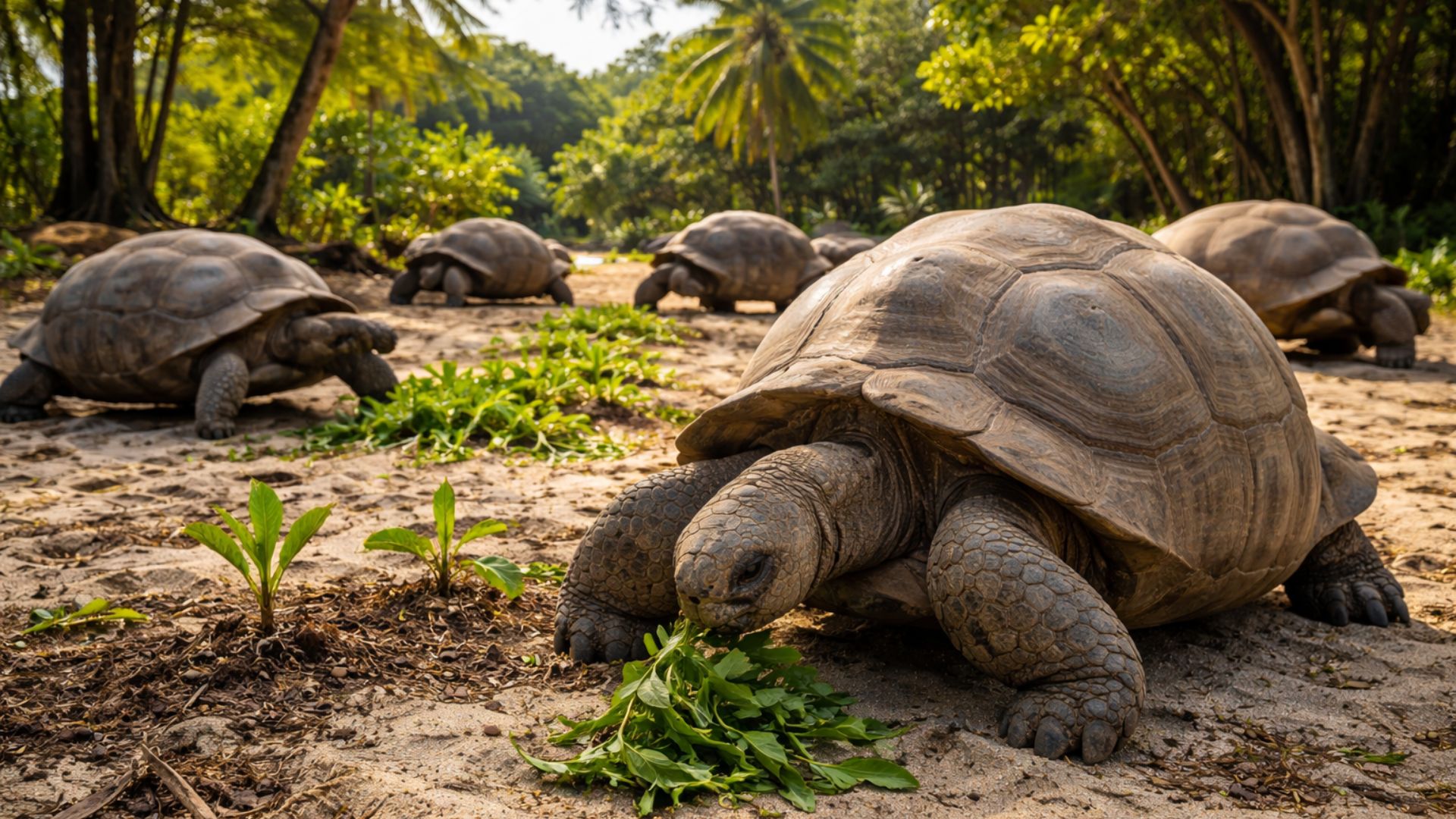


Restoration In Mauritius Island Reignites Lost Ecological Function, With Giant Tortoises Acting As Natural Dispersers And Helping An Endemic Tree Species Threatened To Reappear In New Parts Of The Territory, In A Process Monitored By Researchers And Based On Field Evidence Of Germination And Establishment Of Seedlings.
On a small coastal island in Mauritius, researchers observed an unusual phenomenon for environmental restoration projects.
A native tree, considered critically endangered, reappeared in new areas of the land without the need to plant seedlings in each area.
The engine of this change was not a machine, nor an irrigation system.
-
He started running at 66 years old, broke records at 82, and is now a subject of study for having a metabolic age comparable to that of a 20-year-old, in a case that is intriguing scientists and inspiring the world.

-
Oldest tree on the planet reappears after 130 years of searches: Wattieza, 385 million years old, was 10 meters tall and had no leaves or seeds; Gilboa fossils in New York solved the mystery in 2007.

-
A 48-square-meter house assembled in hours with 4,000 bricks made of recycled plastic that does not absorb moisture, has natural thermal insulation, and costs less than 90,000 reais in a complete kit.

-
Luciano Hang revealed that Havan’s air fleet has already accumulated more than 20,000 landings, 10,000 flight hours, and 6 million kilometers traveled, and he says that without the planes, the company would never have grown so quickly.


The transformation was linked to the controlled reintroduction of a large herbivore, capable of performing an ecological service that had disappeared from the site for generations.
The island is called Île aux Aigrettes. It is a reserve of about 25 hectares near the Mauritian coast.
There, the ebony species Diospyros egrettarum, a native tree with large fruits, faced an obstacle that often goes unnoticed outside the scientific community.
The problem was the limitation by seed dispersal. In simple terms, seeds were indeed produced.
However, they did not efficiently reach places where they had a better chance of germinating and growing away from competition and concentrated impacts under the mother plant’s canopy.
Seed Dispersal And The Regeneration Bottleneck

This type of blockage can occur when the fauna responsible for transporting seeds ceases to exist.
On islands, the problem tends to be even more intense. Ecological networks are smaller and have fewer species capable of replacing lost functions.
In the case of Mauritius, the environmental history includes the extinction of large animals that, in the past, helped move fruits and seeds over significant distances.
Over time, the territory also underwent profound changes in land use, timber extraction, and the introduction of exotic species.
It was in this context that scientists tested a strategy known as functional replacement.
The method is also described as using ecological substitutes. The goal is to bring an existing species from another location to perform part of the role of an extinct species.
This type of action is only considered when there is control, technical justification, and continuous monitoring.
Giant Aldabra Tortoises As Ecological Substitutes
In Île aux Aigrettes, the chosen animal was the Aldabra Giant Tortoise (Aldabrachelys gigantea).
It is a large terrestrial reptile native to the Aldabra Atoll in the Indian Ocean.
The species is known for its broad diet and ability to consume large fruits. The principle of the experiment is simple.


The ecological implications, however, are complex.
Giant tortoises are opportunistic frugivores in certain contexts.
They eat fruits, swallow seeds, and, as they move, leave these seeds in other parts of the environment.
This movement can increase the chances of a seed escaping areas saturated by pathogens and predators concentrated near the mother plant.
It also enhances the probability of finding favorable microenvironments.
Another aspect caught the researchers’ attention.
The passage of seeds through the tortoises’ digestive tract maintained seed viability and was associated with improved germination performance.
This detail is considered relevant when dealing with a rare, slow-growing tree subject to multiple environmental pressures.
Field Evidence: Germination And New Seedlings
The study that described the case recorded that the tortoises ingested ebony fruits and dispersed significant quantities of seeds.
After passing through the intestines, an improvement in germination was observed. There was also successful establishment of new seedlings in different parts of the island.
The scientific reading of the result is cautious. The researchers do not describe the phenomenon as an isolated extraordinary event.
They point out a measurable mechanism for restoring biological interactions, considered essential for ecosystem recovery.
In the environmental debate, the case highlights the importance of process-based restoration.
In many projects, forest recovery depends on direct human intervention. The planting of seedlings, intensive management, and constant maintenance are often indispensable.
When a key interaction is reactivated, part of the system can begin to function more autonomously.
This occurs as long as the minimum habitat conditions are present and threats are controlled.
In the case of Île aux Aigrettes, dispersal by a large herbivore expanded the spatial range of the seeds.
This dynamic created opportunities for natural regeneration for a tree that remained restricted to a few points.
Process-Based Restoration, Not Just Planting
The case also highlights why projects of this kind require rigorous criteria.
Introducing an animal outside of its native range can generate unwanted effects. The risk tends to be greater in island environments.
For this reason, the proposal is debated in the conservation field focusing on reversibility and constant monitoring.
In practice, what determines the viability of the intervention is not the narrative impact.
The central factor is the ability to measure effects, set limits, and respond quickly should problems arise.
The choice of giant tortoises as restoration tools is ecologically grounded. Large animals can act as environmental engineers.
They combine longevity, great body mass, relatively broad movements, and a generalist diet.
In ecosystems where megafauna has been lost, the absence of these herbivores alters plant recruitment.
It also reduces the dispersal of large-fruited seeds and modifies vegetation dynamics.
Functional reintroductions seek, in certain contexts, to restore part of these ecological gears.
Island Conservation And Reintroduction Criteria
In the study conducted on Île aux Aigrettes, the endemic large-fruited ebony was the focus of the intervention.
The research sought to answer a key question for conservation.
If an ecological interaction has been locally extirpated, can it be recovered with a living substitute without compromising the ecosystem’s balance?
The work provided empirical evidence that the dispersal performed by the tortoises helped to break the regeneration bottleneck.
New seedlings began to appear in locations where the species had difficulty establishing itself.
The journalistic strength of the story lies in the simplicity of the mechanism. Restoration does not always depend on planting tree by tree. In some scenarios, what is lacking is the biological link that moves the seed to the suitable location.
When this link returns, the landscape can begin to change in a way that is less dependent on continuous planting. Management and protection, however, remain essential.
Research and conservation documents in Mauritius also discuss the use of giant tortoises on other islands in the archipelago.
The goal is to restore lost functions while paying attention to the specifics of each environment.
The fact that these strategies are being tested in small, controlled areas reflects an effort to balance urgency and caution.
The goal is to recover degraded ecosystems without generating new negative impacts.
When An Animal Returns To “Transport” The Forest
For the public, the image that summarizes the transformation is easy to visualize. A large, slow animal traverses the trails of an island.
As it feeds, it scatters seeds that, months later, emerge as new shoots far from the mother trees.
Behind this scene lies a broader message about biodiversity. When a species disappears, it is not just an isolated organism that vanishes.
The set of interactions that sustained the environment’s renewal also disappears.
If a tortoise can reactivate the dispersal of a critically endangered tree on an island, what other lost ecological functions could be recovered by placing animals back in the role of carriers of plant life?








A turtle does not spread seeds. A tortoise does. It’s a land ****. A turtle lives in the sea.
All tortoises are technically turtles, but not all turtles are tortoises.
This entire article in one sentence. “Introduction of the Aldabra giant tortoise to Île aux Aigrettes in the Maritious chain of islands triggers a TROPHIC CASCADE, resulting in the previously extinct to this island) species of Ebony tree, Diospyros egrettarum.”