





 Portuguese
  English
  Spanish
  8 min of reading
  1 comment


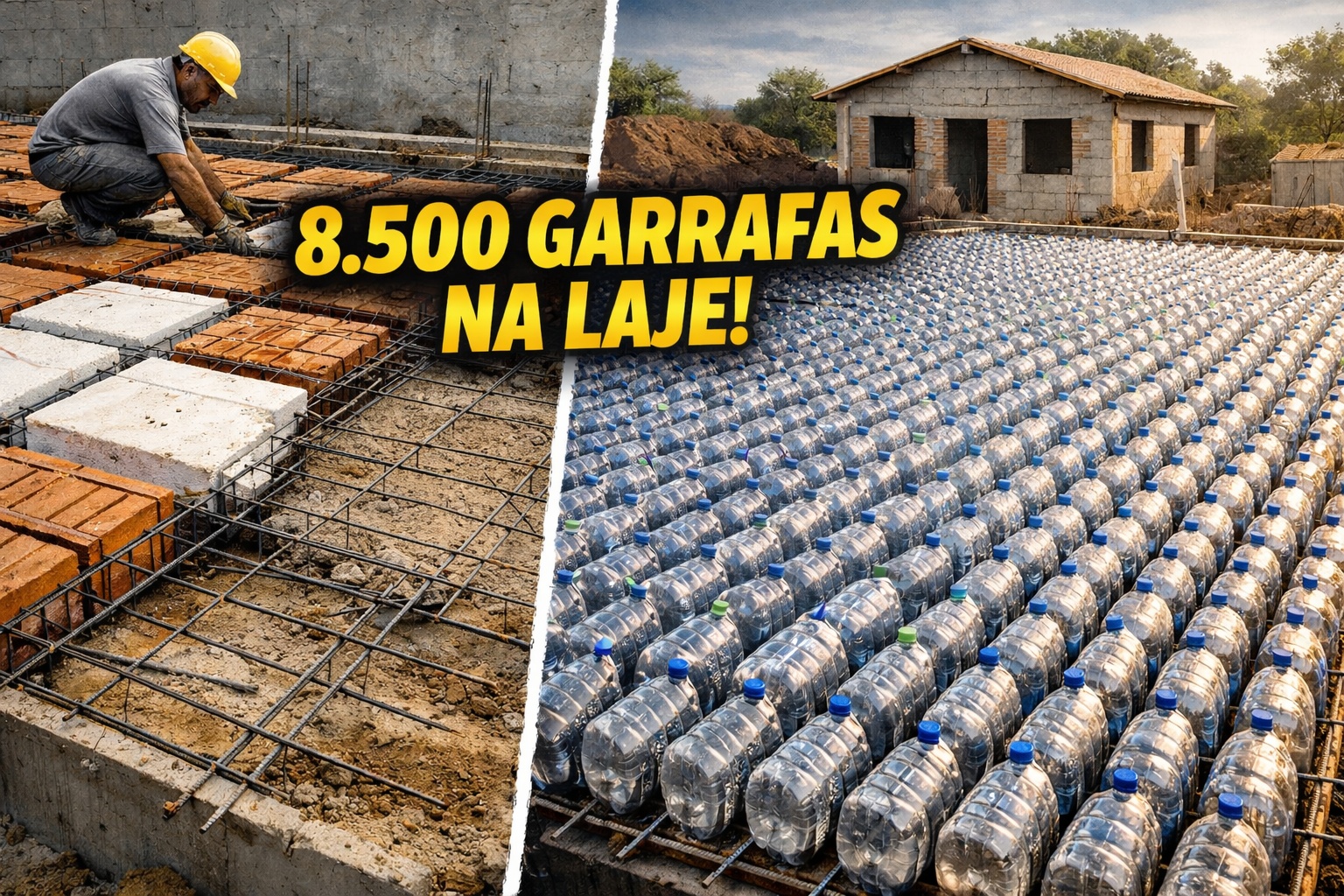


Slab Technique with PET Bottles Reduces Costs by Up to 60% and Uses About 8,500 Units in a 50 m² House, Combining Economy and Sustainable Reuse.
A silent revolution is transforming the way Brazilians build their homes. The slab technique with PET bottles, developed by builders and engineers in different regions of Brazil, allows for the substitution of conventional materials like Styrofoam, ceramic tiles, and even wood with discarded plastic bottles, drastically reducing construction costs while offering significant environmental benefits.
For an affordable 50-square-meter house, approximately 8,500 PET bottles are needed in the complete construction, including walls, slabs, and structures. The savings generated by this method can reach 60% compared to conventional construction with traditional masonry, making the dream of home ownership more accessible for low-income families.
Organic House Develops Unprecedented Method That Replaces Styrofoam and Tiles with PET Bottles in Slabs
The Organic House project, a pioneer in Brazil, developed an innovative method for constructing slabs using PET bottles instead of conventional materials.
-
The lack of welders, electricians, and operators becomes a structural threat in 2025, with the construction industry and manufacturing already suffering from delays, cost pressures, and labor shortages in Brazil.
-
Brazil and Paraguay are just 46 meters away from a historic union on the bioceanic bridge that promises to revolutionize trade between the Atlantic and the Pacific.

-
With 55 km over the sea, a cost of US$ 20 billion, and enough steel to build 60 Eiffel Towers, China’s largest project has connected Hong Kong, Zhuhai, and Macau in a colossal bridge that defies the logic of engineering.

-
A trick with joint compound transforms a Styrofoam ceiling into a plaster-like ceiling: leveled panels, wires and mesh at the joints, sand, paint, and change the environment while spending little today.

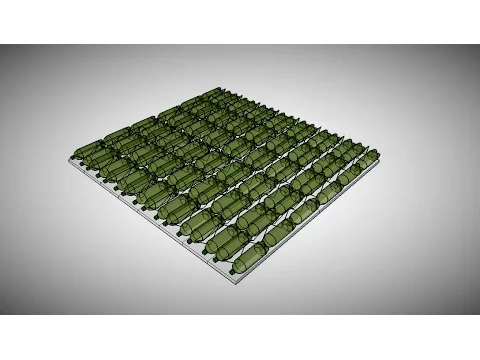
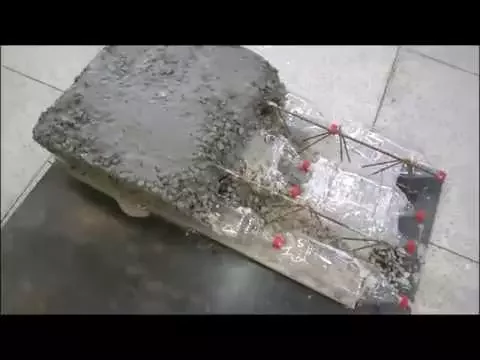
The construction technique involves quickly and easily joining two bottles together, creating pieces with two necks that completely replace Styrofoam or ceramic tiles in filling the beams.


By using H5-type beams, the assembly becomes extremely practical and quick. It’s just a matter of fitting the joined bottles between the beams, forming what builders call a “sea of PET”. The set is extremely resistant: while anyone can break a Styrofoam plate or ceramic tile just by stepping on it, a PET bottle filled with air is practically indestructible under manual pressure.
The resistance of the slab with PET bottles depends exclusively on the iron framework and the thickness of concrete used, exactly like in a conventional slab.
The bottles only act as a filler material, replacing the elements that traditionally occupy the space between the beams. This means that the slab with PET has the same structural resistance as a traditional slab, as long as the structural design is properly sized.
Aluminum Cans Replace Wood and Eliminate the Burning of Boards After Concreting
In addition to the PET bottles in the slab structure, the Organic House introduced another sustainable innovation: replacing wooden boards with aluminum soda and beer cans.
Traditionally, wooden boards are used to seal the underside of the slab during concreting, but these woods cannot be reused afterward because they become impregnated with concrete.
The disposal of these woods usually involves burning, a process that releases toxins harmful to the environment. Aluminum cans solve this problem elegantly: they are permanently placed underneath, sealing the slab and completely eliminating the need for disposable wood.
Every three cans positioned occupy 900 milliliters of concrete, generating additional savings in the volume of material needed for concreting. The cans remain permanently incorporated into the slab structure, with no need for removal and without generating waste at the end of the work.
Brazil is the world champion in recycling aluminum cans, but the recycling process consumes a lot of electricity and water. By using the cans directly in construction, without going through the recycling process, the technique saves natural resources and energy, making the solution even more sustainable.
PET Bottles Offer 76% Higher Compression Strength Than Conventional Bricks
Tests conducted in laboratories show that construction materials produced with PET bottles have superior mechanical strength compared to conventional materials. A common ceramic brick has an average flexural strength of 1.10 MPa (megapascal), while ecological bricks produced with the addition of crushed PET reach 1.94 MPa, representing a 76% increase in strength.
The PET bottle has exceptional mechanical properties: high resistance to compression, fire, natural phenomena, and superior thermal insulation capacity compared to conventional bricks and blocks. The designer from Rio Grande do Norte, Antônio Duarte Gomes, discovered these properties while trying to break a PET bottle filled with water using a brick: the brick broke and the bottle remained intact.
This extraordinary resistance allowed Gomes to develop a construction method using empty bottles (unfilled) positioned vertically. With this technique, he has already built 40 houses across Brazil and a four-story building in Petrolina, Pernambuco, which required 60,000 PET bottles in the complete structure.
PET bottles also demonstrate exceptional durability: plastic remains in nature for more than 200 years until fully decomposed. When incorporated into civil construction structures, these properties translate into extremely durable buildings, resistant to the elements and that do not develop mold even when exposed to constant rain.
Savings of 40% to 60% Makes Construction Affordable for Low-Income Families
The main advantage of building with PET bottles is the drastic cost reduction. Studies and executed projects demonstrate that this system reduces construction costs by 40% to 60% compared to conventional masonry.
For an affordable 50-square-meter house, the savings can represent the difference between achieving or not achieving the dream of home ownership.
The bricklayer Ed Mauro Aparecido Morbidelli, a resident of Extrema, Minas Gerais, built his own 100-square-meter house using 11,000 PET bottles. When he finished the construction in 2012, he had spent only R$ 12,000 on the complete build, representing a 60% savings compared to conventional methods. Morbidelli has lived in the house for over 10 years and confirms that the structure remains solid and comfortable.
The bottles are purchased individually from waste picker cooperatives, generating income for these communities and contributing to the recycling chain. According to Antônio Duarte Gomes, approximately 27 bottles are used per constructed square meter, which means that a 50m² house requires about 1,350 bottles just for the walls, with the remaining 8,500 bottles being used in slabs, columns, and other structural elements.
In addition to savings on materials, the technique significantly reduces labor costs. Building with PET bottles is faster than conventional methods, and the walls weigh half that of a normal wall, facilitating handling and reducing the need for heavy equipment.
Superior Thermal Comfort Keeps House Cooler in Summer and Warmer in Winter
One of the most appreciated benefits by residents of houses built with PET bottles is the exceptional thermal comfort. The bottles, especially when filled with air or other insulating materials, create internal chambers that function as natural barriers against external temperature variations.
Ed Mauro Morbidelli, who has lived in his PET bottle house for eight years, reports that the interior is cooler in summer and warmer in winter compared to conventional masonry homes. This thermal behavior occurs due to the delay in heat transfer from the outside to the inside, provided by the air chambers inside the bottles.
The insulating capacity of PET bottles is superior to that of conventional ceramic or concrete bricks and blocks. This natural thermal insulation significantly reduces the need for artificial climate control systems, resulting in substantial savings on electricity bills over the years.
In addition to thermal insulation, PET bottle walls offer superior acoustic insulation. The air chambers inside the bottles help reduce the propagation of external sounds into the interior of the house, making the environment quieter and more comfortable, especially in areas with a lot of external noise such as busy avenues or densely populated urban areas.
Construction Process Uses Bottles Filled with Sand, Earth, or Compressed Air
There are different methods to use PET bottles in civil construction, each suited for different needs and conditions. The bottles can be filled with various solid materials: damp earth, compacted sand, rice straw, wheat straw, or other composting waste.
For slabs, the most common method uses empty bottles filled only with air, taking advantage of the natural resistance of the plastic and the lightness of the set. The bottles are connected by the necks, forming elongated pieces that fit perfectly between the slab beams. After positioning, the iron framework is placed over the bottles, securing the entire set even more firmly to the structure.

For walls, the bottles are usually filled with sand or earth to increase mass and stability. Filling is done with the help of a funnel, and the drier the material, the easier the filling process becomes. After being filled, the bottles are capped to prevent leaks and ensure durability.
The bottles are then stacked horizontally and tied with nylon or sisal wire, creating a net that keeps everything firm. The spaces between the bottles are filled with a mixture of cement, sand, and lime in the proportion of 1:6:0.5, respectively. In simpler projects or in regions with material availability, it is also possible to use just clay or a mixture of clay with lime.
Projects Around the World Demonstrate Feasibility of the Technique in Different Climates
Building with PET bottles is not exclusive to Brazil. Several countries around the world have already successfully adopted the technique, demonstrating its feasibility in different climatic and cultural contexts.
The idea of using bottles as bricks originated in India, but it was the Renewable Energies Development Association, in partnership with the Africa Community Trust, that built the first documented house made of PET and sand in Yelwa, Nigeria. The construction follows the traditional Nigerian model with a rounded shape, concrete foundation, and walls made of bottles filled with sand, held together with mud and with the bottoms exposed, creating a surprising visual effect.
In Bolivia, artisan and lawyer Ingrid Vaca Diez developed the Casas de Botellas (Bottle Houses) project, inaugurating the first residence in 2000 with 170 square meters and 36,000 bottles. The project has expanded to different countries in Latin America, including Mexico, Panama, Uruguay, and Argentina.
In Taiwan, architect Arthur Huang designed the Ecoark building in 2010, a cultural pavilion that utilizes 1.5 million plastic bricks made from PET bottles. The construction demonstrates that the technique can be applied not only in affordable housing but also in larger, publicly-used buildings.
Challenges Include Need for Large Volume of Bottles and Lack of Government Support
Despite the numerous advantages, construction with PET bottles faces significant challenges that limit its large-scale adoption.
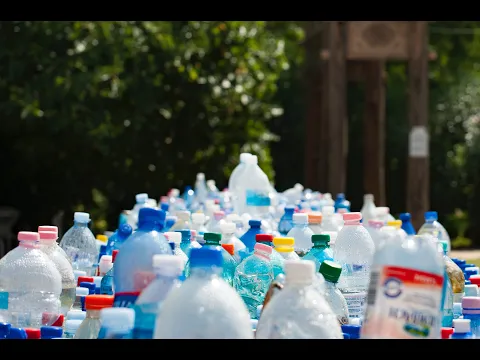
The main practical obstacle is the need for a large volume of bottles to complete a project. For a 50m² house, 8,500 bottles are required, and for a four-story building, this number jumps to 60,000 units.
Collecting, cleaning, and preparing this quantity of bottles takes time and organization. It is necessary to have enough supply before starting the work to avoid interruptions in the construction process. Many builders establish partnerships with waste picker cooperatives, beverage distributors, and commercial establishments to ensure a continuous supply of material.
Another important challenge is the lack of support and recognition from the government. Antônio Duarte Gomes, who has already built 40 houses using the technique, laments that government affordable housing tenders always require conventional brick blocks, preventing sustainable technology from being adopted in official housing programs.
Cultural resistance also represents a barrier. Many people still have prejudice against buildings made from recycled materials, associating them with precarious or low-quality housing. Education and the dissemination of success cases is necessary to change this perception and demonstrate that PET bottle houses are safe, durable, and comfortable.
The lack of specific technical standards and trained professionals in the technique also hinders the expansion of the method.
Many engineers and architects lack experience with the material and hesitate to approve projects that use PET bottles as a construction element, even when the technique has already been validated in dozens of successful constructions.
Despite these challenges, the potential of the slab technique with PET bottles to democratize access to decent housing and contribute to environmental sustainability is undeniable. As more projects are executed and publicized, the trend is that acceptance will increase and that public policies will begin to recognize and encourage this innovative and economical construction method.









Sou arquiteto e gostaria de saber como reduzir custos se vou precisar obter milhares de garrafas perfeitas.