





 Portuguese
  English
  Spanish
  3 min of reading


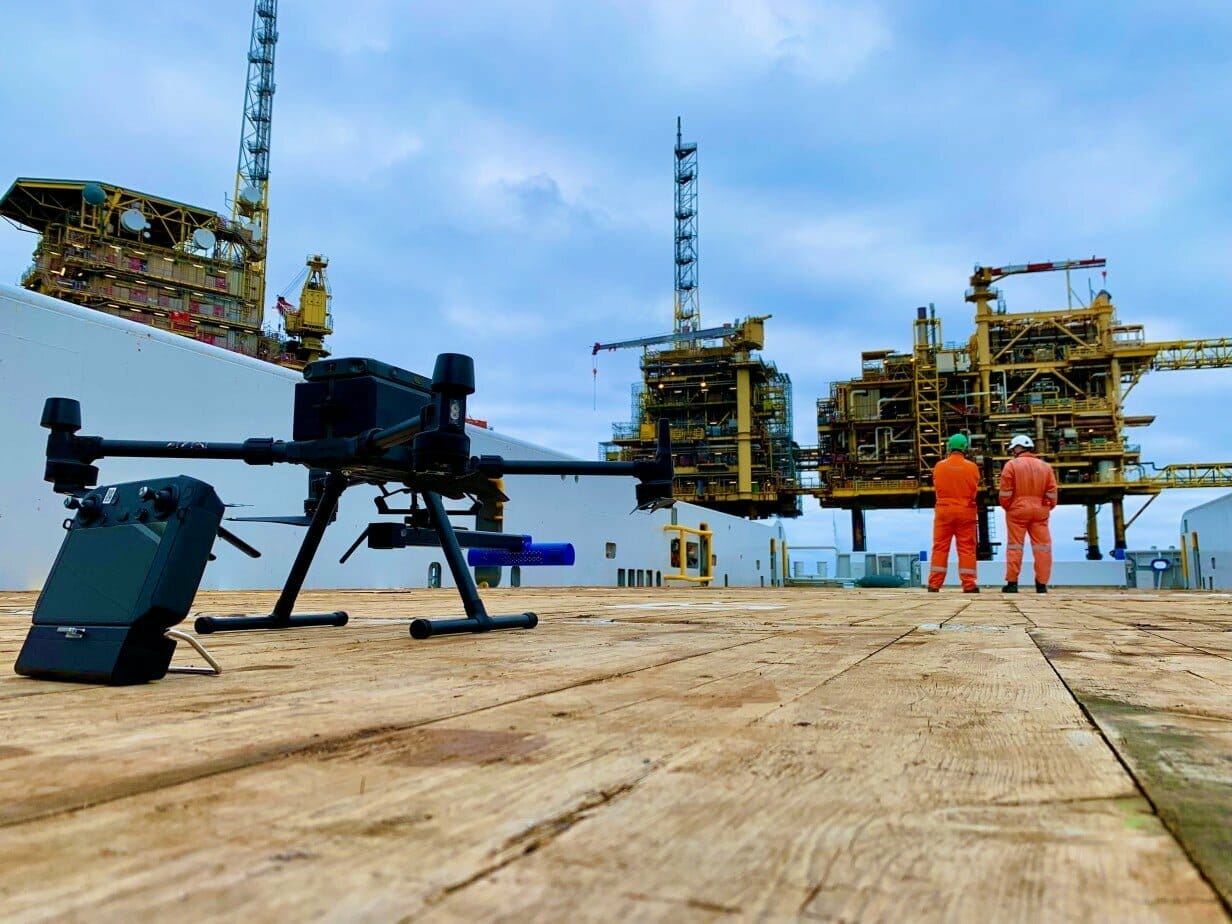
The Drone Technology Developed by NASA Is Being Used for Monitoring Methane Emissions in the Oil and Gas Sector. SeekOps Implemented SeekIR Technology to Measure Emissions in the North Sea.
For this Friday, (08/18), NASA surprises the market once again by adapting its space exploration technology to tackle urgent terrestrial challenges. The American company SeekOps is utilizing the innovative SeekIR solution, initially developed for the Mars Curiosity Rover, to measure methane emissions in the oil and gas industry in offshore environments, overcoming the limitations of conventional methods. The convergence of drones and laser absorption spectrometers is revolutionizing emissions measurement in the sector.
NASA Drone Technology Is Adopted by SeekOps for Methane Monitoring
NASA, renowned for its space explorations, once again brings innovation to the fuel market by adapting its technology for a closer-to-home challenge: monitoring methane emissions in the oil and gas industry.
This innovative initiative aims to tackle a recurring environmental problem in the sector and offers a promising solution for reducing greenhouse gas emissions.
-
With the war silencing the wells of Iran, Brazil set a record of 5.3 million barrels per day and rose in the global oil ranking without anyone noticing — the pre-salt now accounts for 80% of everything that comes from the seabed.

-
After years of delays and billions invested, the Golden Pass megaterminal in Texas is about to start exporting liquefied gas and will reshape the global energy map amid the Middle East crisis.

-
The artificial intelligence market within the oil industry is worth billions today and will more than double by 2033, and those who do not get on board now with the race for digital twins and autonomous drilling will be left behind.

-
Petrobras quietly installed an artificial intelligence system called Smart Tocha in six of its largest refineries, and the technology independently controls the burning of gases to reduce emissions without any operator needing to intervene.

Amidst the growing call for a sustainable energy transition, methane emissions from the oil and gas industry have become a priority target for major companies.
The International Energy Agency (IEA) highlights the importance of reducing these emissions as a significant step in combating climate change. The challenge lies in the precise detection of these emissions, especially in offshore environments.
Thus, SeekOps, an American company specialized in sensors, has taken an innovative step by adapting the technology developed for Mars exploration by NASA.
The SeekIR solution, originally designed for the Mars Curiosity Rover, is now being employed to measure methane emissions in the North Sea.
This creative approach overcomes technical challenges and offers a modern and effective way to monitor offshore emissions.
The combination of drone technology and laser absorption equipment has proven to be a powerful combination for monitoring methane emissions.
SeekOps has conducted innovative research, mounting an in-situ adjustable diode laser absorption spectrometer (TDLAS) on a drone, enabling accurate and cost-effective measurements.
This advancement surpasses the limitations of conventional approaches and provides valuable insights for the energy sector.
SeekOps Innovates in Adapting NASA TDLAS Technology for Oil and Gas Market
The TDLAS technology, originally developed by NASA to search for evidence of microbial life, has found a new purpose in the energy industry.
Adapted and validated by the Methane Emissions Technology Evaluation Center (METEC), this technology provides an accurate and efficient way to quantify methane emissions.
The transformation of a spatial concept for terrestrial application highlights the versatility of technological innovation.
Thus, it is necessary to bring the industry’s spotlight to this innovation, and the NASA JPL drone, along with the adapted space technology, will be showcased at SPE Offshore Europe 2023.
This exhibition highlights the growing importance of technology in the search for environmental solutions. The event also brings to light recent research discoveries, including the measurement of methane concentrations and atmospheric conditions.
Kamel Ben-Naceur, president of the SPE Offshore Europe Conference 2023, emphasized that as the energy transition gains momentum, the role of innovative technologies becomes crucial.
Thus, the adaptation of NASA technology for monitoring methane emissions in the oil and gas market proves to be just a small step toward the future of the sector.





Seja o primeiro a reagir!