





 English
  Francês
  Alemão
  Italiano
  Japonês
  Norueguês
  Portuguese
  Spanish
  4 min of reading
  0 comments


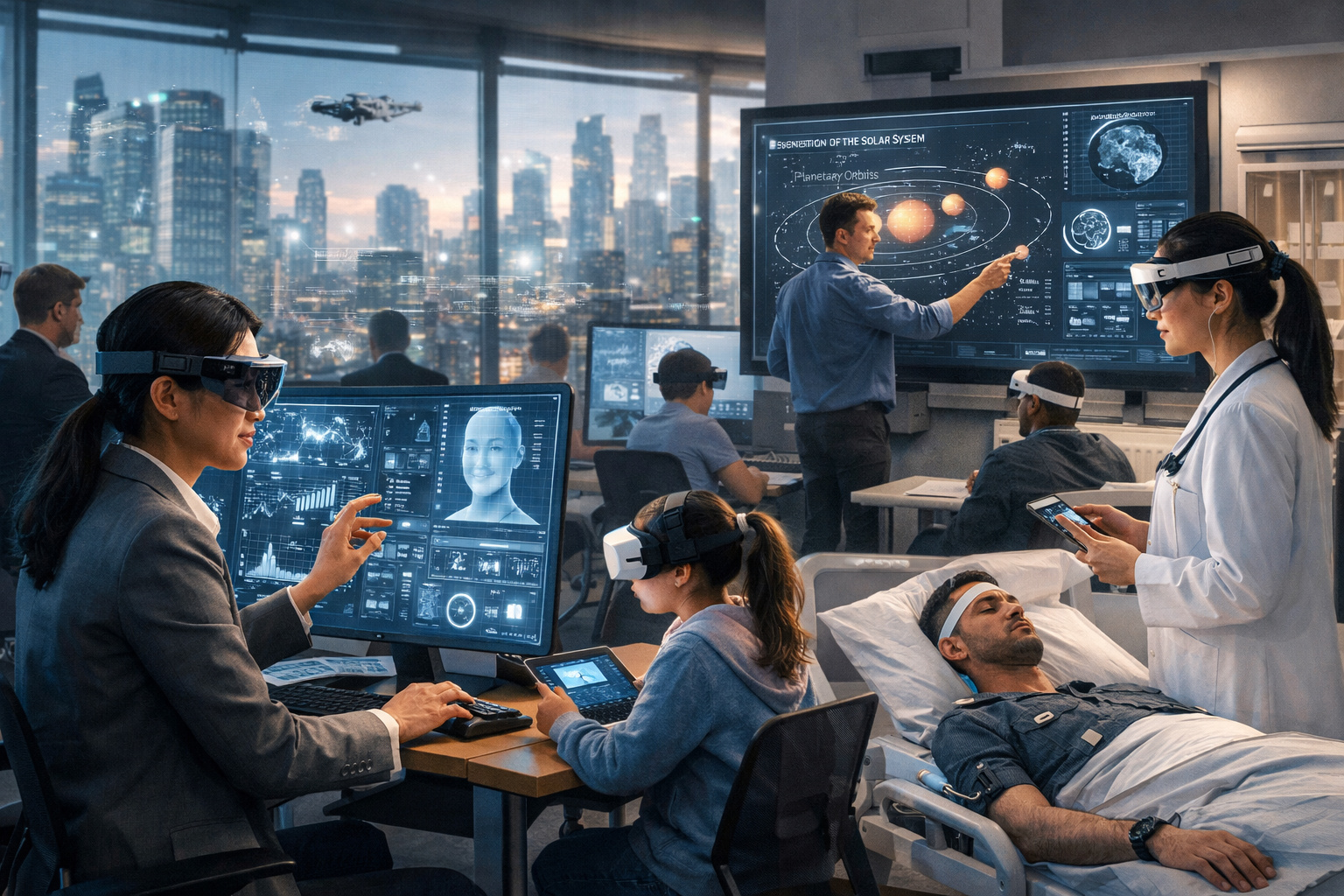
Accelerated Advances in Artificial Intelligence, Connectivity, and Automation Take Experimental Solutions from the Drawing Board and Begin to Directly Impact the Economy, Public Services, and Daily Life

The year 2025 represented a true watershed in the global technological evolution. Within a few months, solutions that previously appeared only as tests or trends began to be incorporated into the daily use of people, businesses, and governments. As a result, simple activities, professional routines, and public services were profoundly altered by smarter, more connected digital tools.
This advancement was not restricted to large urban centers. On the contrary, smaller communities and remote regions also began to adopt integrated technological solutions, expanding the reach of innovation. At the same time, companies from different sectors accelerated investments in automation, artificial intelligence, and digital infrastructure, creating new service models that were faster, more efficient, and scalable.
-
350-year mystery may have been solved: remains of a soldier who inspired the hero of The Three Musketeers found beneath a church in the Netherlands.

-
NASA photographed a nearly perfect square with 3 km sides on Mars, 13 times larger than the Great Pyramid of Giza, but the official explanation is natural erosion; still, no one has explained why the four sides have almost identical lengths.

-
Starlink breaks the barrier of 10,000 satellites in orbit and takes its expansion to an unprecedented level, with a direct impact on global internet, technological competition, and the race for space.

-
Japan finds an alternative to oil amid rising prices by transforming ocean balance into electricity with a new technology that maintains efficiency even when the sea changes.


The information was disclosed through sector analyses and innovation reports, according to specialized articles and studies on digital transformation published throughout the year. According to these assessments, the phrase “technology in 2025” ceased to be a futuristic prediction and began to represent concrete changes in the global economy and social behavior.
How Technology in 2025 Redefined Daily Life
In daily life, technology in 2025 profoundly changed the way of working, studying, and consuming information. Tools for generative artificial intelligence began to summarize texts, draft reports, and support meetings almost instantly. In addition, systems for real-time automatic translation enabled conversations between different languages, reducing language barriers in professional and personal interactions.
At the same time, urban mobility took on new contours. Transportation platforms integrated data on traffic, weather, and local demand. As a result, drivers and users began to receive dynamically adjusted routes, improving flow and reducing delays. In certain urban corridors, autonomous vehicles began to share space with traditional cars.
Although this coexistence still requires specific regulation, pilot projects advanced in a controlled manner. Thus, technology ceased to be merely a promise and began to materialize in real experiences for the population.
Innovations That Led the Technological Transformation in 2025
Among the main trends observed in 2025, some technologies stood out for driving this transformation on a global scale. Artificial intelligence led this movement, accompanied by the consolidation of cloud computing and the advancement of connectivity networks.
Among the most relevant fronts of the period, the following stand out:
- Generative artificial intelligence, capable of producing texts, images, and code in seconds
- Advanced 5G networks and the first tests of 6G, expanding real-time connections
- Internet of Things (IoT) and connected homes, integrating appliances, security, and energy
- Augmented reality, which added digital layers to physical environments
- Green technologies, focused on reducing energy consumption and waste
These innovations combined with new digital business models. Subscription platforms expanded software, entertainment, and even mobility services. In this way, consumers began to pay for continuous use, not just for ownership of products. This logic influenced everything from small applications to large corporate systems.
AI and Automation Transform the Job Market
In the professional environment, technology in 2025 provoked structural changes. Intelligent tools began to create drafts of contracts, codes, and marketing campaigns. Human teams then took on the roles of review, curation, and critical analysis, elevating the strategic level of functions.
At the same time, automation reduced repetitive tasks in factories, offices, and services. Collaborative robots worked alongside operators on production lines. In administrative areas, virtual assistants organized digital queues and responded to simple queries.
Additionally:
- Platforms analyzed data in real-time
- Algorithms suggested priority actions
- Managers began to use visual dashboards to simulate scenarios
- Teams adjusted strategies based on updated metrics
This flow reduced response times in several sectors. However, it also required professional training and greater attention to data governance. As a result, technical schools and universities updated curricula more swiftly, while short courses gained space as a quick qualification alternative.
Impacts of Technology in 2025 on Health and Education
In the area of health, technology in 2025 consolidated the use of telehealth and remote monitoring. Patients began utilizing wearable sensors to track vital signs. These devices sent data to medical platforms at regular intervals, allowing for the identification of changes before the worsening of clinical conditions.
Artificial intelligence tools also assisted in the analysis of imaging tests and medical histories. As a result, professionals gained more agility in complex diagnoses. At the same time, hospitals adopted integrated systems for managing beds, inventories, and appointments, reducing communication failures.
In education, hybrid learning was definitively consolidated. Adaptive learning platforms adjusted exercises according to individual performance. Moreover, recorded classes and live broadcasts began to coexist in integrated digital environments.
In this scenario:
- Students accessed content at flexible times
- Teachers monitored learning indicators in real-time
- Institutions expanded the geographic reach of their courses
Throughout 2025, innovation maintained a rapid pace. At the same time, debates about privacy, information security, and digital inclusion gained relevance. Thus, it became clear that the impact of technology depends not only on the tools created but also on the decisions made by governments, businesses, and society.
With all these changes already happening, how is technology in 2025 impacting your routine, your choices, and your personal future?







-

-

2 pessoas reagiram a isso.