





 Portuguese
  English
  Spanish
  4 min of reading
  3 comments


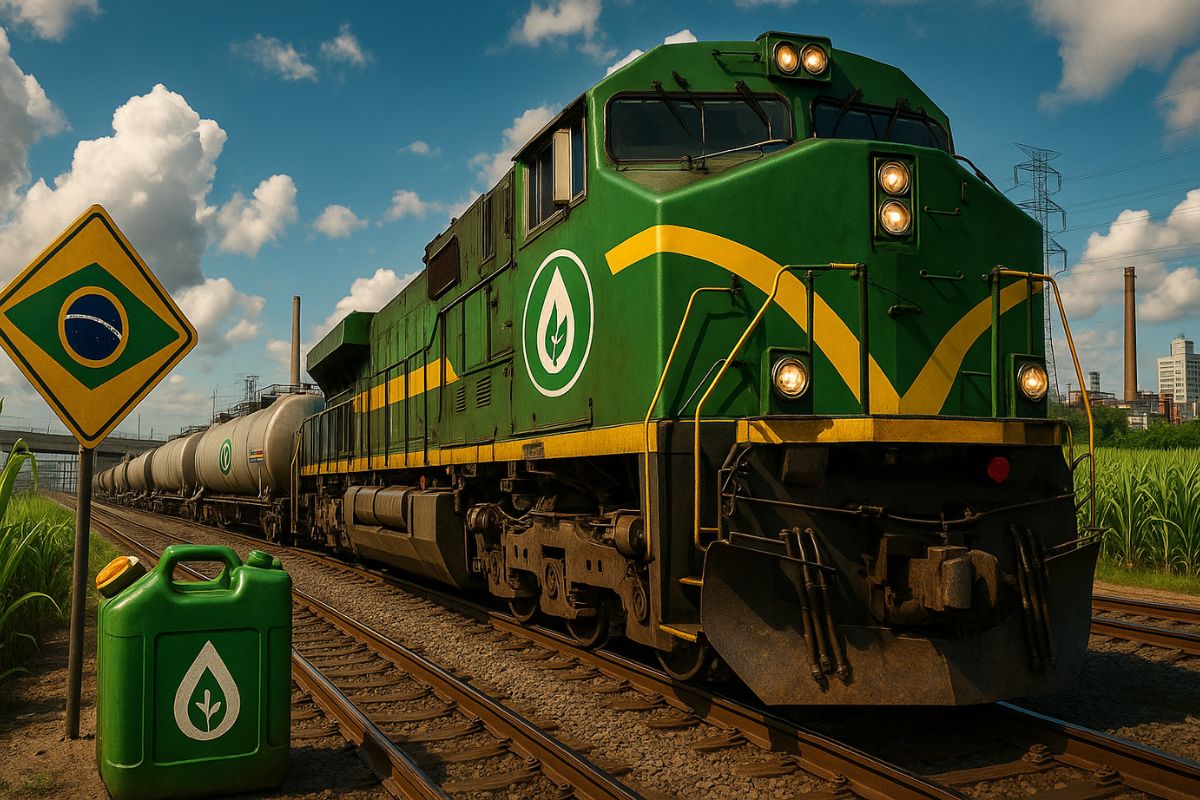


The First Step Places the Ethanol-Powered Train at the Center of a Technical Validation Aiming to Reduce Diesel Use in Locomotives by Half, with Adaptations to the Engine, Injection System, and Tank to Operate with Biofuel on Real Routes.
The tests of the ethanol-powered train are advancing with laboratory protocol and field preparation to validate the replacement of up to 50% of diesel without loss of performance. The initial phase takes place at partner facilities in Europe, focusing on calibration, material compatibility, and operational safety before implementation in the Brazilian network.
The plan foresees a progressive transition by 2028, when pilot projects are expected to reach commercial routes. The strategy starts with corridors that have a consolidated supply of ethanol, especially in the Midwest and Southeast regions, reducing supply risk while measuring consumption, available power, and emissions.
What Is Being Tested
The proposal for the ethanol-powered train combines adaptations to the main diesel engine with calibration of injection, assisted ignition, and mixture control, allowing flexible operation with a relevant fraction of biofuel.
-
Friends have been building a small “town” for 30 years to grow old together, with compact houses, a common area, nature surrounding it, and a collective life project designed for friendship, coexistence, and simplicity.

-
This small town in Germany created its own currency 24 years ago, today it circulates millions per year, is accepted in over 300 stores, and the German government allowed all of this to happen under one condition.

-
Curitiba is shrinking and is expected to lose 97,000 residents by 2050, while inland cities in Paraná such as Sarandi, Araucária, and Toledo are experiencing accelerated growth that is changing the entire state’s map.

-
Tourists were poisoned on Everest in a million-dollar fraud scheme involving helicopters that diverted over $19 million and shocked international authorities.


The goal is to preserve torque and reliability in typical load regimes for freight and, in the future, passengers.
Studies indicate the potential for replacement of up to 50% of diesel with ethanol, a level that depends on parameters such as altitude, temperature, and track profile.
The technological goal is to scale the percentage without compromising fleet availability, while always maintaining temperature, pressure, and vibration limits of the powertrain.
Engineering and Necessary Adaptations
For the ethanol-powered train, the fuel line requires seals and materials compatible with hydrated alcohol, in addition to specific injection maps to compensate for different calorific power and stoichiometry than diesel.
Sensors, pumps, and nozzles undergo revalidation for long service cycles.
The tank, currently dedicated to diesel, requires hybrid or compartmentalized configuration to ensure autonomy and safe alternation between fuels.
The electronic management of the engine takes on a central role, coordinating starting, transients, and ramp acceleration without power oscillations.
Timeline and Field Validation
The bench phase of the ethanol-powered train measures specific consumption, emissions, and durability of components.
Subsequently, prototypes will undergo dynamics tests on track, with telemetry monitoring for traction effort, exhaust temperature, soot, and thermal stability.
The adoption in selected corridors is planned incrementally until 2028, prioritizing segments with mature ethanol logistics.
The pilot design includes performance and availability metrics, comparing equivalent locomotives in conventional and hybrid operation.
Supply, Logistics, and Safety
The feasibility of the ethanol-powered train depends on supply points close to the track and handling procedures that respect the flammability and hygroscopicity of the fuel.
Team training and emergency protocols are incorporated from commissioning.
At bases with established diesel, the most predictable solution is dual infrastructure, ensuring energy redundancy.
Contingency plans cover variations in ethanol quality, preventing effects on filters, corrosion, and cold starting at specific altitudes.
Environmental Impact and Emission Targets
By displacing part of the diesel with ethanol, the ethanol-powered train tends to reduce net emissions in the chain, especially where the biofuel has a lower footprint.
A decrease in particulate matter and SOx is expected in stable load regimes, provided the calibration controls HC and CO.
In the long term, the hybrid platform may enable higher blends and integration with other biofuels, reinforcing corporate decarbonization goals without replacing the entire fleet.
This represents a measurable incremental gain, with continuous monitoring on real routes.
Operating Costs and Availability
The ethanol-powered train aims to reduce variable cost per ton-kilometer when there is a competitive supply of ethanol. The economic balance considers the relative price of fuels, locomotive productivity, maintenance windows, and the lifespan of adapted components.
Key indicators include specific consumption, availability factor, and maintenance cost per thousand km. The standardization of kits and procedures is expected to decrease the marginal cost after the learning curve, preserving the existing fleet and avoiding full capex on new platforms.
Challenges and Next Steps
Risks focus on component durability, supply consistency, and regulatory approval for commercial service use.
Validation must demonstrate performance equivalence under the most critical conditions of the network, including long ramps and varied weather.
Once testing is completed, scaling depends on ethanol supply contracts, engineering of refueling yards, and training programs for drivers and maintenance.
Operational success opens the door for applications in passenger trains with noise and comfort goals maintained.
The ethanol-powered train offers a pragmatic route to halve diesel use without losing traction or availability, combining abundant biofuel in Brazil with low substitution engineering adaptations.
The key is to validate performance and logistics in the right corridors, creating scale with safety and predictability.
Which test do you consider decisive to release the ethanol-powered train for commercial operation: durability on long routes under maximum load or standardized dual refueling at strategic yards?










quem está desenvolvendo isso?
A Volvo nos anos 80 já fez BRT’s com dois combustíveis , diesel e álcool em Curitiba!
Não entendo o motivo porque o projeto não avançou!
As operadoras em ferrovias deveriam comprar as locomotivas 100% elétricas fabricadas pela Vale, pois estas a Etanol, irá onerar os custos do mesmo nos postos de combustíveis para os carros flex, sendo que já está caro demais.