





 Português
  Inglês
  Espanhol
 2 min de leitura


Sludge Transformation May Also Help Restore Degraded Soils
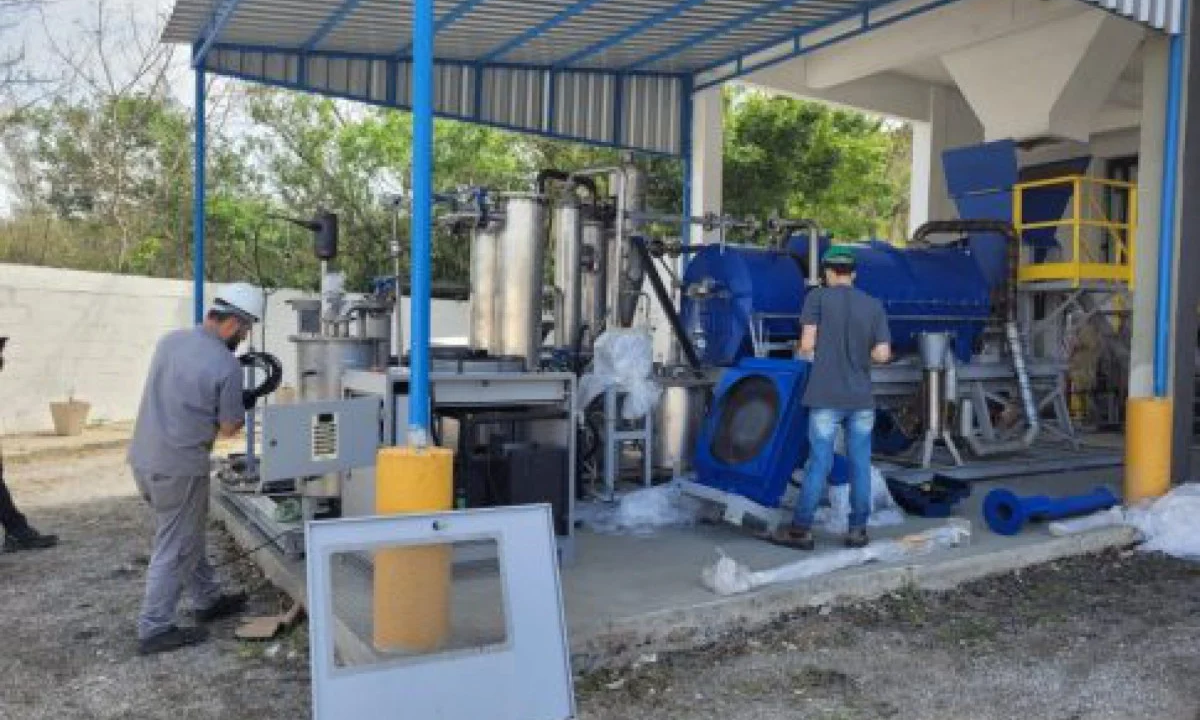
The project involves a Waste Treatment Unit (UTR) and will be capable of transforming the sludge resulting from domestic sewage treatment into energy through an innovative and sustainable technology. Sludge is typically disposed of in landfills, in a substance that can be treated and reused as biogas or in a type of charcoal called biochar, which can be used for agricultural applications to restore degraded soils and for carbon sequestration.
The Retransformar Project Was Received by the Sewage Treatment Station (ETE), Learn How It Works
The treatment unit will be capable of processing all the sludge produced at the ETE. This represents about 2 tons per day, and the project will last 3 years. The equipment used in the transformation employs ‘slow pyrolysis in a rotary drum,’ which is a thermochemical decomposition process of the material. Then, the produced gas is filtered and sent to burners and for power generation. A portion of the gas returns to fuel the process, and thus, no polluting or toxic gases are produced.
Project Tests Are Conducted in Partnership with the Federal Fluminense University (UFF)
According to an article from O Dia, the tests for the sludge treatment project using ‘slow pyrolysis in a rotary drum’ take place at the operational unit of Prolagos, funded by Águas do Rio and the State Department of Science, Technology and Innovation, in partnership with Agenersa, the Federal Fluminense University (UFF), and the City Hall of Arraial do Cabo.
-
Renewable energy advances over protected areas in Brazil, and a survey by the Energy Transition Observatory reveals silent impacts that challenge environmental conservation and pressure sensitive traditional territories.

-
The Economist states that Brazil has a “secret weapon” against expensive oil and highlights how the country can reduce economic impacts even in international scenarios of high volatility.

-
Rio Grande do Sul accelerates energy transition: State invests in renewable technologies and consolidates decarbonization strategies and pathways to attract billions in new industrial investments.

-
With 160,000 m² of collectors, an area larger than 20 football fields, Silkeborg, in Denmark, hosts a solar thermal plant that heats 19,500 homes and could become the largest solar heating plant in the world.


According to Rodolfo Cardoso, a PhD in Production Engineering from the Federal Fluminense University and the project manager, “the tests to be conducted will yield innovative results in the country. We will analyze the best ways to reuse the sludge and which will have the best cost-benefit ratio, impacting not only companies focused on sanitation but also other industries. We will also explore ways to increase the plant’s capacity to serve even larger treatment stations. Using software, we will create digital twins of the unit and conduct tests simulating productivity expansion.”









Seja o primeiro a reagir!