





 English
  Francês
  Alemão
  Italiano
  Japonês
  Norueguês
  Portuguese
  Spanish
  5 min of reading
  0 comments


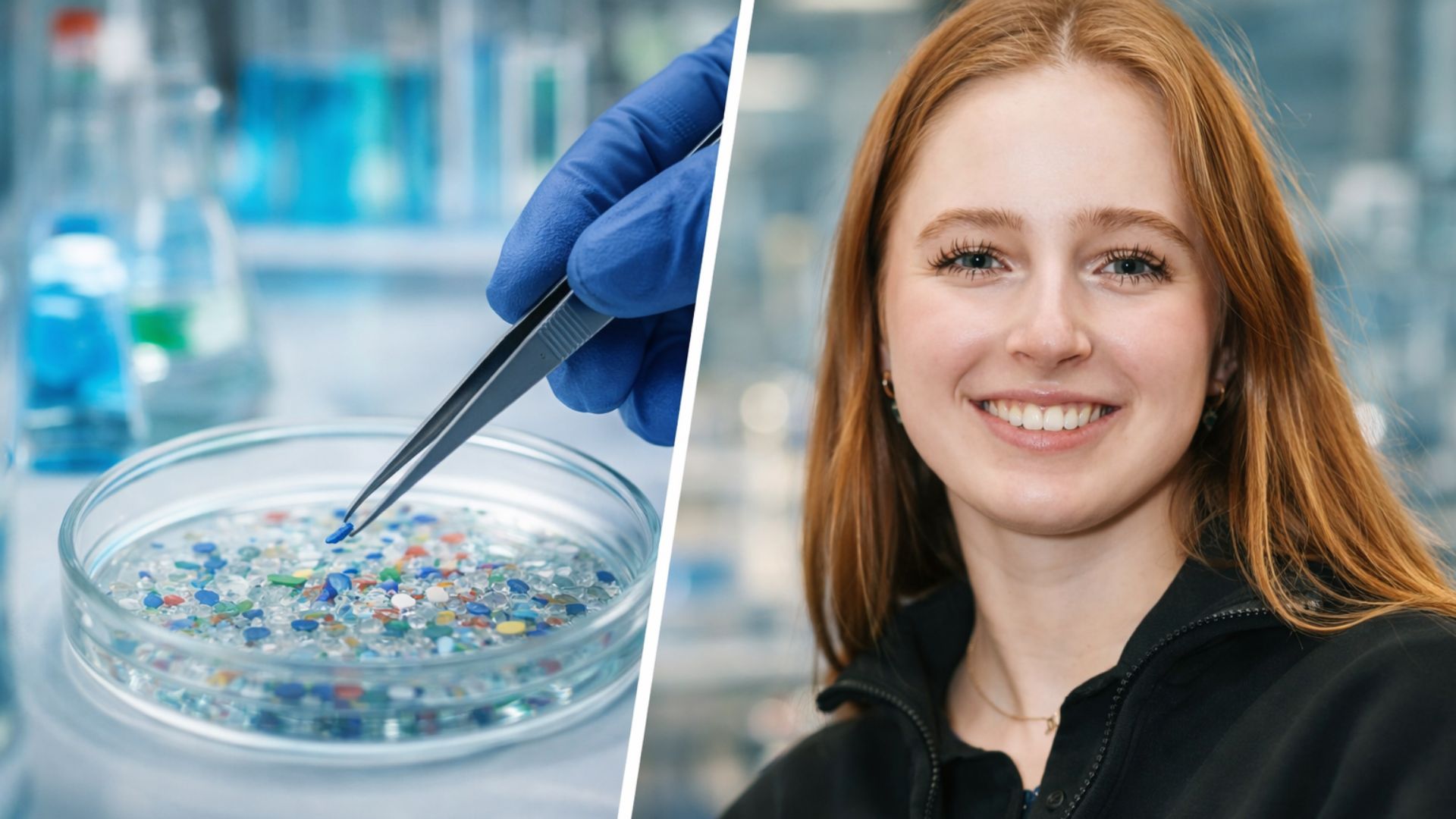
Young develops innovative water purification technology that removes microplastics with high efficiency, creating an accessible and sustainable filter that can transform water quality and impact global health
The growing presence of microplastics in drinking water has become not just an environmental concern but a rising public health issue. In this context, an 18-year-old teenager caught the attention of the scientific community by developing an innovative filter capable of significantly improving water purification, removing about 95.52% of these invisible particles.
Young Mia Heller, a student in the United States, created a system that dispenses with traditional membranes and uses a magnetic process to capture contaminants. The result is a more accessible solution, with lower maintenance costs and global application potential.
According to information from Smithsonian Magazine, the innovation emerges at a critical moment. Recent studies indicate that microplastics have already been detected in various parts of the human body, including the brain, bones, and even the placenta. In light of this, advances in water purification are becoming increasingly necessary to reduce health risks.
-
350-year mystery may have been solved: remains of a soldier who inspired the hero of The Three Musketeers found beneath a church in the Netherlands.

-
NASA photographed a nearly perfect square with 3 km sides on Mars, 13 times larger than the Great Pyramid of Giza, but the official explanation is natural erosion; still, no one has explained why the four sides have almost identical lengths.

-
Starlink breaks the barrier of 10,000 satellites in orbit and takes its expansion to an unprecedented level, with a direct impact on global internet, technological competition, and the race for space.

-
Japan finds an alternative to oil amid rising prices by transforming ocean balance into electricity with a new technology that maintains efficiency even when the sea changes.

When a household problem leads to the creation of a filter against microplastics
The story behind the innovation began simply. The teenager came across a local article revealing high levels of water contamination by PFAS and microplastics in her area, in Virginia. The most concerning aspect was the lack of public investment to solve the problem.
Without government support, the responsibility for filtration fell on the residents themselves. The young girl’s family decided to install a home filtration system, but soon realized the limitations: constant maintenance, frequent component replacement, and high costs.
It was by observing this scenario that the student decided to take action. The repetitive process of replacing membranes sparked the idea of developing a more efficient and practical filter for water purification, without relying on disposable parts.
The silent advance of microplastics and their increasing risks
Microplastics are extremely small particles, ranging in size from 1 nanometer to 5 millimeters. Despite being tiny, their impact is significant and growing.
Research indicates that these particles have been found in over 1,300 species, including humans. They are present in organs such as the brain, bones, testicles, semen, and even in the placenta of fetuses.
Another alarming statistic shows that the ingestion of microplastics has increased sixfold since 1990. Additionally, a 2025 study from the University of New Mexico revealed that the concentration of these particles in the human brain has grown by about 50% in less than a decade.
Although the effects are still being studied, there are indications of associations with various health problems, such as:
- Cardiovascular diseases
- Hormonal disorders
- Respiratory problems
- Neurological diseases
- Possible links to cancer
Even without a definitive consensus, the signs are sufficient to justify the search for more effective solutions in water purification.

How the water purification filter developed by the teenager works
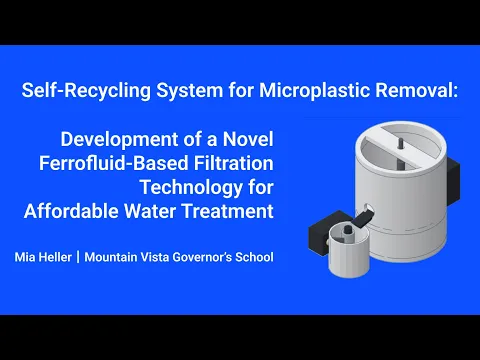
The key difference of the project lies in replacing traditional membranes with a system based on ferrofluid, a magnetic liquid capable of binding to microplastic particles.
The process occurs in an integrated and efficient manner. When contaminated water passes through the system, the ferrofluid captures the plastic residues. Then, a magnetic field separates these particles, allowing for water purification.
The system developed by the teenager consists of three main modules:
- An initial reservoir to store contaminated water
- A compartment with magnetic ferrofluid
- A separation chamber where the main process occurs
This model functions as an independent filter, similar to a household pitcher, capable of treating approximately one liter of water at a time.
Another important point is the reuse of ferrofluid. About 87.15% of the material used is recycled within the system itself, which reduces costs and increases the sustainability of the solution.
Practical results reinforce the potential of the technology
The tests conducted with the prototype showed significant results. The filter developed by the teenager managed to remove approximately 95.52% of the microplastics present in the water.
This performance is comparable to — and in some cases competes with — traditional treatment systems, which typically remove about 70% to 90% more of these particles.
To validate the results, the young girl created a turbidity sensor capable of measuring the amount of suspended solids in the water. This allowed for precise calculation of the system’s efficiency.
The data indicates that the project not only works but also has the potential to evolve with additional investments in engineering and development.

Why current water purification systems still face limitations
Despite the existence of various water purification methods, many still present significant challenges. Traditional systems often rely on physical membranes, which require constant replacement.
Additionally, these models may involve complex chemical processes and high costs, limiting access in more vulnerable regions.
Among the main problems are:
- High maintenance costs
- Need for frequent component replacement
- Variable efficiency in removing smaller microplastics
- Dependence on more robust infrastructure
In this context, the filter created by the teenager stands out by offering a simpler, more efficient, and potentially more accessible alternative.
Scientific recognition and international interest in the innovation
The innovation has caught the attention of the scientific community and garnered international recognition. The teenager was a finalist at the 2025 Regeneron International Science and Engineering Fair, considered the largest global science competition for high school students.
During the event, she received a special award of $500 granted by the Patent and Trademark Office Society, highlighting the relevance of her water purification technology.
Experts also expressed enthusiasm. Toxicologist Matthew Campen described the project as a “really brilliant” idea and emphasized that the initiative addresses an urgent need.
Technical challenges and the path to expand the use of the filter
Despite the advances, there are still points that need improvement. One of the main challenges is ensuring that the removed microplastics are disposed of safely, without generating new waste.
Another important aspect is scalability. The system still operates on a small scale, filtering about one liter at a time. To achieve a greater impact, it will be necessary to adapt the model for larger volumes.
Furthermore, experts highlight the importance of validating the technology under different conditions and environments, ensuring its efficiency on a large scale.
Teenager shows real paths to confront microplastics
The creation of this filter by a teenager reinforces the role of science and education in the search for solutions to global challenges. In a scenario where microplastics are already part of daily life, initiatives like this offer concrete hope.
The developed technology presents clear advantages:
- High efficiency in removing microplastics
- Reduction of operational costs
- Less need for maintenance
- Potential for large-scale application
More than a technical solution, the project represents a shift in perspective. It shows that innovative ideas can arise from personal experiences and gain global relevance.
With the advancement of research and potential investments, the system has the potential to significantly contribute to water purification and help reduce one of the greatest environmental challenges of the century.






Seja o primeiro a reagir!