





 Portuguese
  English
  Spanish
  6 min of reading
  2 comments


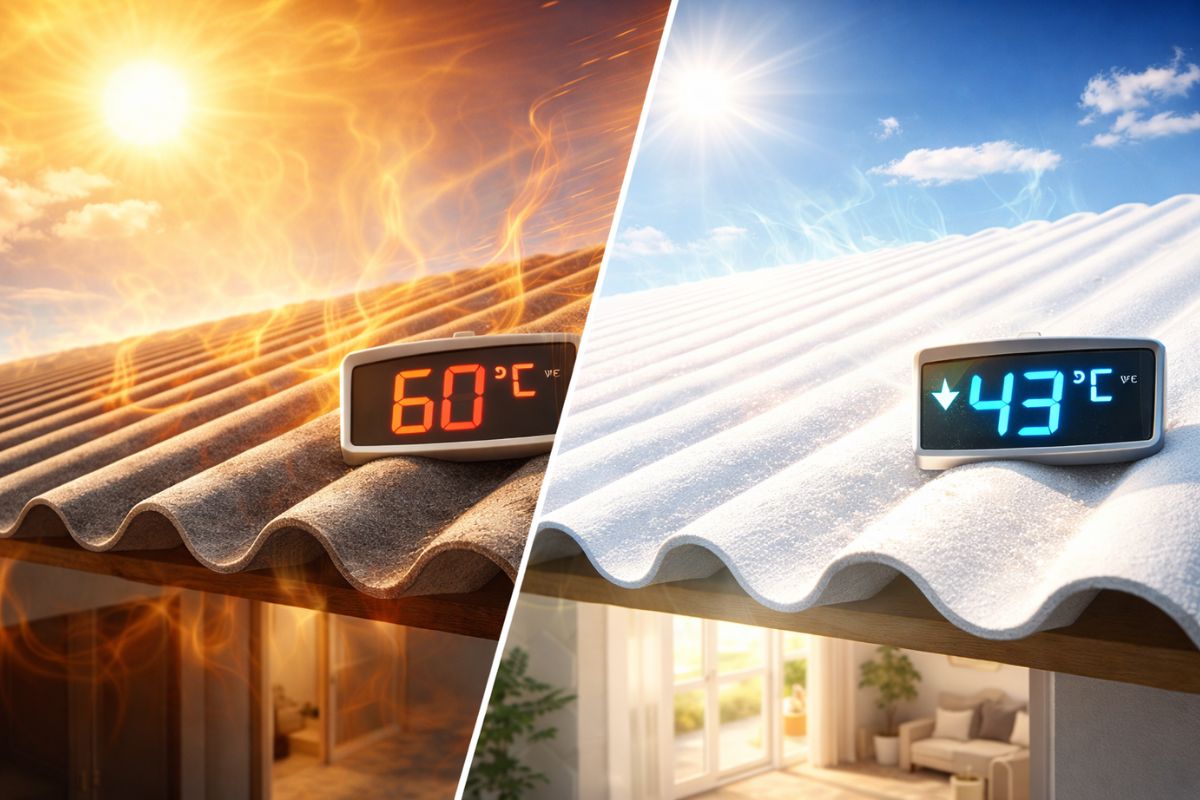


On a Fibercement Roof, Practical Test with White Waterproofing Shows a Reduction of Up to 17 ºC on the Tile, Moisture Blockage, and Real Improvement in Thermal Comfort Inside the House.
When the fibercement roof of a simple laundry registered 60 ºC measured from underneath the tile, the heat inside the environment became a daily problem. The space was stuffy, the air felt stagnant, and the thermal sensation was of a greenhouse, especially on sunny days. Looking from above, the scene was typical of many Brazilian homes: dirty, darkened fibercement roof, never washed and full of crusts of stuck dust.
The situation worsened when stains appeared on the ceiling, clear signs that moisture was passing through the tile.
Instead of replacing the entire fibercement roof, the resident decided to test a white waterproofing solution, applied directly over the existing tiles. The goal was twofold: reduce the temperature of the fibercement roof and, at the same time, stop leaks and moisture.
-
New CCR concrete paving technology promises roads up to 3x more durable, less maintenance, and cost reduction in Brazil.

-
Made from recycled plastic, plastic wood is gaining space in the construction industry because it does not rot, resists moisture, and reduces maintenance costs over the years.

-
Florianópolis will receive a million-dollar BRT that will begin construction in 2026 with nearly 400 million in funding from the federal government and the Inter-American Development Bank, and the map already shows the routes for the exclusive bus corridors.

-
Without a blueprint, without an engineer, and using scrap from the dump, a father spends 15 years building an 18-room castle for his daughter, featuring tram tracks, 13 fireplaces, and over 700 m², which may now be demolished.

The result, measured with a thermometer on the surface itself, was a drop of about 17 ºC between the raw tile and the painted tile, in addition to a visible change in water behavior. pasted
When the Fibercement Roof Becomes a Greenhouse Over the House
The first step was to face the reality: the fibercement roof was working against thermal comfort, not in favor. The measurement taken from underneath the tile, before any treatment, reached 60 ºC on a very hot day. Inside the house, this means heated walls, warmer air, and a constant feeling of stuffiness, even in small areas like laundry rooms.
From above, the problem appeared in another way. The fibercement tiles, old and never washed, accumulated a thick layer of dirt, dust, and stuck particles.
This dark surface absorbs much more solar radiation than a light-colored tile, which helps explain why the fibercement roof reaches extreme temperatures so easily.
The darker and dirtier the tile, the greater the tendency for the indoor environment to become unbearably hot.
Microcracks, Stains, and Leaks That Nobody Sees From Outside

Looking at the underside, there came another alert: stains in several spots on the fibercement roof. Even without obvious leaks, the wood and ceiling showed signs of constant moisture.
Over time, fibercement tiles, whether old with asbestos or new, tend to develop microcracks. These small cracks allow water to pass through, first as humidity, then as more intense leaks. pasted
In practice, this means that if this fibercement roof is over a bedroom or living room, moisture can promote mold, fungi, and respiratory problems for those living there.
In this specific case, the problem appeared in the laundry room, but the reasoning is the same: where there are stains and a smell of moisture, there is a risk of leakage worsening over time.
Aggressive Cleaning Before Any White Solution
Before applying any product, the most labor-intensive but essential step came: a complete cleaning of the fibercement roof. Instead of just using a broom or spraying water with a hose, the responsible person used a high-pressure washer to remove the crust of dirt accumulated over the years.
With each pass, the water carried away a thick mixture of dust and residues that formed a dark insulating layer. pasted
This step is critical for a simple reason: no waterproofing product, no matter how good, adheres well to a dirty, greasy, or fungus-infected fibercement roof. If the product does not penetrate the tile, it tends to peel off over time, allowing leaks and heat again.
After washing, a strategic choice was made: clean only one part of the fibercement roof and prepare it to receive the product, keeping another part untreated to compare temperatures and water behavior.
How the White Waterproofing Solution Was Applied
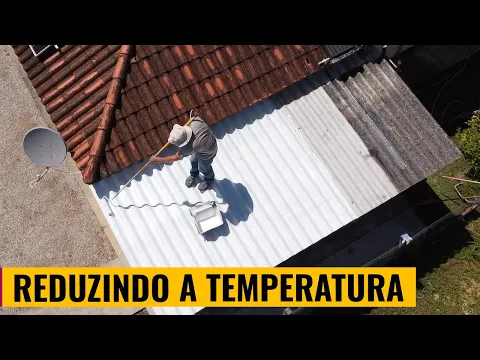
With the fibercement roof clean and dry, a white elastomeric liquid membrane of the ready-to-use type, suitable for waterproofing tiles, sloped slabs, and covers in general, came into play. The application was done in successive coats, using a high-pile wool roller. pasted
In the first coat, the product was diluted in about 10% water, specifically to penetrate better into the fibercement roof. The subsequent coats were applied with the product almost pure, just with a small correction of viscosity to facilitate spreading.
An important detail was observed: the surface of the fibercement roof could not be above approximately 35 ºC at the time of application. At higher temperatures, the product dries too quickly and does not create the desired continuous film.
After the drying interval, the second coat was applied. In this practical case, two coats were already sufficient to test the temperature reduction and water blockage on the tile.
If the goal had been maximum leakage protection in more critical areas, it would have been possible to add a third coat, creating a thicker and continuous film over the fibercement roof.
How Much the Fibercement Roof Really Cooled
With strong sunlight, the real test began. First, the temperature measurement was taken on the part of the fibercement roof that did not receive any cleaning or product.
The thermometer marked between 58 and 63 ºC on the tile surface, depending on the measured point.
Next, the measurement was repeated on the section painted white with the elastomeric waterproofing. The result: around 46 ºC in the treated area, compared to over 60 ºC in the original area, a difference of approximately 17 ºC on the tile. pasted
In the part that was only washed, but without painting, the temperature was around 52 ºC. This shows that simply washing the fibercement roof helps a bit, but it does not come close to the reduction achieved with the white waterproofing layer.
It is a temporary improvement, which tends to disappear in a few months when the surface darkens again with dust and fungi.
Meanwhile, the white finish, besides reflecting more light, is formulated to resist water and dirt adherence, increasing the durability of the effect.
How the Fibercement Roof Began to Behave with Water
Another simple test reinforced the change: a bucket of water was thrown first over the untreated section and then over the waterproofed section of the fibercement roof.
In the raw part, the water was quickly absorbed by the tile, especially in the more porous and cracked areas. In the treated part, the water simply ran off, forming sheets and drops that slid down the surface without penetrating. pasted
This behavior is exactly what is expected from well-done waterproofing on a fibercement roof: instead of acting like a sponge, the tile begins to repel water, preventing moisture from permeating and appearing in the form of stains, mold, or leaks down below.
Less moisture means less risk of fungi and less chance of the indoor environment becoming unhealthy, especially in bedrooms, living rooms, and areas with little ventilation.
Thermal Comfort, Health, and Lifespan of the Fibercement Roof
To sum it all up, what this intervention showed is that a relatively simple solution can tackle three problems at once: excess heat, leaks, and chronic moisture.
By applying a white liquid membrane over the existing fibercement roof, the resident reduced the temperature of the tile, decreased water absorption, and created an additional barrier against leaks, without having to replace the entire cover.
Moreover, the fibercement roof begins to age differently. Instead of wearing out directly, the tile is protected by a flexible film that accommodates expansion and contraction, reducing the emergence of new microcracks.
In practice, it is a way to extend the lifespan of the fibercement roof, improve thermal comfort, and make the indoor environment healthier.
Knowing that a simple white treatment can reduce the tile temperature by up to 17 ºC and also prevent leaks, do you think it’s worth investing in waterproofing for your fibercement roof, or do you prefer to go straight to replacing the tiles?








Considerado que a vida útil do telhado pode se estender muito e o benefício da redução da temperatura e proteção Seria uma boa cartada!
Depende do custo/benefício.
A reportagem não menciona o custo por m² para cada tipo de manutenção e nem o valor de mercado do tal impermeabilizações.