





 Portuguese
  English
  Spanish
  4 min of reading
  0 comments


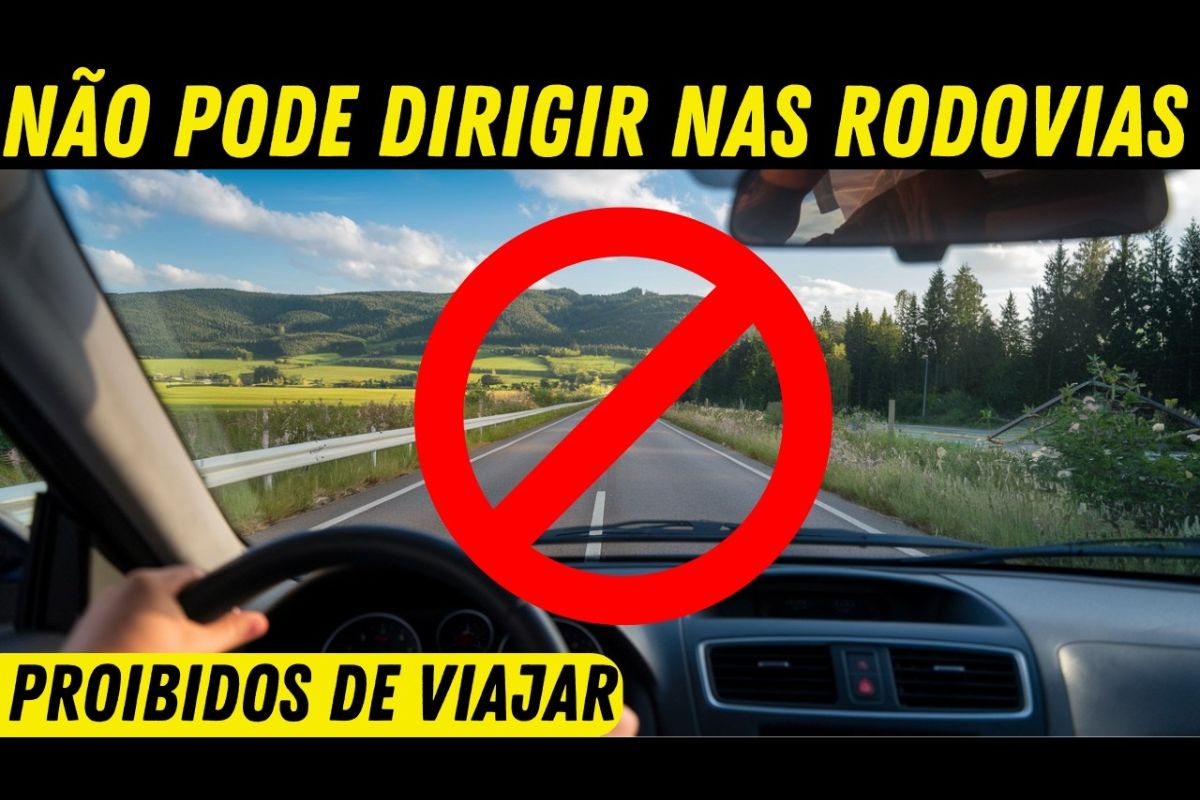
Driver’s License with Specific Observation May Restrict Circulation on Fast Lanes and Highways, and Many Drivers Only Discover It During Inspections or When Trying to Travel
There is a little-known piece of information in the Driver’s License that can limit the right to drive outside the conventional urban perimeter. It is an alphanumeric observation that, when present, imposes objective circulation restrictions, including the prohibition of traveling on highways. Many drivers do not know that they carry this limitation and continue driving normally until they are inspected.
The origin of this situation lies in the physical and mental fitness examination conducted during the first licensing and renewals. When the examiner identifies a condition that requires additional care, the Driver’s License receives a code in the observation area. The letter T is the most sensitive case for those who rely on travel, as it prohibits driving on fast lanes and highways, which in practice makes intermunicipal and interstate travel unfeasible.
What Is the Letter T and Why Does It Appear on the Driver’s License
The letter T is a restriction code that limits the driver to circulate only on roads that are not fast lanes or highways.
-
The noise law will no longer be in effect at 10 PM starting in June with a new rule valid during the 2026 World Cup.

-
The Chamber opens a debate on driver’s licenses at 16 years old as part of a reform that includes around 270 proposals to change the Brazilian Traffic Code and may redesign rules for licensing, enforcement, and circulation in the country.

-
The new Civil Code could revolutionize marriages in Brazil with “express divorce” and changes that could exclude spouses from inheritance.

-
Banco do Brasil sues famous influencer for million-dollar debt and intensifies debate on delinquency, risks of seizure, and direct impact on Gkay’s credibility.


In practice, this prevents travel, as access to other cities usually requires the use of highways.
This observation arises from a clinical assessment by the examiner, in the same process that can generate, for example, the letter A for mandatory use of corrective lenses.
It is not a punishment, but a technical condition recorded to guide inspections and preserve road safety.
Where to Find the Information on the Driver’s License and How to Check It
The record appears in the observation field of the document.
It is there that the letters indicating requirements or limitations are noted, such as the well-known letter A for those who need to drive using glasses or contact lenses.
The verification is simple: open your Driver’s License and look for the observation field.
If the letter T is present, the driver cannot drive on fast lanes or highways.
If there are other letters, it is worth checking carefully the meaning, as each indicates a specific obligation.
When the Restriction Is Usually Applied and What the Technical Logic Is
The letter T is applied when the clinical assessment concludes that the driver should avoid scenarios of higher average speed and fluidity, typical of fast lanes and highways.
These roads have controlled access, absence of level crossings, and require faster decision-making, which raises the criticality for certain assessed profiles.
This framing follows the same principle as other clinical observations.
If the driver’s condition recommends mitigating risks, the examiner inserts the restriction to adapt the use of the road to the safety profile of that driver.
What Happens If a Driver with Letter T Drives on Highways
If the Driver’s License shows the letter T and the driver continues to travel on highways, there is a risk of being fined during a potential inspection.
The observation serves as an objective parameter for the agent to verify compliance with the rule, just as occurs with the use of lenses for those with the letter A.
In the inspection, the analysis is straightforward: the restriction exists, and the inspected road is incompatible, which characterizes non-compliance with the recorded condition.
In addition to the fine, the trip may be interrupted, as the driver is not authorized to continue on that type of road.
What the Driver Can Do to Regularize or Reassess the Condition
If the driver believes that the restriction no longer makes sense due to clinical improvement, the way is to request a new assessment in the regular process, with the required exams.
Without an updated report, the observation remains valid, even if the driver feels fit.
In practice, the step-by-step involves scheduling a re-examination, presenting medical documentation verifying the change, and following the procedures for updating the document.
Only after the formal review is the Driver’s License issued without the observation that restricts road use.
Objective Checklist to Not Be Caught by Surprise
Before traveling, review your Driver’s License and confirm the observation field. If the letter T is present, do not use highways.
Plan routes through roads compatible with your condition and evaluate the need for clinical reassessment if you believe the situation has changed.
For those renewing, bring updated medical reports. During the assessment, clarify your driving context and usual routes.
The more accurate the examination, the more faithful the framed record will be in the Driver’s License.
The letter T on the Driver’s License is a clear sign of circulation restriction that sometimes goes unnoticed.
Ignoring the code can turn an ordinary trip into an infraction and inconvenience, as well as expose the driver to situations for which they are officially not authorized.
Checking the observations, understanding what they mean, and taking action to regularize when necessary is the safest way to drive within the rules and avoid problems on the road.
Have you checked the observation field on your Driver’s License today? If you found the letter T, how would you adapt your routine for travel and commutes?









-

-

-

7 pessoas reagiram a isso.