





 Portuguese
  English
  Spanish
  4 min of reading
  0 comments


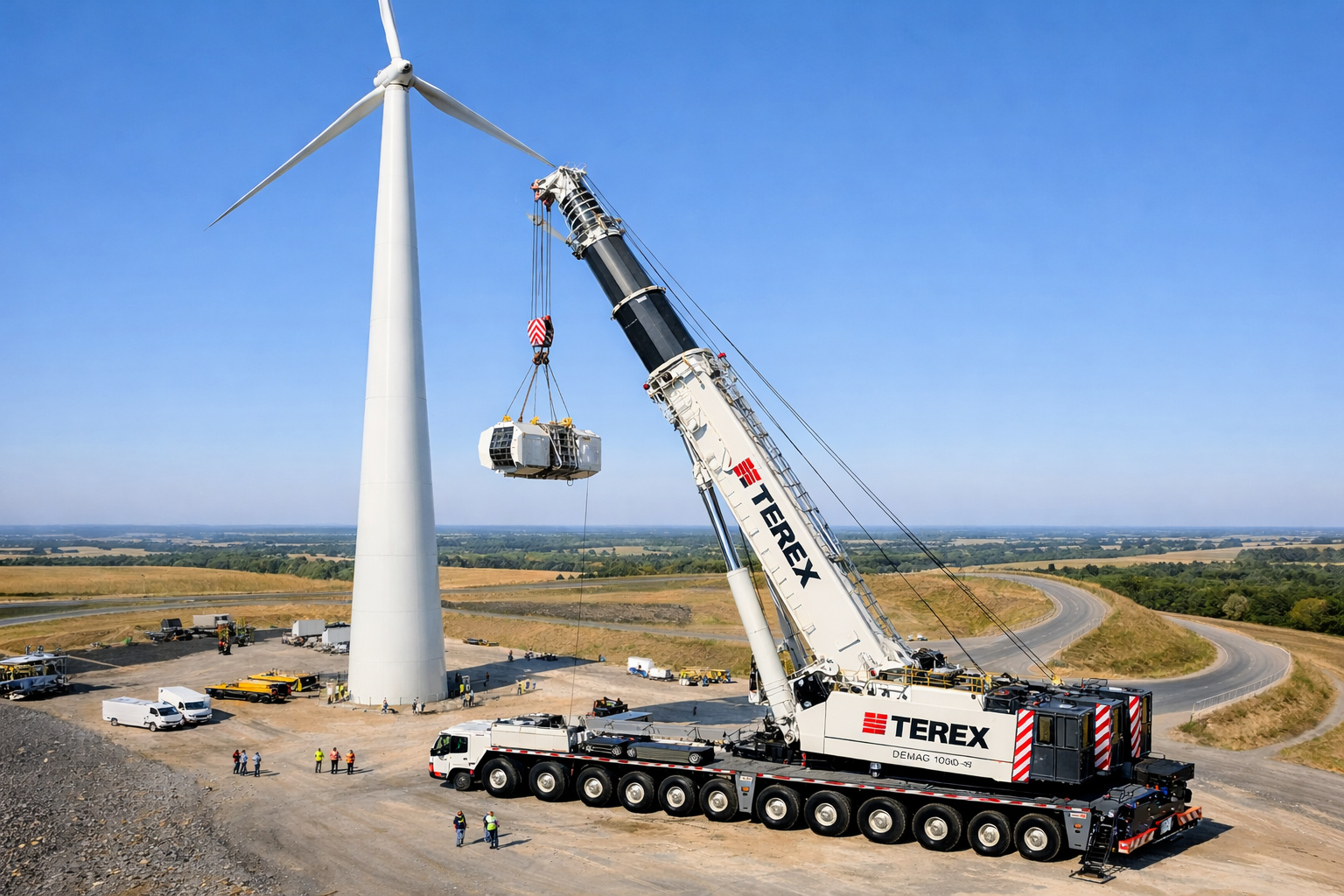
With Nine Axles and Capacity Over 1,200 Tons, the Terex Demag AC 1000-9 Is One of the Largest Mobile Cranes in the World Still Allowed to Operate.
When it comes to mobile cranes, most people envision large, yet “normal” machines. The Terex Demag AC 1000-9 does not fall into that category. It operates in a territory where heavy engineering, extreme logistics, and road legislation intersect.
This crane is one of the largest wheeled cranes ever produced, capable of lifting loads that easily exceed the weight of entire buildings, without relying on tracks or fixed assembly on site.
What Is the Terex Demag AC 1000-9
The AC 1000-9 is a 9-axle telescopic mobile crane, developed for large-scale projects, such as power plants, refineries, bridges, industrial platforms, and wind farms.
-
He saw a loophole in the 1967 space treaty and claims to have made millions selling lots on the Moon and other planets.

-
Researchers from Rio Grande do Sul have discovered a plant species that does not exist anywhere else on the planet within a park in the far west of Rio Grande do Sul, and it is already critically endangered.

-
More than 411 helicopters, 11.9 million inhabitants, and a trillion-dollar GDP place the largest city in Brazil and the Southern Hemisphere in a league of its own, with figures that already rival giant countries like Morocco, Hungary, and Ecuador.

-
Mysterious rock formation found in the interior of Paraná does not follow any natural erosion pattern, and now specialists are investigating whether humans carved those cavities centuries ago.
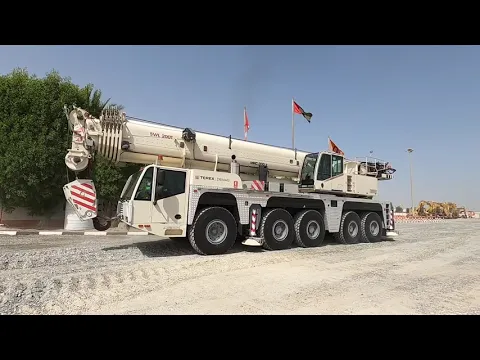

Its differentiator is not just the lifting capacity, but the fact that it can travel on highways, something unthinkable for equipment of this scale just a few decades ago.
Nine Axles and Dozens of Tires to Distribute Extreme Weight
To make this possible, the AC 1000-9 uses nine directional axles, with dozens of tires working together to distribute the gross weight within legal limits — or as close to them as possible.
Even so, the transportation requires special permits, technical escorts, and detailed route planning, including analysis of bridges, overpasses, and turns.
Load Capacity That Exceeds 1,200 Tons
The most impressive number is its maximum lifting capacity, which exceeds 1,200 tons, depending on the configuration of the boom and counterweights.
This means lifting giant transformers, complete industrial modules, and components that simply cannot be disassembled.
Telescopic Boom That Reaches Absurd Heights
The main boom of the AC 1000-9 can exceed 100 meters in height, and can be combined with additional extensions.
In practice, this allows for the lifting of extremely heavy loads to great heights, which is essential in modern industrial works where space is limited and precision is critical.
Counterweights That Turn Into Their Own Logistical Operation
To operate safely, the crane relies on hundreds of tons of counterweights, which do not travel coupled to the vehicle during long moves.
These blocks are transported in separate trucks, turning each operation into a complete logistical convoy, with planning worthy of heavy infrastructure projects.
Why It Can Still Operate on Public Roads
The most curious point is that despite its size, the AC 1000-9 is not a stationary piece of equipment. It was designed to operate legally, albeit with restrictions.
This drastically reduces the time and cost of mobilization compared to rail cranes, which require complete disassembly and weeks of preparation.
Embedded Technology to Prevent Catastrophic Failures
In machines of this size, errors are not an option. The AC 1000-9 uses advanced electronic load control systems, tilt sensors, wind, weight, and boom reach sensors.
These systems automatically prevent operations outside the safe envelope, avoiding tipping and structural collapses.
Why Few Exist in the World
The cost of acquisition, operation, and maintenance of the Terex Demag AC 1000-9 is extremely high. Furthermore, only large heavy engineering companies have a real demand for such equipment.

For this reason, the number of units produced is limited, and each one usually operates on strategic projects, often international.
Where This Type of Crane Makes Sense
This level of machine is only justified in projects such as:
- Assembly of refineries and petrochemical plants
- Installation of large wind turbines
- Construction of giant bridges and overpasses
- Movement of indivisible industrial modules
In smaller projects, it would simply be unfeasible.
The Practical Limit of Mobility on Wheels
The AC 1000-9 represents a practical limit of mobile engineering. Beyond this size, mobility ceases to be efficient, and transport by rail or fixed assembly becomes the only viable solution.
It exists at the point where it is still possible to operate, but any additional growth would require a different operational logic.
When Engineering and Logistics Walk the Knife Edge
The Terex Demag AC 1000-9 is not just a giant crane. It is the result of extreme engineering applied to overcome physical and legal limits.
With nine axles, a capacity exceeding 1,200 tons, and controlled road mobility, it shows how far the industry can go before the very concept of “vehicle” ceases to make sense. It is the kind of machine that does not impress with luxury, but with the technical boldness of existing.









-

-

-

-

-

-

66 pessoas reagiram a isso.