





 Portuguese
  English
  Spanish
  4 min of reading
  1 comment


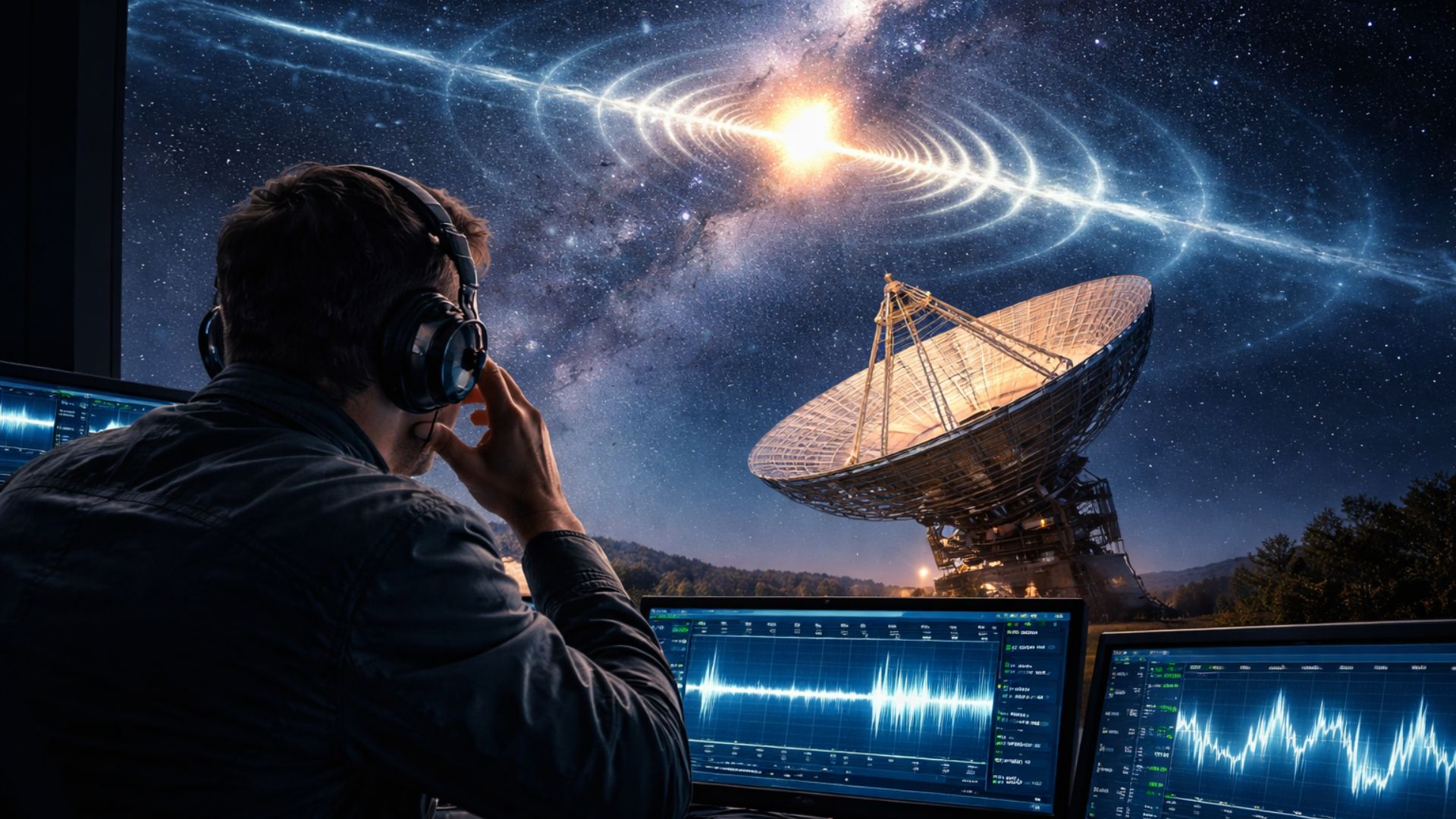


Periodic Signal from the Depths of the Milky Way Intrigues Researchers by Revealing Extremely Regular Radio Pulses Detected by Modern Radio Telescopes and Also in Historical Records, Indicating Continuous Activity for Decades and Raising New Questions about Neutron Stars, Magnetars, and Rare Phenomena in the Universe.
Astronomers have identified a source of radio waves in the Milky Way that stands out for its unusual regularity: the object GPM J1839-10, located about 15,000 light-years from Earth, emits pulses at intervals of approximately 21 to 22 minutes and maintains this behavior, according to available records, since at least 1988.
The finding caught the attention of the scientific community because the observed cadence deviates from the more common pattern of compact objects known to emit radio waves in space.
The detection was validated through recent observations made with the Murchison Widefield Array radio telescope in Australia, and gained momentum when the team reviewed archives from large observatories and found the same signal in old data.
-
Three submerged shipwrecks from the Iron Age found in the port of Dor challenge what was known about trade in the Mediterranean, and only 25% of the site has been excavated.

-
Maria Branyas Morera lived to be 117 years old, eating three yogurts a day without developing cancer or dementia, and when scientists analyzed her DNA, they found a secret that no one expected: her biological clocks indicated an age two decades younger than her actual age.

-
Dialysis as we know it may be numbered: researchers at the University of Southern California have managed to cultivate kidney cells in the lab that refuse to die and form mini-structures that mimic the actual functioning of a kidney.

-
Upside Down House transforms abandoned warehouses from the 1970s, blending art with concrete and steel engineering, becoming a phenomenon in South Korea and impressing with a surreal experience that attracts tourists from around the world.


This cross-referencing of information showed that the phenomenon was not episodic nor a result of instrumental noise, but a persistent emission that went unnoticed for decades because there was no expectation of finding a source with this profile.
Radio Pulses with Uncommon Periodicity
The recorded pattern also helps explain why the case has become so relevant.
Instead of pulses separated by milliseconds or a few seconds, as occurs in many pulsars, GPM J1839-10 produces bursts that can last between 30 and 300 seconds, with significant brightness variation and a much longer periodicity than predicted by classical models for this type of emission.
In practical terms, it is an object that appears, releases radio energy for a few minutes, and then disappears until the next emission cycle.
This behavior led researchers to categorize the source as a long-period radio transient, a rare and relatively recent group in modern astronomy.
Interest in this category has grown in recent years with advancements in radio sky surveys and improvements in instrument sensitivity, which have begun to capture signals previously invisible in the large volumes of data accumulated by observatories.
Recent scientific literature describes these objects as an emerging population whose origin still lacks a single or definitive explanation.
Scientific Hypothesis Involves Slow-Rotating Magnetar
The main hypothesis currently discussed is that GPM J1839-10 is linked to a ultra-long-period magnetar, that is, a neutron star with an extreme magnetic field and a rotation much slower than observed in other similar objects.
magnetars are compact remnants of massive stars that exploded as supernovae and are usually associated with intense energetic phenomena and extremely powerful magnetic fields.
Even so, the study itself emphasizes that the observed source challenges traditional models because an object rotating so slowly would theoretically be in a region where regular radio emission should have ceased.
This point has become central to understanding why the discovery has sparked great interest among astrophysicists.
According to the team responsible for the study, the object appears to be below the so-called “death line” of rotational emission models, a theoretical limit indicating when a neutron star would stop producing detectable radio beams from Earth.
Despite this, GPM J1839-10 continues to emit regular pulses, suggesting that there is some physical mechanism not yet completely described by current models.
Astronomical Archives Reveal Decades of History
The analysis of historical records played a decisive role in confirming the persistent nature of the phenomenon.
After identifying the source in the sky and determining its main characteristics, researchers searched for the same pattern in old observations made by large international radio telescopes.
It was at this stage that compatible records dating back to 1988 emerged, drastically extending the known timeline for the source’s activity.
These data indicate that the object has been emitting pulses for more than three decades, possibly much longer than the available records can demonstrate.
In addition to confirming the longevity of the emission, the prolonged history allows scientists to impose more rigorous limits on hypotheses regarding the origin of the signal.
Monitoring over such long time scales helps measure variations in the rotation period and test different physical scenarios capable of explaining the observed behavior.
Natural Phenomenon Still Challenges Astrophysical Models
So far, there is no reliable evidence that the signal has an artificial origin.
Although the regularity of the emissions may seem unusual outside the scientific context, the data points to natural processes associated with the extreme physics of compact objects, such as neutron stars and magnetars.
What makes GPM J1839-10 especially relevant is the fact that it exists in a theoretical region where this type of emission would be unlikely according to traditional models.
For this reason, the discovery has come to be considered an important element for revising or refining theories about the evolution of neutron stars and the dynamics of extreme magnetic fields.
New Radio Telescopes May Reveal Similar Signals
The identification of this source also highlights the scientific value of revisiting astronomical databases accumulated over decades.
Old observations can gain new meaning when analyzed with modern techniques and with scientific questions different from those that motivated the original surveys.
This kind of approach allows signals ignored or unrecognized in the past to be reinterpreted in light of new models and new instrumental capabilities.
As more sensitive radio telescopes come into operation and large sky surveys continue to be conducted, the expectation grows that other long-period radio transients will be identified.
With a larger number of available examples for comparison, researchers hope to better understand the physical mechanisms responsible for this unusual type of cosmic emission.






Nasci em 1986.
Mas ninguém vai indentificar porque esse sinal é mais facilmente obtido no Brasil.
Torna-se difícil compreensão para alguns,mas tenho os mesmos picos energéticos.
Caminhamos para a terceira guerra mundial,mas acredito que devo ficar fora dela.
Coisas estranhas à mente humana podem acontecer com fatores ainda não explicaveis.
Afirmo que essa descoberta só será feita em 2046, haverá uma queda fonte nos colos certos os números remetem a justiça e assim será.