





 Portuguese
  English
  Spanish
  7 min of reading
  1 comment


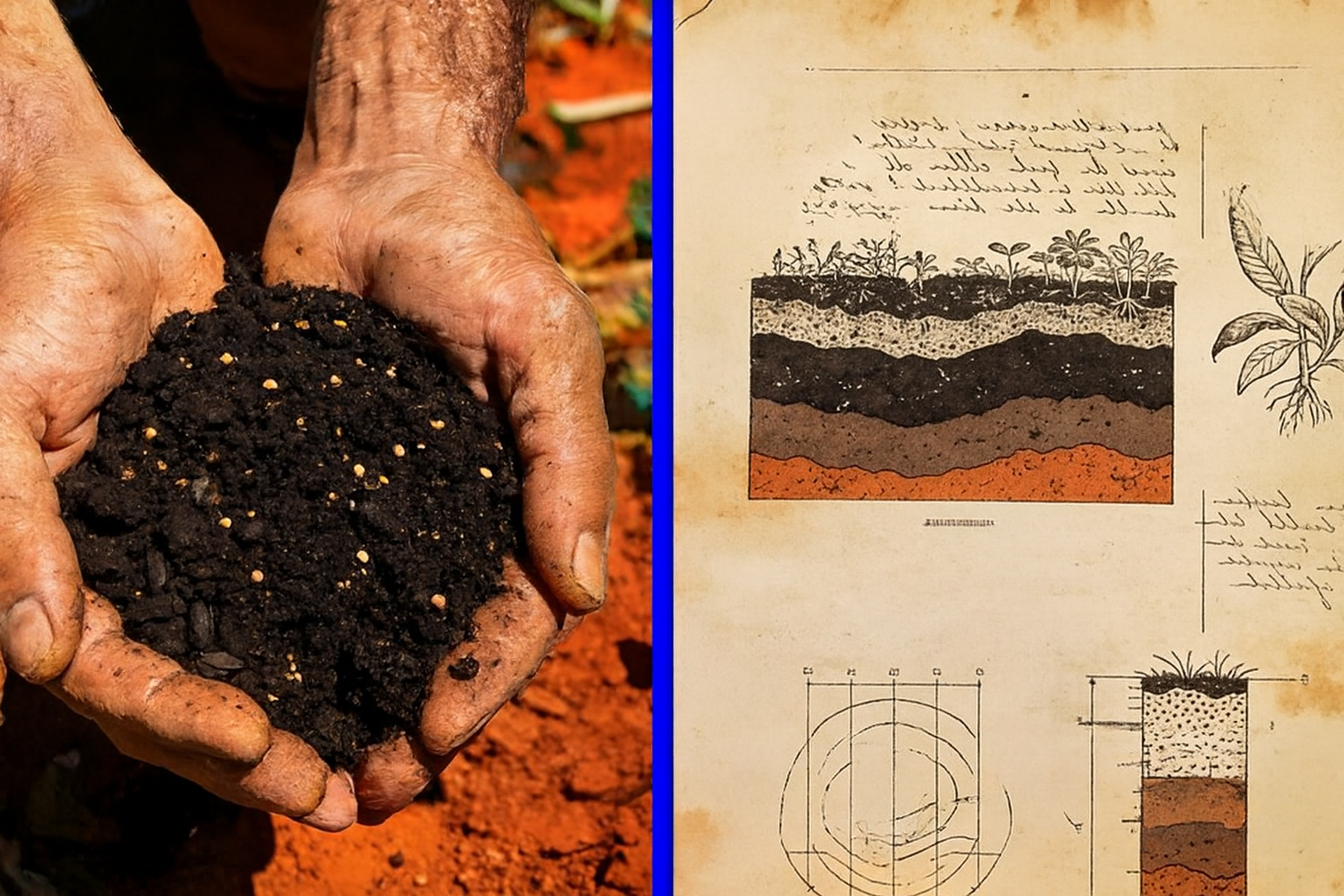


Amazonian Dark Earth: The Artificial Soil Created by Indigenous Peoples Thousands of Years Ago That Inspired Modern Biochar Science and Could Revolutionize Agriculture and Carbon Sequestration
Nutrient-Poor Amazon Soil: Why Forest Fertility Does Not Come from the Land. The soil of the Amazon basin is, in many ways, an ecological trap. Those observing the forest from the outside see lush vegetation, gigantic trees, and seemingly endless biodiversity. The intuitive impression is that the foundation of this ecosystem must be an extremely fertile soil. The scientific reality is almost the opposite. Much of the tropical soils of the Amazon consists of highly weathered latosols, rich in clay but extremely poor in essential agricultural nutrients. The intense rain typical of the region — which in some areas exceeds 2,500 millimeters per year — triggers a constant leaching process. Minerals such as calcium, magnesium, potassium, and phosphorus are continuously dissolved and washed away to deep layers before plants can absorb them.
This process means that the apparent fertility of the forest is not in the soil itself, but in the continuous recycling of biomass. Leaves, branches, fruits, and organic matter decompose rapidly on the surface, and the released nutrients are reabsorbed almost immediately by the roots. It is a closed system of biological circulation. When this vegetation is removed for conventional agriculture, the system collapses quickly. Without permanent plant cover, nutrients disappear in just a few agricultural cycles, and the soil becomes unproductive.
It was in this context that scientists began to find something that seemed impossible.
-
While the world looks at oil, the war with Iran is already disrupting helium supply from Qatar, affecting car and iPhone chips, threatening AI expansion, and putting pressure on aluminum packaging at the highest value in four years.

-
Global warming will expose a treasure hidden under the ice of Antarctica and may spark an international dispute over gold and valuable minerals.

-
A street vendor from Praia Grande built a robot made of scrap from scooters and washing machines that pulls his popcorn cart on the beach, emits sounds, and interacts with customers, becoming an attraction on the coast of São Paulo.

-
The specifications of the Xiaomi 18 Pro Max have been leaked, and the highlight is a dual 200 MP camera with a new 22-nanometer technology that promises to consume less energy and capture details in shadows and bright areas using LOFIC HDR.


Amazonian Dark Earth: Patches of Extremely Fertile Soil Amidst Poor Lands
At various points in the Amazon, geologists and agronomists found patches of dark and extraordinarily fertile soil, in direct contrast to the red and impoverished soil surrounding them. These soils exhibited unusual characteristics. The color was nearly black, the texture was deeper and richer in organic matter, and agricultural productivity was significantly higher. In some locations, crops thrived for decades without signs of depletion.


Local farmers had known about these soils for generations and recognized that they were much more productive. But for modern science, the phenomenon was puzzling. The explanation only began to become clear when archaeological analyses revealed that these soils were not natural.
They had been created by humans.
Indian Black Earth: An Amazonian Anthrosol Created Thousands of Years Ago
Researchers began to refer to this soil as Indian Black Earth or simply Amazonian Dark Earth. It is a type of anthrosol, a soil whose composition has been intentionally altered by human activities over generations.
Carbon-14 dating indicates that many of these soils began to form at least 2,500 years ago, although some archaeological sites suggest origins that could date back 9,000 years.
The geographical extent of this phenomenon is significant. Estimates indicate that about 10% of the Amazon basin contains areas of Dark Earth, distributed in patches ranging from a few square meters to dozens of hectares.
In some locations, the fertile layer can reach almost two meters in depth, resulting from centuries of agricultural management and organic matter deposition.
How Indigenous Peoples Created Amazonian Dark Earth
Pedological and archaeological studies have revealed that Amazonian indigenous peoples produced Dark Earth through a sophisticated combination of organic waste and charcoal.
The typical composition includes:
- food scraps
- animal bones
- manure and household waste
- ceramic fragments
- charcoal produced by controlled burning
The decisive element is the charcoal produced under low oxygen conditions, resulting from a process known today as pyrolysis.
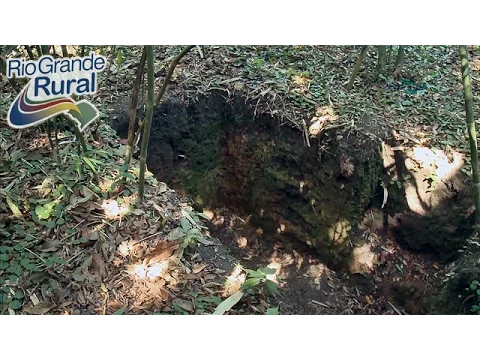
Unlike complete combustion, which transforms biomass directly into carbon dioxide, pyrolysis converts part of the organic matter into a highly stable and porous charcoal. This material is what modern science refers to as biochar.
Amazonian Biochar: The Charcoal That Stabilizes Carbon in Soil for Centuries
Biochar is a special type of charcoal produced when biomass waste is heated to temperatures between 350°C and 700°C in low-oxygen environments. This process alters the molecular structure of carbon, creating highly stable aromatic compounds that resist microbial decomposition.
The result is a porous material with enormous internal surface area — some measurements indicate values equivalent to over 800 square meters per gram. When incorporated into the soil, this material functions like a kind of microscopic sponge, capable of retaining water, nutrients, and beneficial microorganisms.
Amazonian Dark Earth contains exactly this type of stable carbon.
Extraordinary Fertility: The Numbers That Make Dark Earth Unique
Laboratory analyses of Dark Earth revealed impressive data. The content of black carbon can be up to 70 times greater than in adjacent tropical soils. The concentration of available phosphorus often ranges between 200 and 400 mg per kilogram of soil, levels rarely found in natural tropical soils.
In addition, Dark Earth exhibits:
- higher cation exchange capacity
- greater water retention
- greater structural stability
- higher microbiological activity
In terms of total organic carbon, Dark Earth can contain between 3 and 18 times more carbon than common Amazon soils. And most impressively, this carbon remains stable for hundreds or even thousands of years.
Wim Sombroek and the Scientific Rediscovery of Dark Earth
The first major modern scientific study on these soils occurred in 1966, when Dutch researcher Wim Sombroek published the book Amazon Soils. Sombroek identified the fundamental paradox of the region: how could poor tropical soils sustain extremely fertile areas?
His conclusion was revolutionary: these areas were the result of long-term indigenous agricultural management. Sombroek spent decades advocating the idea that Dark Earth could inspire a new model of sustainable tropical agriculture.
He also proposed the concept of “New Dark Earth”, an attempt to artificially replicate this soil.
Biochar and Modern Soil Science: A Field That Grew 17 Times
The term biochar was formally adopted in 2009 during an international scientific conference in Birmingham. Since then, research on biochar has grown rapidly.
In 2015, there were about 20 scientific publications annually on the subject. By 2024, this number exceeded 350 articles per year, a growth of approximately 17 times in less than a decade.
This increase reflects the growing interest in biochar’s ability to improve soil fertility and capture atmospheric carbon.
Biochar and Climate Change: The Carbon Sequestration Potential According to the IPCC
The Intergovernmental Panel on Climate Change (IPCC) included biochar in its climate mitigation scenarios.
According to the 2022 report, the global carbon sequestration potential from biochar could reach 2.6 billion tons of CO₂ per year.
Some recent analyses indicate values between 2.6 and 10.3 gigatons of CO₂ per year, depending on the sustainable use of agricultural residues.
A study from Cornell University showed that 12 countries could sequester more than 20% of their current emissions by using agricultural residues to produce biochar.
India represents the country with the highest potential, with estimates of reducing up to 53% of national emissions.
Degradation of Agricultural Soils: Half of the Soil Carbon Has Already Been Lost
The importance of these technologies grows as the planet faces a global soil degradation crisis. Intensive agricultural practices — such as deep tillage, monoculture, and excessive use of synthetic fertilizers — have drastically reduced natural soil carbon stocks.
It is estimated that about 50% of the organic carbon in the planet’s agricultural soils has been lost over the 20th century. This carbon has been released into the atmosphere as carbon dioxide. The FAO estimates that 24 billion tons of fertile soil are lost annually due to erosion.
When applied correctly, biochar profoundly transforms soil structure. Its network of microscopic pores creates micro-habitats for beneficial bacteria and fungi. These organisms help decompose organic matter and make nutrients available to plants.
The result is soil with greater water retention capacity, increased fertility, and enhanced chemical stability. However, modern research has uncovered an important detail: freshly produced biochar should not be applied directly to the soil.
Before that, it needs to be “charged” with nutrients, typically mixed with organic compost or manure for a few weeks. This process prevents biochar from absorbing nutrients from the soil before plants can utilize them.
Amazonian Dark Earth: A Two-Millennia Agricultural Experiment
Dark Earth represents one of the oldest and most successful agricultural experiments in human history. While natural soils around it have progressively become poorer over the centuries, Dark Earth has remained fertile. This soil continues to be productive even after two millennia of use.
Modern science has arrived at the same principle through climate models, industrial pyrolysis, and agronomic research.
Amazonian indigenous peoples arrived at the same solution through observation and knowledge transmission over generations. The deepest lesson of Dark Earth may not be technological.
It is temporal. Real solutions for soil are not measured in harvests or decades. They are measured in centuries.








Imagine quantas soluções perdemos… Quanta CIÊNCIA perdemos, porque uma turba de “civilizados” resolveu apagar civilizações inteiras de “selvagens”…