





 Portuguese
  English
  Spanish
  7 min of reading
  0 comments


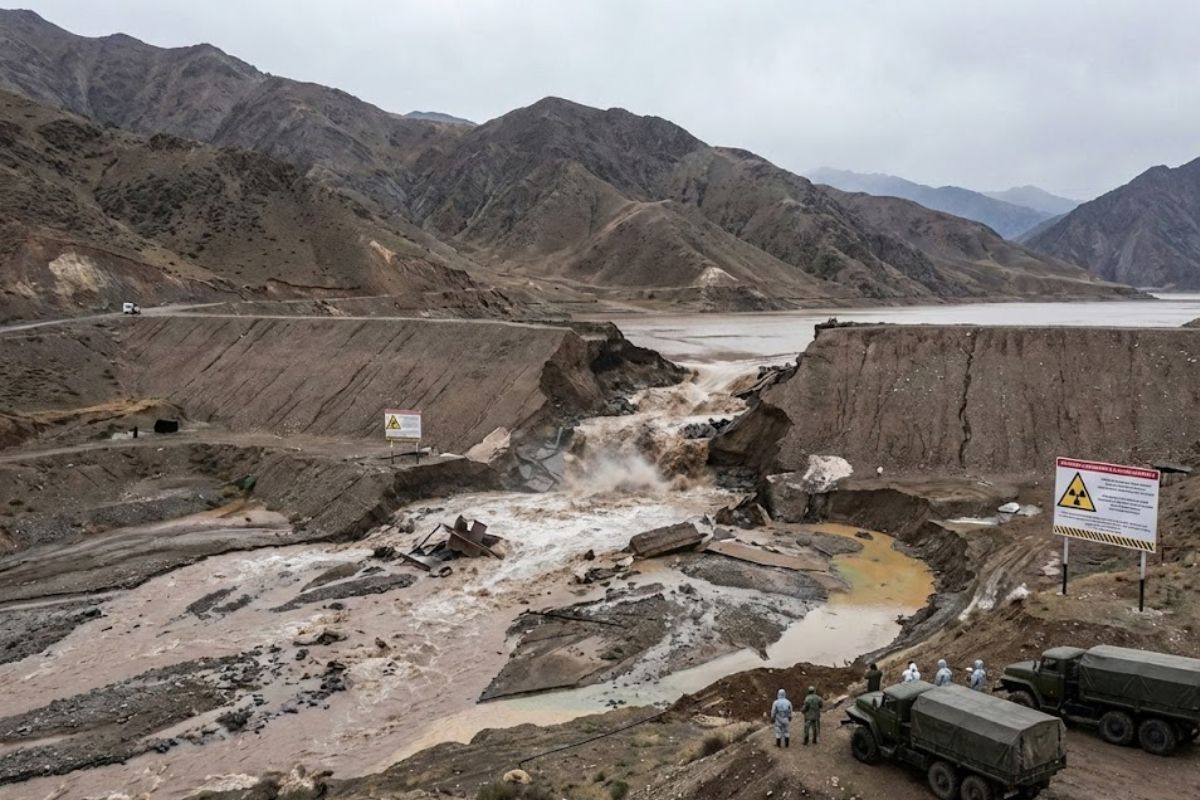
Earthquakes of 2023 Between 4.5 and 5.6 Shook Meusu and Exposed Dams Holding Uranium Concentrates and Radiation. With 23 Deposits and Up to 106 Million Cubic Feet, the Risk Threatens the Syr Daria Basin. Cases in Zambia and Brazil Show the Cost in Lives and Crops.
After the earthquakes of 2023, between magnitudes 4.5 and 5.6, residents of the Meusu valley in Kyrgyzstan breathed a sigh of relief when they realized that the dams in the mountains did not crack. The relief, however, did not come from their robustness, but from a simple and frightening idea: it only takes one rupture to trigger a chain collapse.
The problem is that these dams do not hold water. They hold uranium waste and its residues, a mass that can flow like wet paste, with the potential to reach rivers, agriculture, and millions of people. And, when looking at what has already happened in other countries, it is clear that dams that fail leave not only an environmental trail: they reorganize entire economies.
What Lies Behind the Dams in the Mountains of Kyrgyzstan
The current risk stems from a legacy from the late 1940s, when the Soviet Union accelerated its search for uranium to catch up with the United States.
-
NASA issues a warning for the feared Godzilla El Niño that could change the planet’s climate in 2026 with extreme warming of the Pacific capable of causing devastating droughts in some regions and historic floods in others simultaneously.

-
Archaeologists discover a 100-meter ship graveyard in a submerged Greek city, and what has appeared on the seabed of Libya could change what was known about this ancient port.
-
You buy the refrigerator and still have to see ads: Samsung starts displaying advertising on appliances and generates negative reactions among consumers.

-
What can really trigger large volcanic eruptions? Research suggests that gas returning to the magma may be more dangerous than gas escaping from it.

The operation in the Meusu river valley began in 1946, in a remote area, surrounded by mountains and little marked on maps. Nearby, the settlement of Meusu grew to support the uranium industry and became a closed city, registered with the code name: P.O. Box 200.
With the collapse of the Soviet Union in 1991, the arms race ended, but the problem remained. Kyrgyzstan inherited uranium waste, residues still containing uranium and materials such as radium and thorium, as well as products from their deterioration.
It is not waste that “ages” until it becomes harmless within human life. What defines the risk is where it is and how it has been confined.
In the Meusu area, the numbers show the scale: there are 23 waste deposits and 13 mine dumps. Together, they store between 67 and 106 million cubic feet of radioactive waste in a valley with a river, steep slopes, and unstable soils.
The dams in this region have, in practice, become the only physical barrier between this mass and the surrounding environment.
Why Are These Dams So Vulnerable to a Stronger Quake
What is held in Meusu does not behave like a compact block. Inside, it is a soft, moist, and mobile mass, with weak connections between particles, described as something close to toothpaste. This changes everything: if the material does not hold together, stability depends almost entirely on the dams that contain it.
The problem is that these dams were designed for a different operating regime and, for a long time, did not receive proper maintenance.
At the same time, Meusu is located in a seismically active area, with a history that reinforces the warning. In 1992, an earthquake with an approximate magnitude of 6.2 had an epicenter nearby.
In 2025, tremors around 4.3 were recorded there, strong enough to be felt without instruments. And the very regional framing admits that strong earthquakes, up to around seven, are possible.
When the factors are combined, the risk ceases to be theoretical: mobile radioactive waste, aging dams, mountainous terrain, and active tectonics. The question is no longer whether there will be too much pressure, but when.
The Warning That Comes from 1958 and the Path That Water Takes After the Valley
This is not an abstract fear. In April 1958, the waste dam number 7 gave way. Between 14 and 21 million cubic feet of radioactive waste escaped, flowed down the slope, and went straight into the riverbed of the Meusu, just a few dozen feet from the released mass.
For a long time, details of the accident remained classified, and even today it is difficult to precisely measure the number of affected people or direct fatalities, but one point has remained constant: there was large-scale contamination of soils and water systems.
The aggravating factor here is not just the local event, but the trajectory. The Meusu river does not end at the boundary of a city.
It continues south and connects to a much larger and more vulnerable region: the Fergana valley, one of the most densely populated areas of Central Asia, shared by Uzbekistan, Kyrgyzstan, and Tajikistan. In 2025, the population of this region is estimated to be around 17 million people.
In this fertile plain, agriculture depends on constantly moving water, in an intricate network of canals, cities, and villages.
If radioactive waste reaches aquifers or waterways connected to the Syr Daria system, the shock is not restricted to one municipality.
It becomes a transboundary risk with the potential to affect fields, drinking water, and productive chains.
The “Solution” That Exists and Why It May Not Happen at the Necessary Pace
Reinforcing dams seems intuitive, but it does not resolve the core of the problem: the material remains a mobile mass, and the structures continue to be under seismic and erosive threat.
The practical alternative described to reduce the risk is to move the waste to a safer location, which involves digging, transporting, and storing again, with engineering preparation and layers of insulation that can reach 6 feet thick to limit moisture and migration of radioactive components.
On paper, it sounds like a project. In reality, it is an expensive, time-consuming process with strict requirements. There is a preliminary estimate of around €17 million, which may seem manageable for wealthy countries but weighs heavily for a country already facing difficulties even in the routine maintenance of waste areas.
There is also a plan associated with funding that aims to relocate 12 million cubic feet of waste to a safer location, a relevant advance, but it covers only part of the total volume.
And there is still a concrete detail that is often overlooked until it becomes a crisis: the roads. Narrow and difficult mountain routes would be the path for trucks carrying hazardous loads.
Every curve and every cliff increase the chance of an accident. Moving waste may be the solution, but the movement itself carries risk.
What Zambia Showed When a Dam Burst and the Country Lost Its River
The harshest comparison is to see how a dam rupture immediately translates into a water and security crisis.
On February 18, 2025, in Zambia, a waste dam burst and released about 13 million gallons of waste into the environment. The flow reached the Mambashi river, a tributary of the Kafue, and flowed downstream.
The reaction was urgent: there were reports of fish mortality, changes in the color and smell of the water, and the temporary interruption of supplies to a city of about 700,000 people.
As the Kafue serves as the artery of the country, traversing agricultural areas, cities, industrial zones, and fishing villages, the impact is not “contained” at one point.
River water feeds irrigation, human consumption, industry, and even aquifer recharge, opening the way for contamination to spread far beyond the initial stretch.
The attempt to contain the situation exposed logistical desperation: the air force was used to drop hundreds of tons of lime into the river, while boats also spread lime to neutralize acidity.
An independent estimate cited in the episode suggested that the actual volume of waste could reach 1.5 million tons, above the official figures.
In other words, when a dam fails, management turns into a race against time, and there is not always a “real cleanup” possible.
Brazil as Proof That Dams Can Destroy in Minutes and Cost for Decades
Brazil provides an example of how a collapse can erase a place and redesign an entire watershed.
On November 5, 2015, the Fundão dam burst and released 1.4 billion cubic feet of waste.
The wave of mud and toxic sludge advanced rapidly and hit the village of Bento Rodrigues, which was buried. 19 people died, and hundreds lost their homes and livelihoods in a matter of minutes.
From there, the disaster gained the scale of a river. The waste entered the Doce river system, traveled hundreds of miles, interrupted supplies, altered banks and beds, and eventually reached the Atlantic Ocean after about 415 miles along its course.
There was an immediate report of over 29,000 dead fish in the basin. About 80% of the riparian vegetation along tributaries was destroyed, and agriculture suffered with more than 5,000 acres of farmland buried, in addition to nearly 3,600 acres of natural areas buried.
The legal dimension also shows how dams remain “active” in the life of a country many years later.
In 2025, the London courts recognized the responsibility of BHP Billiton and allowed the advancement of a class action involving 620,000 people and a total claim of 48 billion in damages.
And even with this landmark, individual compensations were still placed on a later schedule, with payment definitions expected in 2026. The rupture was in 2015, but the cost continues to march along with time.
What Unites Kyrgyzstan, Zambia, and Brazil in the Risk of Dams
In all three scenarios, the pattern is the same: dams hold volumes that cannot simply be “stopped” when something goes wrong.
In Kyrgyzstan, the risk is a radioactive legacy in a seismic zone, with waste behaving like a mobile mass that can reach a vast agricultural and population basin.
In Zambia, the rupture showed how a river can stop being reliable overnight. In Brazil, the rupture of a dam left a physical, environmental, and social trail that spanned a decade and continues to move through the courts and reparations.
The central lesson is not just technical. It is about governance and time. Dams age, volumes accumulate, risks multiply, and when a triggering event occurs—earthquake, structural failure, continuous pressure—the response needs to be immediate, costly, and imperfect.
Where there are rivers, there is agriculture. Where there is agriculture, there are people. And that is why a problem hidden in a mountain valley can become a global alert.
Do you think the world will act before the next dam collapse, or only after another entire river is compromised?







-

-

-

-

-

8 pessoas reagiram a isso.