





 Portuguese
  English
  Spanish
  3 min of reading
  0 comments


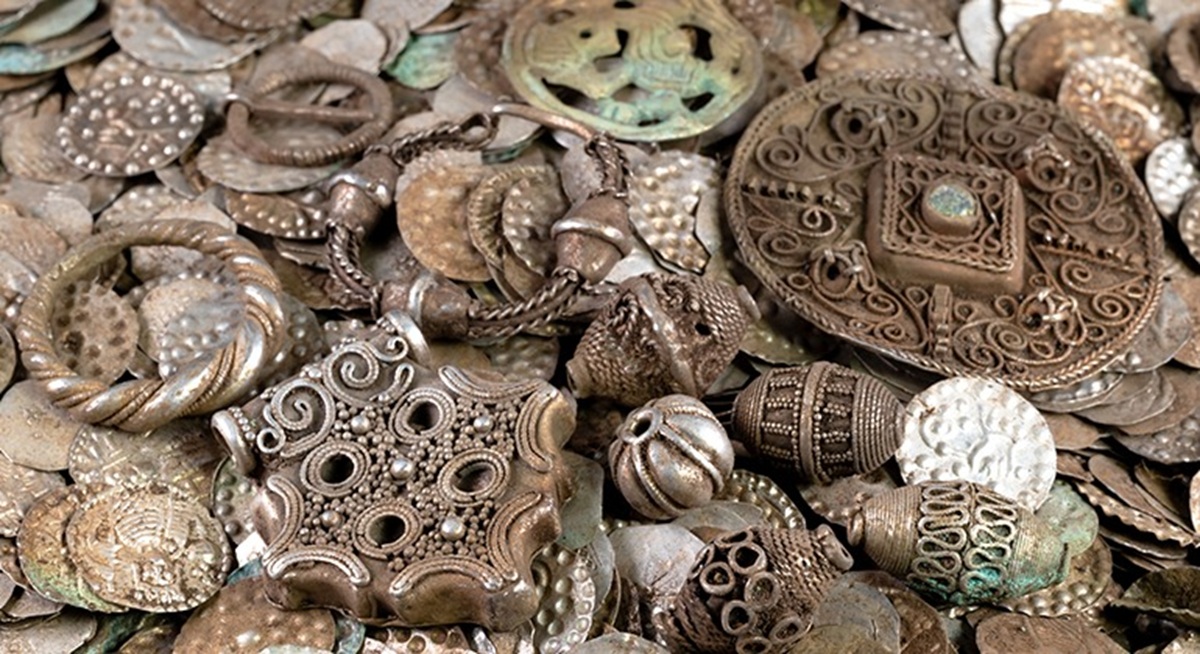
During a Casual Dig for Worms, a Swedish Fisherman Found a Cauldron Filled with 12th-Century Silver. The Treasure, with Up to 20,000 Coins and 6.1 kg of Jewelry, May Be the Largest Ever Discovered in Sweden.
One of the largest archaeological discoveries in Sweden surfaced unexpectedly: a fisherman found, near his summer home in the Stockholm region, a treasure with up to 20,000 silver pieces dated to the 12th century.
The find, revealed by the Stockholm County Administrative Board, is considered one of the largest and most significant in the country’s history. The exact location remains confidential for safety reasons.
The fisherman was conducting a simple dig for worms when he came across a damaged copper cauldron filled with ancient objects. Among them were pendants, beads, and coins that together weighed around 6.1 kg, suggesting they belonged to someone of great wealth. For experts, it is a treasure of invaluable historical and cultural significance.
-
The mysterious giant blue sphere in the middle of the Amazon that went viral on the internet is the Planetarium of Médio Solimões, an impressive project that is revolutionizing access to astronomy in Brazil.

-
Earth is “pulling” water from the oceans into the core at nearly 3,000 km deep, and scientists finally explain how this slow and invisible process may be completely transforming the planet from the inside over billions of years.

-
Japan shocks the world by announcing a billion-dollar plan to build a chip factory on the Moon with the support of Toyota, Sony, and the government, aiming for 2-nanometer technology and global dominance.

-
Scientists in the U.S. transform plastic waste into gasoline and diesel with nearly 60% efficiency using molten salts and less than 200 °C, in a process that could cost less and challenge traditional methods that reach 500 °C.

Largest Medieval Find Ever Registered in the Country
Swedish authorities believe the collection may contain up to 20,000 coins. The volume indicates that whoever buried them did so with an important purpose, likely linked to a period of instability. However, the treasure was never recovered, raising questions about the fate of its original owner.
“Most of the objects are well-preserved, but the copper cauldron in which they were found is unfortunately not as well-preserved,” explained Sofia Andersson, an antiquarian at the Stockholm County Administrative Board.
The absence of human remains at the site led archaeologists to investigate, as it was common for treasures to be buried alongside human remains. The discovery will be forwarded to the National Heritage Board, which is responsible for deciding whether the state will compensate the fisherman.
Coins Reveal a Period of Political and Religious Turbulence
The coins predominantly date from the 12th century, a transitional period in Swedish history. Around the year 1000, the country’s provinces were unified into a single political entity, but the crown only gained significant power by the end of the 13th century.
The treasure provides clues about this process and the political and religious changes of the time.
Some pieces bear the inscription “KANUTUS,” the Latin version of King Knut’s name, known for organizing the monetary system and acting on behalf of the Church. This relationship between state and religion explains the presence of episcopal coins, minted exclusively for ecclesiastical institutions. Many depict a bishop holding a crosier, a symbol of religious authority.
The period was marked by campaigns led by the king against pagan peoples, aimed at expanding Christianity.
By the end of the 12th century, Sweden was divided into five bishoprics, and the Church maintained its own tax system, protected by privileges granted by the monarchy. According to Live Science, this was a politically tumultuous time.
Buried Fortune May Have Belonged to a Family in Danger
Archaeologists raise the hypothesis that a family may have hidden their belongings to protect them during a moment of instability and never returned to recover them. This possibility would explain the volume of the treasure and its preservation over the centuries.
The County Administrative Board praised the fisherman’s decision to report the discovery to authorities, allowing it to be treated with the proper historical care.
In addition to its material value, estimated at thousands of silver pieces and dozens of rare coins, the discovery holds unique historical importance.
It offers a window into the life, beliefs, and conflicts of the 12th century, helping to better understand the formation of the Swedish State and the close relationship between religion and power during the Middle Ages.
For experts, the find represents a rare opportunity to study the past in detail and may reveal valuable information about medieval society.
The case illustrates how, even centuries later, history can still emerge unexpectedly — sometimes during a simple search for worms in the backyard.








-

-

-

-

-

-

50 pessoas reagiram a isso.