





 Portuguese
  English
  Spanish
  5 min of reading
  0 comments


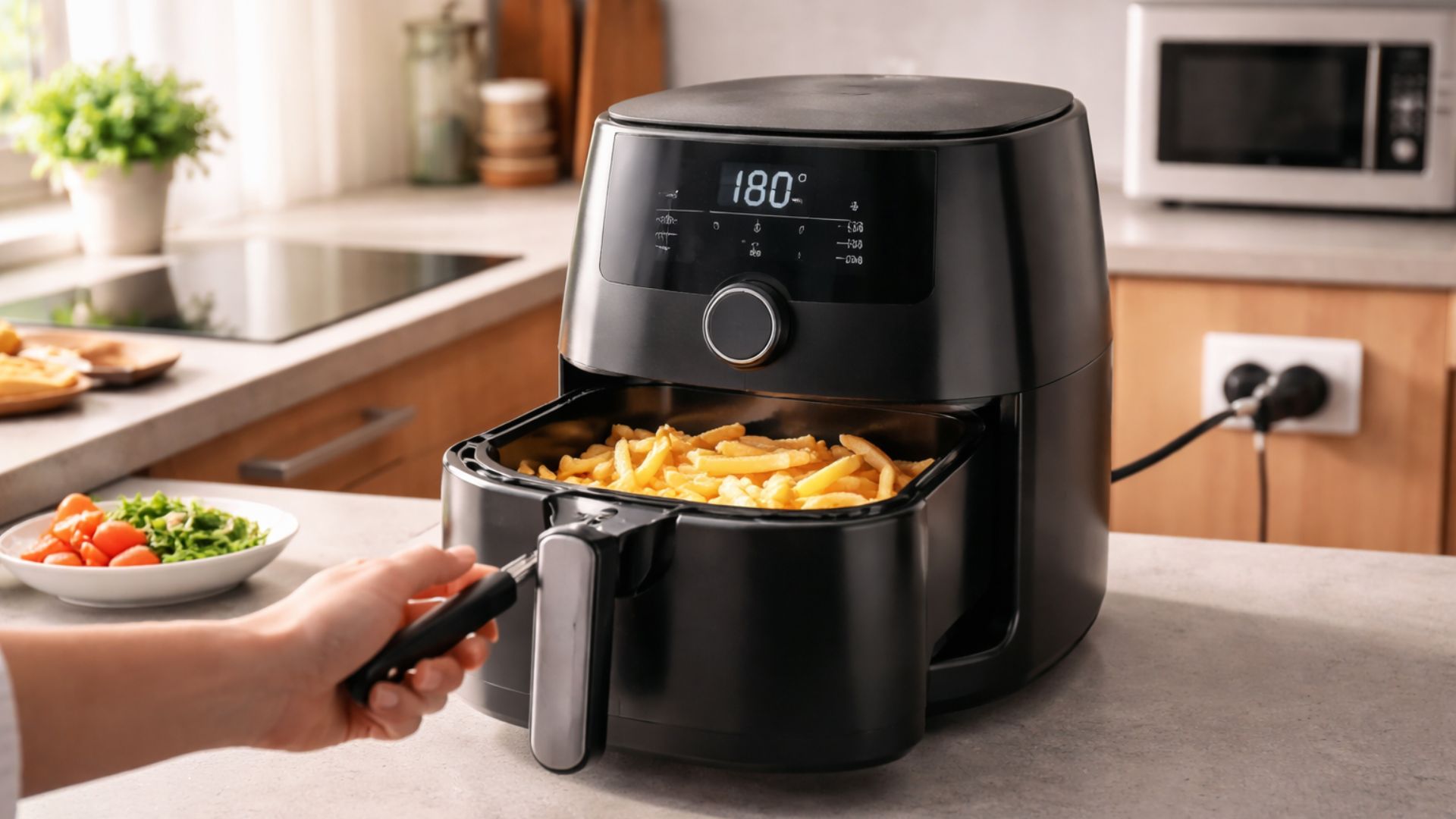
Accelerated growth of the air fryer in Brazil draws attention from the electric sector and enters the official energy consumption planning until 2050, reflecting changes in domestic habits and the expansion of appliances in homes.
The air fryer has been integrated into the official monitoring of energy consumption in Brazilian households.
In a study conducted as part of the PPH 2019, the Survey of Ownership and Usage Habits of Electrical Equipment in Residential Class, the Ministry of Mines and Energy included the electric fryer among the devices observed to measure how changes in domestic habits affect electricity demand in the country and which trends should be considered in planning until 2050.
The presence of the device in this type of survey marks a change in status.
-
Millions of people have been consuming cocoa for centuries without knowing that this ancestral fruit contains flavanols that scientists link to improved blood flow and measurable effects on attention and memory.

-
A Dutch builder has erected a 122-meter Noah’s Ark with 25 barges, cedar, and pine, created 7 floors with cinemas and a restaurant, and now the vessel will be taken to Amsterdam.

-
She took her first steps on the mat while her father was training, started competing at the age of 4, and now at just 9 years old, she is the world champion in Jiu-Jitsu in Abu Dhabi: meet Tina, the girl from Ourinhos who sells canjica at the traffic light to compete in international championships.

-
Measuring 13 meters in length, weighing 82 tons, and installed 19 meters below the surface, the Aquarius is the only operational underwater laboratory in the world, allowing scientists to live for days on the ocean floor surrounded by reefs in Florida.

Instead of appearing merely as a consumption phenomenon linked to convenience in the kitchen, the electric fryer has come to be treated as a relevant variable in long-term projections of the electric sector.
The study does not categorize it as a peripheral item, but as part of a broader transformation of the appliance landscape in Brazilian households.
When the air fryer entered the government’s radar
The report analyzing the results of the PPH 2019 notes that both oil and oil-free fryers were evaluated together, as they are similar technologies.
In the specific case of the oil-free version, its presence in the statistics reflects the recent incorporation of the device into domestic routines.
This helps explain why the air fryer only appears more clearly in the most recent cycle of the survey and, even so, has already been considered in projections of equipment ownership until 2050.
This movement draws attention because the PPH is used precisely to guide diagnoses about residential energy use.
By entering this universe, the air fryer ceases to be merely a thermometer of consumer behavior in retail and becomes part of the technical basis for studies focused on electricity demand.
In other words, what happens inside the kitchen is now also of interest to energy system engineering.
Diffusion of the air fryer in Brazilian regions
The 2019 data show that the diffusion of the electric fryer was still quite uneven among Brazilian regions, although it was already present throughout the country.
In that snapshot, the share of households with at least one electric fryer reached 9.73% in the Southeast, 9.16% in the Midwest, 7.95% in the South, 2.83% in the North, and 2.20% in the Northeast.
The regional pattern indicates stronger adoption in areas with higher average income and greater penetration of appliances.
Even without a homogeneous distribution, the air fryer had already surpassed the phase of being a product restricted to specific urban niches.
The device entered the national map of residential consumption and began to be monitored alongside already established household goods.
Another point observed by the study is that the expansion of the device depended more on its arrival in new homes than on the purchase of multiple units by the same family.
Among households that already owned an electric fryer, the average was close to one unit per residence: 1.01 in the South, 1.03 in the Southeast, 1.02 in the Midwest, 1.01 in the Northeast, and 1.06 in the North.
For the electric sector, this detail changes the way future consumption evolution is projected.
Growth projections until 2050
The study by the Ministry of Mines and Energy is not limited to the snapshot of 2019.
It builds diffusion scenarios until 2050 and shows that the electric fryer tends to increase its presence in all regions, albeit at different rates.
In the scenario of high growth in the number of appliances, the share of households with at least one electric fryer could reach 33% in the Southeast, 26% in the South, 23% in the Midwest, 16% in the Northeast, and 14% in the North.
Even in the most conservative hypothesis, the curve remains upward.
In the low growth scenario, the projection for 2050 indicates 13% in the Southeast, 11% in the South, 10% in the Midwest, 5% in the Northeast, and 4% in the North.
The difference between the two scenarios reveals that factors such as income, demographic dynamics, and the expansion of the durable goods market continue to be determinants for the speed of the device’s dissemination in the country.
The report also presents a national projection in millions of units until 2050, separated between the two scenarios.
The trend is for continuous growth over the coming decades, reinforcing that the electric fryer has come to be treated as a structural item in the horizon of residential consumption.
Change in energy consumption within homes
The inclusion of the air fryer in an official study on electricity demand helps to show how the routines of Brazilian families have been changing.
For years, the discussion about energy in households was concentrated on classic appliances, such as refrigerators, electric showers, and air conditioning.
Now, a device related to food preparation also becomes part of the set of items observed in sector projections.
This shift is not symbolic only because of the type of appliance, but because of the place it occupies in the consumption landscape.
The report with trend scenarios states that the 13 analyzed devices represent about 82% of the total residential consumption considered for 2023.
In this context, tracking the evolution of each item ceases to be mere market curiosity and becomes an input for estimates about load, efficiency, and growth of electricity demand.
The presence of the air fryer in energy planning indicates that changes in daily domestic life, when they gain national scale, begin to carry statistical and institutional weight.
The advancement of new appliances already requires monitoring similar to that of historically more present devices in Brazilian homes.
The electric fryer has not yet reached levels of universalization, but it already appears as a relevant element in official projections about energy consumption in the country.





Seja o primeiro a reagir!