





 English
  Francês
  Alemão
  Italiano
  Japonês
  Norueguês
  Portuguese
  Spanish
  6 min of reading
  0 comments


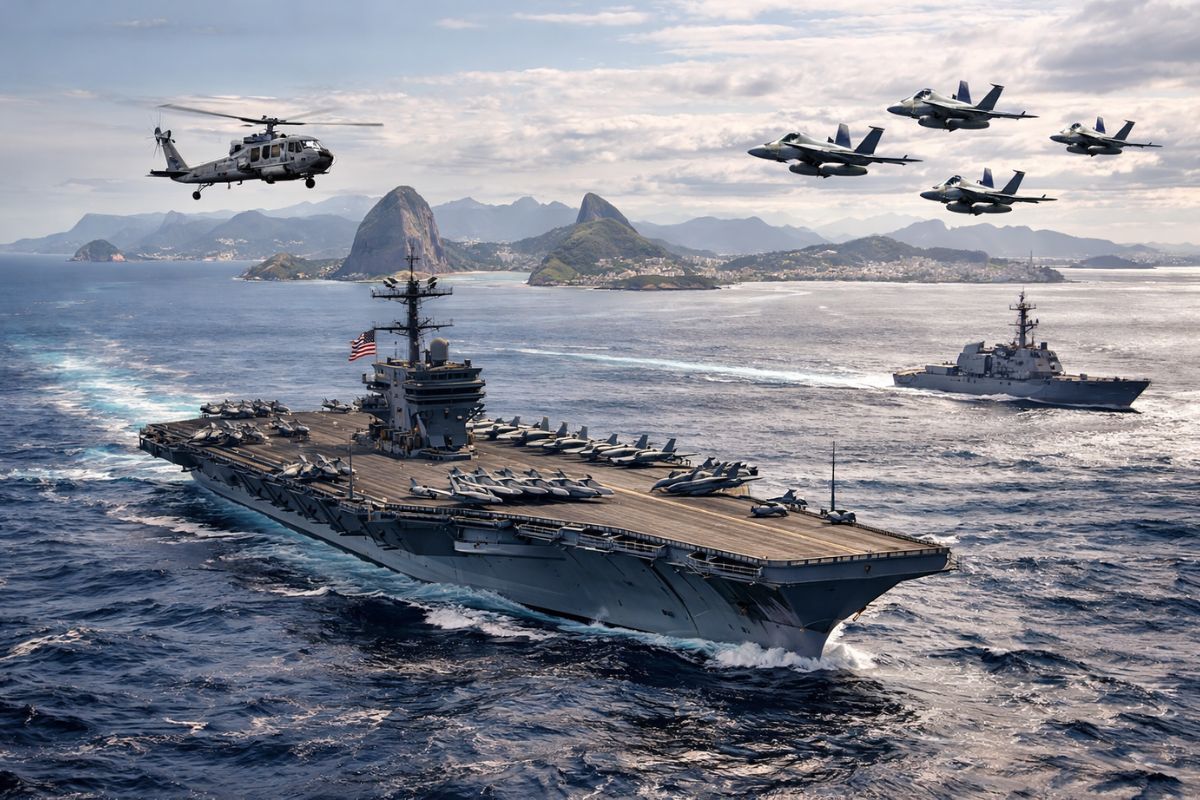
The aircraft carrier USS Nimitz, the oldest in active service in the world, will make a confirmed stop in Brazil as part of Operation Southern Seas 2026, accompanied by the destroyer USS Gridley and an air wing with Super Hornet fighters and Seahawk helicopters during the circumnavigation of the South American continent
The aircraft carrier USS Nimitz (CVN-68), the oldest nuclear ship in operation in the world, is on its way to Brazil. The vessel of the United States Navy will make a confirmed stop in the country as part of Operation Southern Seas 2026, conducted by the Naval Forces of the U.S. Southern Command and the 4th Fleet. The mission includes a complete circumnavigation of the South American continent with joint exercises involving naval forces from ten partner countries, including Argentina, Chile, Colombia, Peru, and Uruguay.
The aircraft carrier USS Nimitz is not coming alone. It is accompanied by the guided-missile destroyer USS Gridley (DDG-101), of the Arleigh Burke class, and carries the Carrier Air Wing 17, composed of Boeing F/A-18E/F Super Hornet fighters, EA-18G Growler electronic warfare jets, C-2A Greyhound cargo planes, and Sikorsky MH-60R/S Seahawk helicopters. In previous editions of Southern Seas, the aircraft carriers docked in Rio de Janeiro, but the specific schedule for the stop in Brazil in 2026 has not yet been disclosed.
What is Operation Southern Seas 2026 and why was the aircraft carrier USS Nimitz chosen

Southern Seas is an annual military operation conducted by the U.S. Southern Command since 2007. The 2026 edition marks the 11th time the mission takes place and aims to promote interoperability among the navies of the Americas, strengthen maritime partnerships, and address shared threats in the region.
-
The skeleton of D’Artagnan, the legendary musketeer who inspired Alexandre Dumas, may have been found beneath the floor of a church in the Netherlands after workers discovered human bones and a French coin during a renovation.

-
The problem has never been the steel, never been the engineering, and never been the safety: the grain silo house that heats itself is blocked by aesthetic laws, banks that don’t know how to evaluate it, and insurers that can’t price it.

-
For 20 years, this man from Ceuta has been collecting used oil from bars, mixing it with chemicals in a machine he built himself, and producing his own diesel at almost no cost while the world struggles with fuel prices.

-
Every butcher asks to have the knife sharpened as soon as they buy it, and this process that changes the geometry of the blade is the real reason why that white-handled knife cuts so well all day long without losing its edge.


The operation involves passage exercises, combined maritime operations, technical exchanges, and port visits in various countries.
The choice of the aircraft carrier USS Nimitz to lead the operation carries symbolic and operational weight. Launched in 1972, the Nimitz is the oldest nuclear aircraft carrier in active service in the world and has participated in conflicts such as Operation Desert Storm, the Iraq War, and the Afghanistan War.
Sending the most historic flagship of the U.S. Navy to circumnavigate South America is a demonstration of capability and commitment to naval presence in the Western Hemisphere.
What ships and aircraft accompany the aircraft carrier USS Nimitz

The strike group of the aircraft carrier USS Nimitz consists of the ship itself as the flagship, the staff of Carrier Strike Group 11, Destroyer Squadron 9, and the embarked air wing Carrier Air Wing 17 (CVW-17).
The USS Gridley destroyer, equipped with guided missiles, accompanies the aircraft carrier as an air defense and anti-submarine escort.
The CVW-17 embarked on the aircraft carrier USS Nimitz is composed of six squadrons. The Boeing F/A-18E/F Super Hornet fighters operate in air superiority and strike missions, while the EA-18G Growlers engage in electronic warfare.
The Sikorsky MH-60R/S Seahawk helicopters perform anti-submarine warfare, rescue, and logistical support functions. The C-2A Greyhound cargo planes ensure the transport of personnel, mail, and spare parts between the ship and shore bases. Among the squadrons are VFA-22, VFA-137, VAQ-139, HSM-73, HSC-6, and VRC-40.
What will the aircraft carrier USS Nimitz do in Brazil and which countries participate
The stop of the aircraft carrier USS Nimitz in Brazil is part of a route that includes visits to ports in Chile, Panama, and Jamaica. In total, ten countries are scheduled to conduct joint activities during the circumnavigation: Argentina, Brazil, Chile, Colombia, Ecuador, Peru, Mexico, El Salvador, Guatemala, and Uruguay.
The operation provides for passage exercises among the navies, combined maritime operations, and technical exchanges among crews.
In previous editions of Southern Seas, American aircraft carriers docked in Rio de Janeiro, but the detailed schedule for the stop of the USS Nimitz in Brazil in 2026 has not yet been disclosed by the authorities.
The operation will also allow invited authorities from partner countries to closely observe flight operations and combat routines aboard the ship, something rare and restricted to cooperation missions like this.
The history of the aircraft carrier USS Nimitz and why it is still in operation
The aircraft carrier USS Nimitz was launched in 1972 and became the first of a class that bears its name. The Nimitz class includes ten nuclear aircraft carriers, the largest warships ever built at the time of their conception.
Even with over five decades of service, the Nimitz remains operational thanks to regular maintenance cycles, system upgrades, and nuclear reactor refueling.
Throughout its career, the aircraft carrier USS Nimitz has participated in virtually all major military conflicts involving the United States in recent decades.
Operation Desert Storm in 1991, the Iraq Freedom starting in 2003, and the war in Afghanistan are among the ship’s most significant missions.
Southern Seas 2026 is expected to be one of the last major operations of the Nimitz before its anticipated retirement in the coming years, making the passage through Brazil a historically significant event.
What Operation Southern Seas means for the defense of the Western Hemisphere
According to Rear Admiral Carlos Sardiello, commander of the Naval Forces of the Southern Command, the operation reinforces international cooperation and demonstrates the American commitment to regional security. “Deployments like this demonstrate our unwavering commitment to ensuring a safe and stable Western Hemisphere”, he stated.
Southern Seas seeks to enhance integration among the naval forces of the continent and build mutual trust to address shared threats, from maritime trafficking to natural disasters.
Rear Admiral Cassidy Norman, commander of Carrier Strike Group 11, highlighted the continuity of the Nimitz’s legacy in joint operations.
For Brazil, the passage of the aircraft carrier USS Nimitz represents an opportunity to train with one of the most advanced naval forces in the world and to demonstrate operational capability in exercises that simulate real maritime defense scenarios.
The presence of a complete strike group in South American waters also serves as a geopolitical signal that the United States maintains active attention on the region.
One of the last great deployments of a legendary ship
The arrival of the aircraft carrier USS Nimitz in Brazil in 2026 is more than a stop in a military operation. It is the passage of a ship that has participated in wars, crossed all oceans, and now possibly undertakes one of its last great missions.
With Super Hornet fighters on deck, Seahawk helicopters in the air, and a guided missile destroyer in escort, the Nimitz strike group shows why the United States still projects naval power like no other country in the world.
The combination of combat fighters, anti-submarine helicopters, and escort ships is what transforms an aircraft carrier into a floating military base capable of operating in any ocean.
Would you like to see the aircraft carrier USS Nimitz docked in Brazil? Do you think operations like Southern Seas really strengthen the defense of the continent or are they just displays of power? Leave your comments and share this article with those who follow military and geopolitical issues.







Seja o primeiro a reagir!