





 English
  Francês
  Alemão
  Italiano
  Japonês
  Norueguês
  Portuguese
  Spanish
  3 min of reading
  0 comments


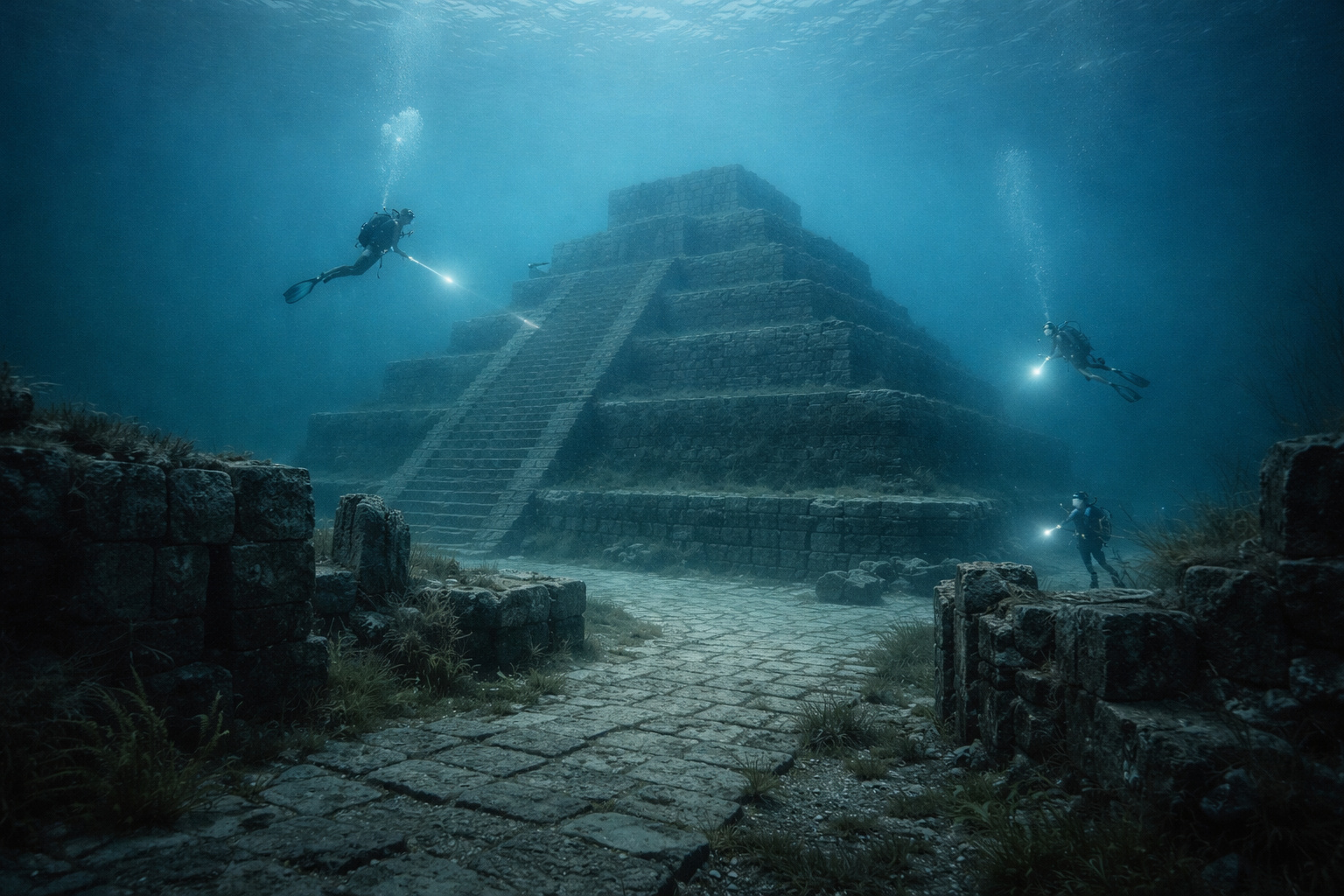
Discovery in Lake Fuxian reveals submerged metropolis with pyramids, paved streets, and monumental structures that challenge known chronologies about ancient Asian civilizations
Lake Fuxian, in Yunnan, China, gained attention after researchers identified a submerged metropolis with pyramids, paved streets, and monumental structures, a discovery that challenges chronologies about Asian civilizations and expands the debate on development.
Historical debate
The discovery in Lake Fuxian is compared to Atlantis due to the size of the site and the structures preserved under fresh water. The find suggests an advanced culture in a period earlier than indicated by official records.


The ruins in southwestern China are regarded as one of the greatest enigmas because they indicate the existence of a complex society, with advanced engineering skills. The identified area surpasses many contemporary cities of its time in size.
-
350-year mystery may have been solved: remains of a soldier who inspired the hero of The Three Musketeers found beneath a church in the Netherlands.

-
NASA photographed a nearly perfect square with 3 km sides on Mars, 13 times larger than the Great Pyramid of Giza, but the official explanation is natural erosion; still, no one has explained why the four sides have almost identical lengths.

-
Starlink breaks the barrier of 10,000 satellites in orbit and takes its expansion to an unprecedented level, with a direct impact on global internet, technological competition, and the race for space.

-
Japan finds an alternative to oil amid rising prices by transforming ocean balance into electricity with a new technology that maintains efficiency even when the sea changes.


The urban organization observed in the structures reveals rigorous planning and a well-defined social hierarchy among the original inhabitants.
This set enhances the historical weight of Lake Fuxian and reinforces the need for in-depth studies.
The preservation under water allowed for the maintenance of minute construction details over millennia. This offers scientists a rare window into the past and may rewrite entire chapters of human history.
Submerged pyramids
Among the most striking elements of the submerged complex are the stepped pyramids. They bear remarkable similarities to structures attributed to the Maya in Central America, in terms of shape, monumental scale, and identified geometric precision.
These constructions were built with solid stone blocks and demonstrate, according to the analysis presented, a deep knowledge of mathematics and astronomy by their builders. This level of precision is noted as rare for the indicated period.
The scale of the pyramids suggests a ceremonial or observatory function. This reinforces the idea of a culture that valued the observation of celestial bodies and the celebration of complex rituals around their central structures.
The analysis of the materials revealed that the stones were likely extracted and transported from distant locations. This data indicates sophisticated logistics and a coordinated workforce to ensure the stability of the constructions.
Underwater mapping
The identification of the structures on the bed of Lake Fuxian only occurred with the use of side-scan sonar and state-of-the-art robots. These tools allowed for the production of detailed three-dimensional maps of the entire explored area.
The digital models revealed the actual extent of the city and the layout of the main buildings, previously hidden by water turbidity and sediment accumulated over centuries. The mapping helped confirm the size of the submerged complex.
In addition to digital readings, specialized divers collected samples and took photographic records. This material confirmed the artificial nature of the stone blocks found in the depths of the lake.
Among the decisive resources for the mission were high-frequency sonars to penetrate sediments, remotely operated vehicles with high-definition cameras, and reconstruction software capable of transforming radar data into precise volumetric models.
Cause of the city’s sinking undefined
The cause of the city’s sudden sinking remains a topic of debate among experts. Some theorists argue that a major earthquake triggered landslides, while others advocate for drastic climate changes and flooding.
Despite the disagreement about the exact phenomenon, the impact of the event is described as devastating. The submersion would have sealed the fate of thousands of people and preserved their culture in an underwater time capsule.
Among the cataloged geological evidence are deep fissures crossing the bases of the main structures, signs of rapid water erosion, and uniform layers of organic sediments on the roofs of the buildings.
The success of the investigations in Lake Fuxian has opened the door for explorations in lakes and rivers. The integration of geology, biology, and study points to a more comprehensive methodology aimed at preserving remnants for future generations.
With information from Catracalivre.






Seja o primeiro a reagir!