





 Portuguese
  English
  Spanish
  5 min of reading
  0 comments


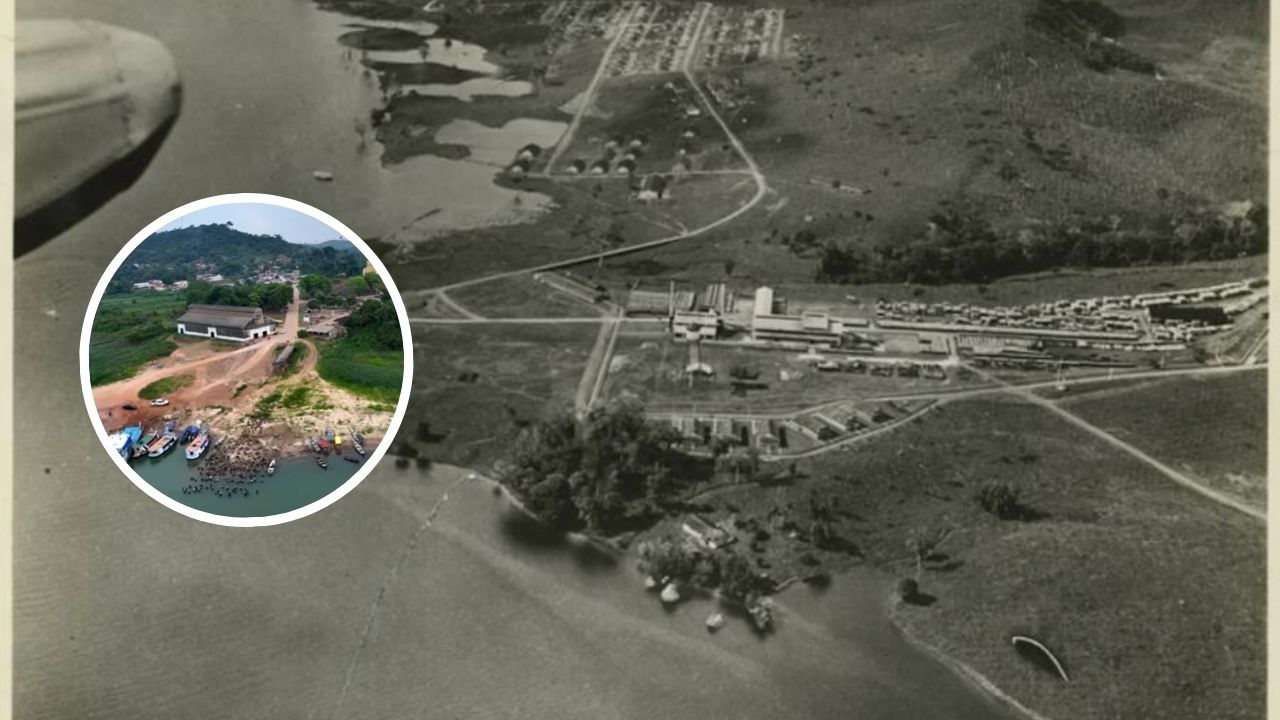
Discover The Story Of Fordlândia, The Utopian Brazilian City Created By Henry Ford That Collapsed Due To Cultural And Ecological Failures
In the heart of the Amazon, in Pará, lie the ruins of Fordlândia, a Brazilian city envisioned by Henry Ford in the 1920s. Designed to be a worker’s utopia and a self-sufficient source of rubber for his automotive industry, the colossal venture is today a “monument to arrogance“, as described by historians, a skeleton of concrete and metal being consumed by the rainforest.
The project did not fail for a single reason, but due to a triple collision: the imposition of American culture that sparked revolts, the ecological ignorance that led to devastating plagues, and finally, the invention of synthetic rubber. Today, the “ghost town” is, paradoxically, inhabited by thousands of Brazilians who live among the ruins of this failed industrial dream.
Ford’s Dream: A Rubber Empire In The Jungle
The genesis of Fordlândia lay in the economy. In the early 20th century, Henry Ford relied on a British-Dutch cartel that controlled Asian rubber, vital for the tires of his cars. For the industrialist, obsessed with vertical integration (controlling the entire production chain), this dependence was unacceptable. The solution, as historian Greg Grandin points out in his book Fordlândia: The Rise And Fall Of Henry Ford’s Forgotten City In The Jungle, was to create his own source of raw material in the cradle of rubber trees, Brazil.
-
Friends have been building a small “town” for 30 years to grow old together, with compact houses, a common area, nature surrounding it, and a collective life project designed for friendship, coexistence, and simplicity.

-
This small town in Germany created its own currency 24 years ago, today it circulates millions per year, is accepted in over 300 stores, and the German government allowed all of this to happen under one condition.

-
Curitiba is shrinking and is expected to lose 97,000 residents by 2050, while inland cities in Paraná such as Sarandi, Araucária, and Toledo are experiencing accelerated growth that is changing the entire state’s map.

-
Tourists were poisoned on Everest in a million-dollar fraud scheme involving helicopters that diverted over $19 million and shocked international authorities.


But the ambition went beyond money. Ford saw the project as a “civilizing mission“. He wanted to export his model of an idealized society, based on the efficiency, sobriety, and discipline of his factories in Detroit, to what he considered the “green hell”. As detailed by Grandin, Fordlândia was conceived to be a moral utopia, a piece of purified America transplanted into the jungle, proving that “Fordism” could tame nature and man.
Building A “Little America” On The Tapajós River


The logistical effort was monumental. The Ford Motor Company sent cargo ships up the Tapajós River with a pre-fabricated town: houses, generators, hospital equipment, and even grass for the golf course. The isolated site quickly transformed into an American enclave with paved streets, 24-hour electricity, and modern sanitation, an infrastructure unimaginable for the region at the time.
The architecture was a tool of control. The city had a state-of-the-art hospital and schools, but also a strict segregation: standardized bungalows for Brazilian workers and comfortable homes in the “American Village” for managers. As noted by various historical articles and reports, the project imposed controlled leisure (cinema, golf) and strictly prohibited alcohol, in an attempt to shape the local worker in the image of the Fordist ideal.
The Collision: The Human Revolt And The Revenge Of The Forest
The cultural shock was immediate. Brazilian workers, accustomed to seasonal work rhythms, resented the rigid discipline, punch cards, and constant supervision. The breaking point, according to Greg Grandin, was the imposition of diet: hamburgers and oatmeal instead of fish and flour. In 1930, dissatisfaction exploded into the Break-Pans Revolt, a violent riot where workers destroyed dining halls, time clocks, and expelled managers into the jungle, violently rejecting the imposed social model.
Meanwhile, the deeper failure was agricultural. Ford managers, ignoring tropical agronomy, applied the logic of monoculture, planting millions of rubber trees in dense rows, like corn in Iowa. In the Amazon, this was a disaster. As detailed in Fordlândia: The Rise And Fall, this practice created the perfect environment for the fungus Leaf Blight (Microcyclus ulei), which grows uncontrollably in dense plantations. The plague decimated the trees, sealing the agricultural fate of the project.
There was a second attempt in Belterra, 300 km away, using grafting techniques to combat the plague. Although it achieved modest success, as shown by Ford’s archives, the venture continued to be unprofitable and proved too late to save Ford’s dream.
The Final Blow And The Legacy Of A Failed Utopia
As the project was already failing internally, the Second World War changed the game. With Japan dominating Asian rubber, the USA quickly developed s synthetic rubber. By the end of the war, synthetic material was cheap and abundant, rendering the strategic justification for Fordlândia obsolete. In 1945, Henry Ford II sold the entire concession back to the Brazilian government for a symbolic amount, ending a loss of over $20 million (hundreds of millions today).
Fordlândia is often referred to as a “ghost town”, but as reports highlight (such as those from the magazine Superinteressante), it was never deserted. Today, this Brazilian city is a district of the municipality of Aveiro with about 2,000 inhabitants. These residents occupy the decaying American-style houses, adapting the ruins of a failed utopia into a resilient home, living off agriculture and an emerging historical tourism.
The Lessons Of Fordlândia Resonate Today
The ruins of Fordlândia are much more than a historical curiosity. They represent a timeless lesson about industrial arrogance, cultural imperialism, and the irreducible complexity of the Amazon. The collapse of the project demonstrated that nature and culture cannot be reconfigured like an assembly line.
This legacy is not confined to the past. As pointed out in the documentary Beyond Fordlândia, the extractive and monoculture logic that failed in Ford’s project resonates directly with today’s challenges in agribusiness and mining in the region. History, it seems, continues to repeat itself.
What shocked you the most about the story of Fordlândia: the cultural arrogance or the ecological disaster? Do you think modern projects in the Amazon have learned from these mistakes? Share your thoughts in the comments.









-

Uma pessoa reagiu a isso.