





 Portuguese
  English
  Spanish
  4 min of reading
  0 comments


Brics Surpassed G7 in Global Economic Representativeness. Dilma Rousseff Highlights the Block’s Potential to Occupy 40% of GDP by 2028
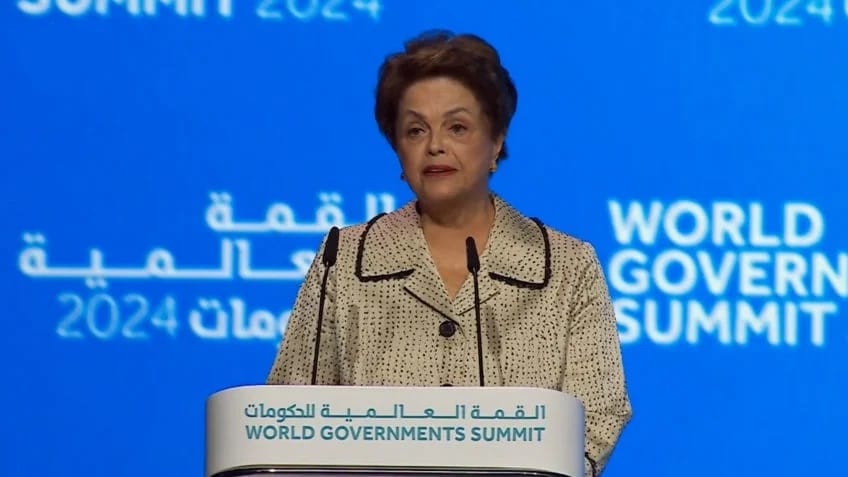
The economic world is undergoing significant changes, and the Brics is at the center of this transformation. According to former president Dilma Rousseff, the combined Gross Domestic Product (GDP) of the Brics countries has already surpassed that of the G7, the group composed of Germany, Canada, the United States, France, Italy, Japan, and the United Kingdom, as well as the European Union. This statement was made during the World Government Summit in Dubai, where Dilma highlighted the accelerated growth of the block.
Dilma took office as president of the New Development Bank (NDB) in March 2023 and has since been a strong voice in defense of the Brics. She explained that the calculation used takes into account Purchasing Power Parity (PPP), a measure that equalizes the purchasing power of different currencies. This approach is more comprehensive than simply converting GDP values to dollars at the market rate.
The Potential of Brics and Global Representativeness
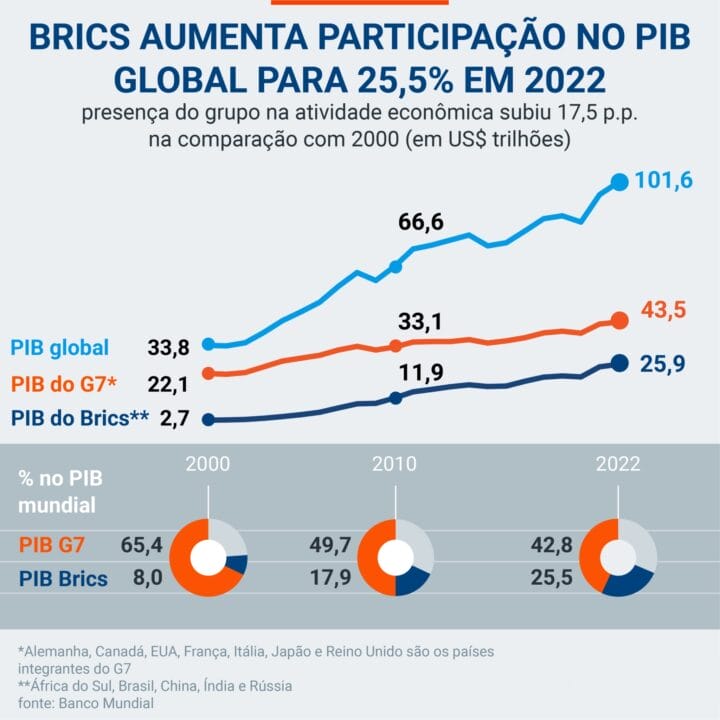
The Brics is formed by Brazil, Russia, India, China, and South Africa, and together these countries represent 31.5% of the global GDP. Dilma highlighted that the block has the potential to increase this representativeness to 40% by 2028, according to projections from the International Monetary Fund (IMF). This growth contrasts with the projected decline in the G7’s share, which is expected to drop to 27.8% in the same period.
-
The government requests the Federal Revenue Service for a new system to automate the income tax declaration, reducing errors, time, and bureaucracy for millions of Brazilians.

-
Pix in installments, international Pix, and contactless payment without internet: the Central Bank revealed the new features coming to the tool that is already used by almost every adult in Brazil.
-
Mercado Livre has just started selling medications with delivery in up to three hours to your door, and this move could completely change the way Brazilians buy medicines on a daily basis.

-
In Dubai, rising tensions from the war in the Middle East are causing super-rich individuals to leave the Gulf and direct their fortunes to a new financial refuge in Asia.

The former president emphasized that the economic power of the Brics countries has been growing rapidly, primarily driven by China and India. These two Asian giants together account for 21% of the global GDP and have played a fundamental role in the growth of the block. Since 2010, China’s GDP has nearly tripled in current values, rising from US$ 6.1 trillion to US$ 18 trillion. Meanwhile, India has doubled its economic activity, increasing from US$ 1.7 trillion to US$ 3.4 trillion in the same period.
The Rise of Brics and Its Impact on the Global Economy
The rise of Brics as a significant economic block has been one of the main narratives of the global economy in recent decades. Established in 2009, Brics quickly positioned itself as a counterpoint to the G7, representing a group of emerging countries with considerable economic potential. The term “Brics” was coined by Goldman Sachs’ chief economist, Jim O’Neill, in 2001, initially referring only to Brazil, Russia, India, and China. The addition of South Africa in 2010 further strengthened the block, which has since sought to increase its global influence.
The Role of the New Development Bank (NDB) and Challenges Ahead
As president of the NDB, Dilma has led efforts to promote sustainable development in the Brics member countries and other emerging economies. The NDB was created in 2014 to finance infrastructure and sustainable development projects in Brics countries and other emerging economies. The bank has an authorized capital of US$ 100 billion and aims to promote sustainable development and reduce poverty through infrastructure projects and sustainable development initiatives.
The rise of Brics represents not only a shift in the global economy but also a challenge to the established international economic order. The countries in the block are becoming increasingly assertive in their quest for greater representativeness in international financial institutions and for reform of the global financial system. This new trend, as Dilma highlighted, is a response to the challenges faced by developing countries, including the unjust international financial order and the significant debt levels of these nations.
Expansion of Brics and New Challenges
Brics has sought to expand its global influence, and in August 2023, announced the admission of six new countries: Argentina, Saudi Arabia, Egypt, United Arab Emirates, Ethiopia, and Iran. This expansion demonstrates the recognition of the increasingly relevant role of the block in the world economy. However, not all the countries announced as new members have confirmed their participation, as was the case with Argentina, which under the government of President Javier Milei withdrew and decided not to join Brics.
The Role of Purchasing Power Parity (PPP) in Economic Analysis
Purchasing Power Parity (PPP) plays a crucial role in analyzing GDP and the global economy. By considering PPP, economists can gain a more accurate view of the true purchasing power of countries, taking into account not only exchange rates but also the relative costs of goods and services in different countries. This is especially important when comparing economies with different levels of development and living standards.
Future Prospects and Challenges for Brics
Brics faces significant challenges as it seeks to consolidate its position as a global economic block. One of the main challenges is ensuring that economic growth is sustainable and inclusive, benefiting not only the elites but also the most vulnerable layers of society. Additionally, the block needs to address issues such as climate change, food security, and global financial stability.
Brics as an Emerging Global Actor
Brics has emerged as a prominent global actor in the world economic landscape. With a combined GDP that already surpasses that of the G7 and an even greater potential for growth, the block represents a new economic world order in formation. Under Dilma Rousseff’s leadership at the NDB, Brics has sought to promote sustainable development and reduce global inequality. Despite the challenges it faces, Brics remains a significant economic force and an example of cooperation among emerging countries.









Seja o primeiro a reagir!