





 Portuguese
  English
  Spanish
  5 min of reading
  0 comments


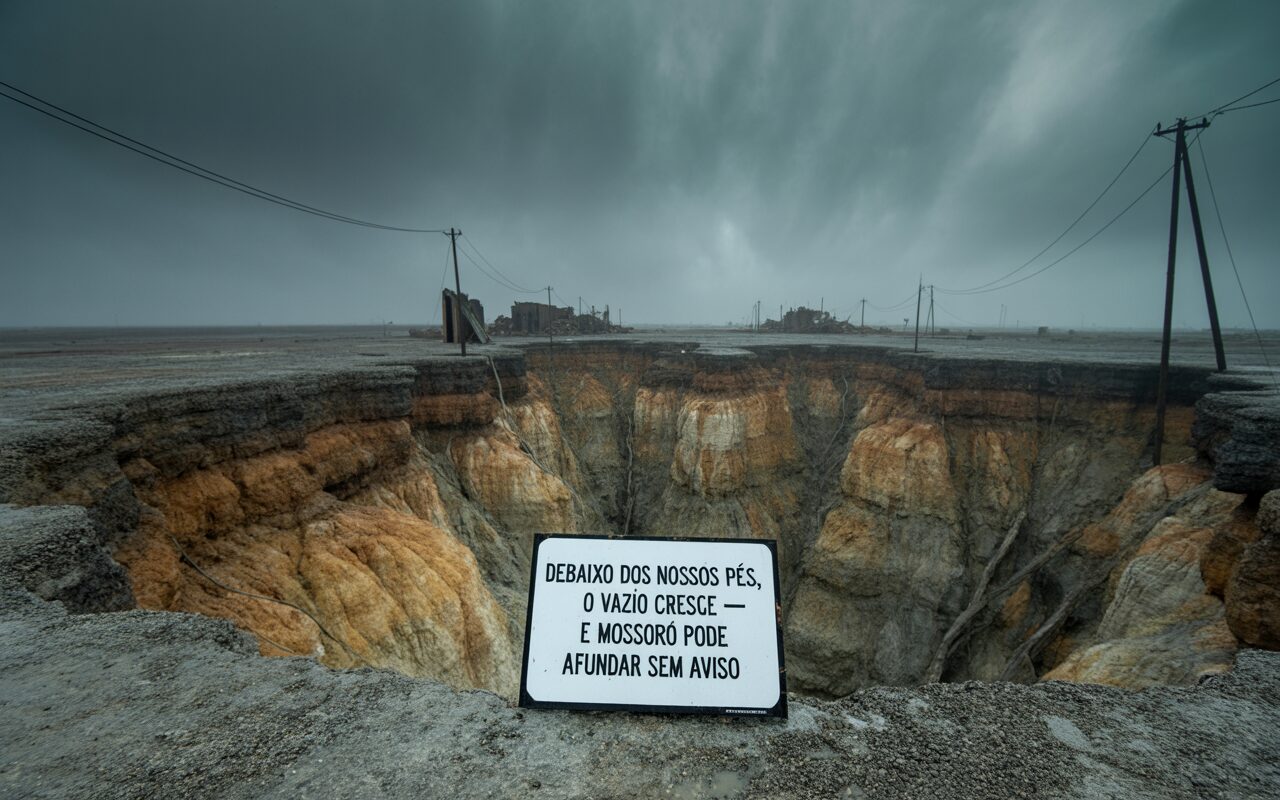
In Mossoró (RN), The Exploration Of Rock Salt Forms Underground Caverns That Could Cause A Collapse Similar To Maceió. Experts Are Already Pointing To An Imminent Geological Risk In The Region.
In the silence of the Potiguar sertão, an underground threat worries geologists and environmentalists. Mossoró, a city with over 300 thousand inhabitants in Rio Grande do Norte, may face a large-scale urban collapse in the coming years. The reason? The presence of underground cavities formed by the exploration of rock salt, the same type of activity that caused the sinking of five entire neighborhoods in Maceió (AL).
Although evacuations are not currently underway, research indicates real geological risks associated with decades of intense mining, especially in urban areas where the presence of salt underground is dominant.
Rock Salt: What Is It And Why Is It Dangerous
Rock salt is the name given to mineralized sodium chloride (NaCl) found in large layers underground. It is widely used in the chemical and petrochemical industries, especially in the production of caustic soda, PVC, detergents, soaps, and chlorine.
-
Friends have been building a small “town” for 30 years to grow old together, with compact houses, a common area, nature surrounding it, and a collective life project designed for friendship, coexistence, and simplicity.

-
This small town in Germany created its own currency 24 years ago, today it circulates millions per year, is accepted in over 300 stores, and the German government allowed all of this to happen under one condition.

-
Curitiba is shrinking and is expected to lose 97,000 residents by 2050, while inland cities in Paraná such as Sarandi, Araucária, and Toledo are experiencing accelerated growth that is changing the entire state’s map.

-
Tourists were poisoned on Everest in a million-dollar fraud scheme involving helicopters that diverted over $19 million and shocked international authorities.

To extract it, companies inject water underground to dissolve the salt and then pump this brine solution to the surface — a process known as solution mining. The problem is that, over time, these cavities can cave in, causing ground subsidence and collapses.
Mossoró And Salt: A Deep Story
Mossoró is historically the largest salt production center in Brazil. The city concentrates both the production of sea salt (extracted by evaporation) and the underground extraction of rock salt. According to data from ANM (National Mining Agency), more than 40% of the rock salt extracted in the country comes from the Potiguar Basin, where Mossoró is located.
And it is precisely beneath the city and its surroundings that there is a vast geological formation of salt, with thicknesses reaching up to 200 meters deep.
What Studies Say About The Risk Of Subsidence
The Geomechanics Laboratory of UFRN (Federal University of Rio Grande do Norte) has been studying the topic for years. In 2023, a technical article published in the journal Geosciences indicated that some areas near the peripheral neighborhoods of Mossoró show ground subsidence — that is, gradual sinking.
According to Professor Francisco Torres, a geologist at UFRN:
“There are geomorphological patterns and altimetric variations that indicate lowering in areas of old mining. This needs to be monitored in real time, to avoid tragedies like the one in Maceió.”
Maceió As An Example Of What Could Happen
In Maceió, the extraction of rock salt by Braskem resulted in an unprecedented urban collapse. Entire neighborhoods such as Pinheiro, Mutange, and Bebedouro were evacuated after studies indicated an imminent risk of collapse.
About 60 thousand people were removed, and the indemnification costs exceeded R$ 13 billion. The case has become a global alert model regarding urban mining.
In Mossoró, the technical process is similar. The difference is that, for now, the signals are being detected early — which makes preventive action still possible.
Risk Areas: Where Is The Danger In Mossoró?
According to the Master Plan of Mossoró, areas in the south and west zones of the city overlap with former mining fronts of rock salt. Neighborhoods such as:
- Belo Horizonte
- Alto do Sumaré
- Santa Delmira
- Vingt Rosado
…are on the researchers’ radar.
In addition, there are records of abandoned wells without proper sealing, which exacerbates the vulnerability of the underground.
“It’s like an underground sponge that can collapse if there is an increase in pressure on the ground,” summarizes geotechnical engineer Mateus Lima, a consultant for Civil Defense.
Although ANM requires periodic reports from exploring companies, field inspections are scarce. According to a report from TCU (Federal Court of Accounts), less than 30% of the areas of rock salt mining in the country have been inspected in the last 10 years.
In Mossoró, the last official geotechnical inspection occurred in 2017. Since then, extraction activities have continued, and no public network of sensors has been installed for continuous monitoring.
The Role Of Mining Companies
The main companies operating in the region — such as Salina Diamante Branco and Salinas do Nordeste — claim to operate within safety technical limits, with structural reinforcement of the cavities.
However, real data on depth, volume extracted, and stabilization of underground chambers are not publicly accessible, hindering independent monitoring by universities or environmental agencies.
“Transparency is almost nonexistent. Without data, there is no prevention,” criticizes researcher Isabel Nogueira from the NGO Sal Vive.
What Does The City Hall Say About The Risk?
In an official statement sent to the G1 RN portal, the City Hall of Mossoró declared:
“There are no signs of imminent collapse, but the topic will be addressed in the upcoming municipal environmental management plan. Studies will be commissioned for detailed evaluation.”
Meanwhile, residents of affected neighborhoods complain about the lack of communication and a evacuation plan, even if preventive.
Experts point out that to prevent Mossoró from becoming a new Maceió, it is necessary to:
- Establish a real-time subsidence sensor network;
- Make public the complete mapping of salt caverns beneath the city;
- Stop active mining in densely populated urban areas;
- Create an emergency plan with evacuation routes and drills;
- Indemnify families living over proven risk areas.
The cost is high, but much lower than that of a foretold tragedy, as evidenced by the Alagoas case.
The Population Fears But Does Not Know
One of the main difficulties faced by researchers is the lack of information among the local population. In neighborhoods like Santa Delmira and Sumaré, many residents do not know they live over rock salt.
“No one told us this. If it weren’t for these reports, I would never imagine that the ground of my house could give way,” said housekeeper Luciana Moura, who has lived there for 12 years.
Mossoró thrived thanks to salt. It generated jobs, attracted industries, and established the city as a mineral powerhouse of the Northeast. But now, what was once wealth may turn into a liability.
Hidden caverns, deactivated galleries, and abandoned old wells form an explosive scenario beneath the feet of thousands of people.
The question that remains is: will the government act before it is too late?
The risk of subsidence in Mossoró is not science fiction. It is documented in technical studies, confirmed by similar experiences, and visible in small cracks, unevenness, and subsidence.
The city has the opportunity to act in advance, preventing deaths, billion-dollar losses, and the forced displacement of thousands of people.
But this will only be possible if the salt caverns cease to be a secret — and become a public priority.








Seja o primeiro a reagir!