





 Portuguese
  English
  Spanish
  5 min of reading
  0 comments


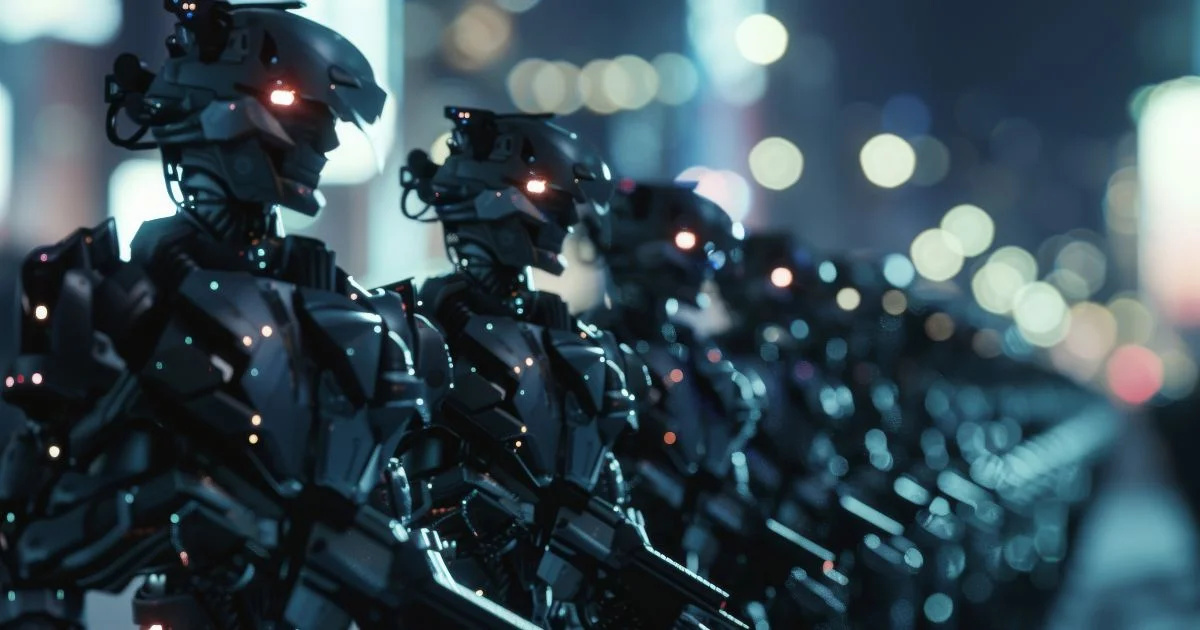
Military robotics project advances in the United States with tests, contracts, and expansion plans, while the use of humanoids in defense operations increases attention to technology, strategy, and limits of automation in risk scenarios.
Foundation Future Industries, a robotics company based in San Francisco, seeks to establish itself as a military supplier for the United States with the Phantom, a humanoid robot that the company presents as capable of operating in industrial and defense scenarios.
The company reports having research contracts totaling $24 million with the Army, Navy, and Air Force, in addition to mentioning an agreement under the SBIR Phase 3 model, a stage used in the transition of publicly funded technologies to the acquisition and commercialization phase.
According to the company, the proposal is to position the robot as a tool to take on missions considered dangerous, repetitive, or high-risk for human troops.
-
The waste that can double a household’s water bill is not in the faucet or the shower; it happens hidden within the walls and can go unnoticed for months, according to sanitation experts.

-
Darkness can surpass light in an optical phenomenon confirmed by scientists, which expands the understanding of relativity and reveals new behaviors of waves in the universe.

-
A Brazilian scientist created a pen that touches human tissue and identifies cancer cells in seconds using a drop of water and artificial intelligence, and Lívia Eberlin’s invention has already been used in over 400 surgeries in the United States and Brazil.

-
An inventor in China creates flying drones shaped like swords that respond to hand gestures in real time, with technology based on motion sensors transforming interaction into a scene worthy of a movie and redefining the control of machines in the air.

In this group, Foundation includes surveillance, logistical support, reconnaissance, operations in contaminated areas, and operations in hostile environments.
The company states that the goal is not to launch a fully autonomous combatant, but a system operated with human supervision, via telepresence, and with the support of artificial intelligence.
Humanoid robot Phantom and defense applications
In Foundation’s institutional material, the Phantom appears as the company’s first production humanoid.
The robot stands 1.80 meters tall, weighs about 80 kilograms, and is designed to navigate spaces intended for people, which includes factories, warehouses, and other environments already structured for human presence.
The manufacturer also claims that the system was designed to combine strength and fluidity of movement.
The project’s architecture brings together language models and systems aimed at executing tasks in the physical world.
In practice, the company seeks to connect natural language commands to the robot’s mechanical actions, associating environmental perception, software-assisted decision-making, and bodily movement.

Another point highlighted by the company is the use of proprietary cycloidal actuators, regarded by Foundation as a central piece to ensure precision, torque, and continuous operation in demanding contexts.
Although the company promotes the Phantom as a system applicable to different sectors, the defense area stands out in its public communication.
In its institutional plan, Foundation states that it considers the military segment a relevant front for the technological expansion it intends to develop in the coming years.
The text also mentions the international competition for robotic systems aimed at defense.
Military tests, Ukraine, and use in reconnaissance
One of the most cited episodes in this strategy appeared in a report by Time magazine published in March 2026.
According to the publication, two Phantom robots were sent to Ukraine in February, initially to support reconnaissance missions near the front line.
This information brought the project into a real conflict context, albeit initially in an operational support capacity.
According to the same report, Foundation is preparing to begin tests related to the “methods of entry” course of the U.S. Marine Corps.
The proposal, according to Time, is to train the robots to position explosives on doors during invasion actions, with the justification of reducing the direct exposure of military personnel in this type of operation.
This movement reinforces the message that the company is trying to consolidate with the defense sector: that humanoids can operate alongside combatants in complex and high-risk locations.
At the same time, the presence of the Phantom in a war theater and in military training has broadened the debate about the limits of using robotic systems in such operations.
Foundation, military sector, and expansion strategy
Foundation argues that humanoid robots can reduce casualties by taking on roles that currently fall on soldiers.
In an interview with Time, CEO Sankaet Pathak stated that a arms race of humanoid soldiers “is already happening”.
The statement summarizes the company’s view on the advancement of this market.
In its institutional material, the company also states that it intends to collaborate with the U.S. Department of Defense to ensure the technological superiority of allies.
This formulation appears explicitly in Foundation’s public communication and helps define the company’s positioning in the sector.
This plan is also linked to the company’s industrial strategy.
In its official communication, Foundation states that it intends to rapidly increase the production of humanoids, aiming to reach tens of thousands of units by 2027.
In parallel, the company presents broader plans that include autonomous vehicles for ground and air transport, continuous operation energy sources, and materials aimed at extreme environments.
Debate on artificial intelligence and robots in war
The entry of humanoids into military operations has been accompanied by discussions that go beyond engineering.
Among the most cited points in this debate are the responsibility in case of failures, abuses, or erroneous decisions in the field.
Even when there is remote human control, the use of systems supported by artificial intelligence in chaotic environments raises doubts about traceability, command, and accountability.
There are also questions about operational risks.
Connected platforms depend on communication, software, sensors, and digital infrastructure, which opens the door to electronic interference, sabotage, and cyberattacks.
In war scenarios, this type of vulnerability can compromise the mission and affect those operating the system or acting alongside it.

Another recurring point involves the political and ethical effects of using these tools.
Researchers, organizations, and critics of the military use of artificial intelligence discuss whether the expansion of robotic systems on the battlefield can lower barriers to the use of force.
This debate also includes the degree of autonomy of these devices and the role they may assume in armed actions.
Meanwhile, the Pentagon and companies in the sector are monitoring the advancement of this market.
The case of Foundation shows that the competition for military contracts has already reached the new generation of humanoid robots and that the boundary between industrial automation and military application is being observed more closely by governments, companies, and industry analysts.
How this type of technology will be incorporated into military operations in the coming years remains an open question.






Seja o primeiro a reagir!