





 English
  Francês
  Alemão
  Italiano
  Japonês
  Norueguês
  Portuguese
  Spanish
  5 min of reading
  0 comments


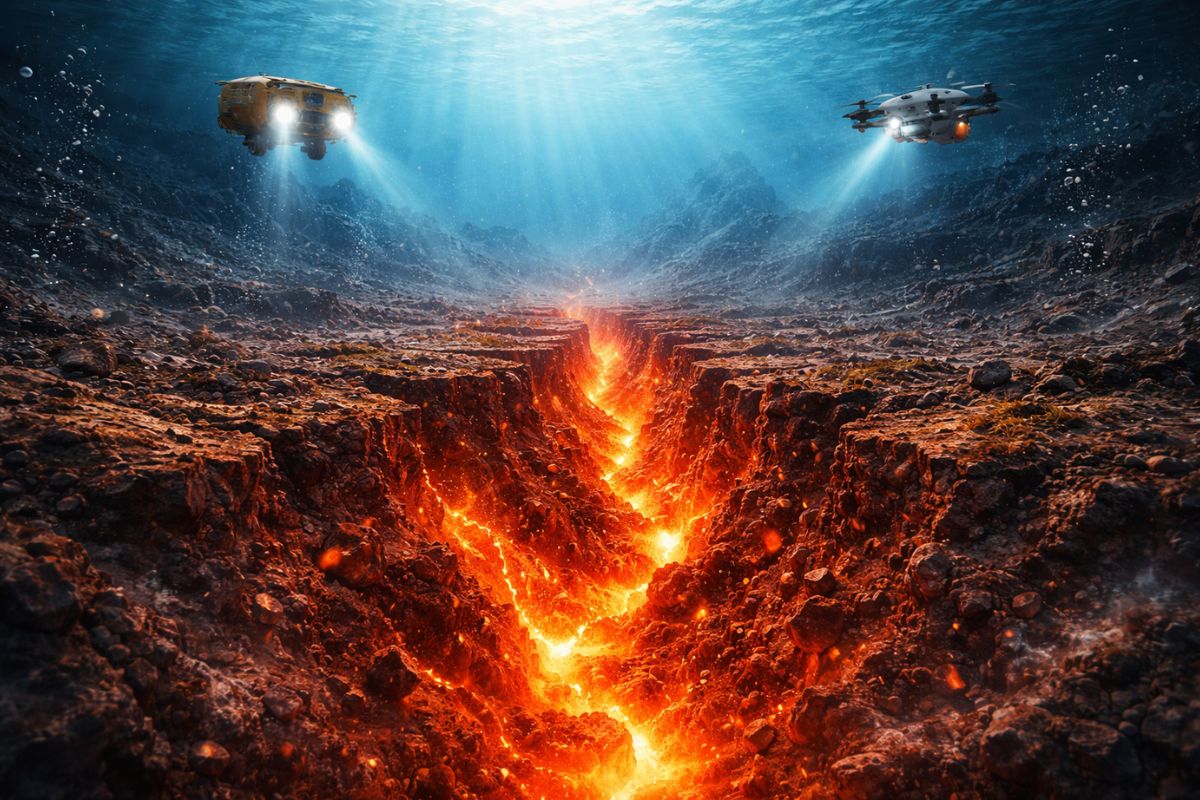
Study published in Science Advances reveals that the Earth’s crust is fragmenting at the bottom of the Pacific, in the Cascadia region. The Nootka fault marks where tectonic plates break into segments, potentially deactivating the subduction zone over millions of years.
Scientists have identified that the Earth’s crust is slowly tearing at the bottom of the Pacific Ocean, near the coast of Canada, in a rare phenomenon that could reconfigure the boundaries between tectonic plates in the region. The study, published in the journal Science Advances, shows that a tectonic plate is undergoing a progressive fragmentation process in a subduction zone in the Cascadia region, with separations occurring over millions of years.
The tear in the Earth’s crust does not happen suddenly. In practice, it is a gradual break of the plate that is being pushed into the Earth. As the plate breaks, parts of it begin to behave independently, forming smaller blocks called microplates. This process may explain how some subduction zones cease to exist over geological time.
What is happening to the Earth’s crust at the bottom of the Pacific

The Earth’s crust in the Cascadia region, in the northeast Pacific Ocean, is undergoing a process that scientists describe as a progressive tear. Unlike an earthquake or a sudden rupture, this phenomenon occurs on a scale of millions of years.
-
350-year mystery may have been solved: remains of a soldier who inspired the hero of The Three Musketeers found beneath a church in the Netherlands.

-
NASA photographed a nearly perfect square with 3 km sides on Mars, 13 times larger than the Great Pyramid of Giza, but the official explanation is natural erosion; still, no one has explained why the four sides have almost identical lengths.

-
Starlink breaks the barrier of 10,000 satellites in orbit and takes its expansion to an unprecedented level, with a direct impact on global internet, technological competition, and the race for space.

-
Japan finds an alternative to oil amid rising prices by transforming ocean balance into electricity with a new technology that maintains efficiency even when the sea changes.

The tectonic plate that dives beneath the North American continent is fragmenting into segments, with different stages of breakage throughout the region.
Researchers used high-resolution seismic data to map the interior of the plate at depth. The results revealed that the tear in the Earth’s crust does not occur uniformly, but in blocks, forming microplates that begin to move independently of one another.
This behavior suggests that the Cascadia subduction zone may be in a process of gradual weakening.
The Nootka fault and the tear in the Earth’s crust
At the center of this phenomenon is the so-called Nootka fault, a submarine fracture zone that marks the boundary between different tectonic plates in the region. This structure acts as a kind of weakness line in the Earth’s crust, facilitating the break of the plate that is being submerged beneath the continent.
The Nootka fault was already known to geologists, but the study published in Science Advances provides unprecedented details on how it interacts with the process of tearing the Earth’s crust.
Seismic data show that the fracture deepens in a segmented manner, creating increasingly defined separations between the blocks of the plate. This indicates that the fault is not just a static boundary, but an active structure that is contributing to the progressive fragmentation of the ocean floor.
What is a subduction zone and why can it be deactivated
Subduction zones are regions where one tectonic plate dives beneath another, being pushed into the Earth. The Cascadia subduction zone is one of the most well-known on the planet, responsible for historic earthquakes of great magnitude and constantly monitored by scientists. It is in this region that the oceanic plate dives beneath the North American plate.
What the research reveals is that the tear in the Earth’s crust may be weakening this subduction zone. With the fragmentation of the plate into smaller microplates, the diving process loses cohesion and may, over geological time, cease to function in that section.
In practice, this would mean a reconfiguration of the boundaries between tectonic plates in the region, a rare event in the geological history of the planet, but one that scientists can now observe in progress.
What does this discovery mean for seismic activity in the region
The Cascadia region is monitored with special attention due to the risk of large magnitude earthquakes. The local subduction zone has already produced the so-called Cascadia megathrust earthquake in 1700, estimated at magnitude 9, and scientists assess that a new event of this magnitude is possible in the future. The discovery that the Earth’s crust is fragmenting in the region adds a layer of complexity to these projections.
Researchers emphasize that the tearing process is extremely slow and does not represent an immediate change on the surface or a sudden increase in seismic risk.
Still, understanding how the Earth’s crust evolves in these regions is crucial for refining seismic prediction models and understanding the long-term dynamics of the planet. The discovery helps explain why some subduction zones lose activity over millions of years.
How scientists mapped the tear at the bottom of the ocean
The research used high-resolution seismic tomography to create detailed images of the interior of the Earth’s crust and the deeper layers of the tectonic plate. This technique works similarly to a medical tomography, but on a geological scale: seismic waves generated by natural earthquakes are captured by sensor networks and converted into three-dimensional images of the underground.
The data allowed scientists to accurately identify where the plate is intact and where fragmentation has already occurred.
The analysis revealed that the tear in the Earth’s crust follows a segmented pattern, with blocks at different stages of separation, reinforcing the hypothesis that the Cascadia subduction zone is undergoing transformation. The study was conducted with international collaboration and published in the journal Science Advances.
The discovery that the Earth’s crust is tearing at the bottom of the Pacific, near Canada, reveals a rare phenomenon that could deactivate the Cascadia subduction zone over millions of years.
The progressive fragmentation mapped with high-resolution seismic data shows that the boundaries between tectonic plates are not permanent and can be reconfigured on geological time scales.
With information from the portal R7.
What do you think about this discovery? Does the idea that the Earth’s crust can slowly reconfigure change your perception of the planet? Leave your opinion in the comments and share with those interested in geology and science.







Seja o primeiro a reagir!