





 Portuguese
  English
  Spanish
  4 min of reading
  0 comments


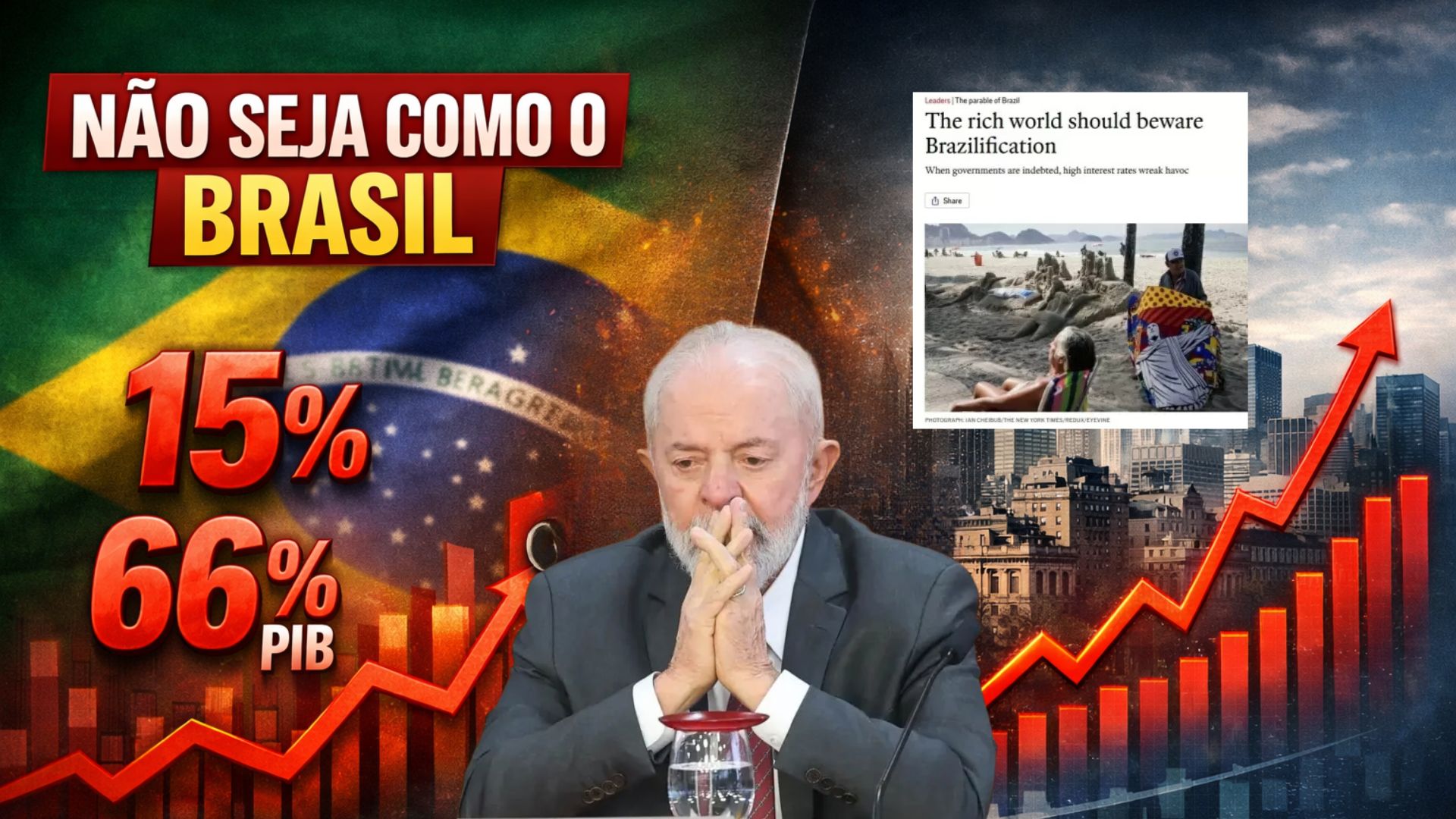
The Term “Brazilification” Gains Highlight in The Economist Editorial by Relating High Interest Rates, Spending Rigidity, and Pressure on Debt, in a Warning About Fiscal and Inflationary Risks That Could Affect Advanced Economies in the Post-Pandemic Context, with Aging Population and Institutions Under Strain.
The British magazine The Economist published, on Thursday (12), an editorial that uses Brazil as an example of fiscal and monetary risk for advanced economies, highlighting signs of a possible “Brazilification” in rich countries.
The warning stems from a specific diagnosis: even with what is considered reasonable growth and institutions that, in theory, would support predictability, the country grapples with high interest rates and a spending structure that is difficult to adjust.
Brazil on The Economist’s Radar and the Debate on Economic Stability
In the text, the publication acknowledges indicators that, in other contexts, would be seen as favorable, such as the existence of a Central Bank with formal independence and a primary result described as nearly balanced when excluding interest expenses.
-
The government requests the Federal Revenue Service for a new system to automate the income tax declaration, reducing errors, time, and bureaucracy for millions of Brazilians.

-
Pix in installments, international Pix, and contactless payment without internet: the Central Bank revealed the new features coming to the tool that is already used by almost every adult in Brazil.

-
Mercado Livre has just started selling medications with delivery in up to three hours to your door, and this move could completely change the way Brazilians buy medicines on a daily basis.

-
In Dubai, rising tensions from the war in the Middle East are causing super-rich individuals to leave the Gulf and direct their fortunes to a new financial refuge in Asia.


Nevertheless, the editorial maintains that the burden of debt servicing alters the perception of stability, as the magazine itself points to net debt at 66% of GDP, a level considered high for emerging economies, even though lower than what is observed in rich countries.
Selic Rate at 15% and the Cost of Public Debt Servicing
The main concern cited is the basic interest rate at 15% per year, maintained by the Monetary Policy Committee in January, at a level described as close to two-decade highs, according to a Reuters report on the inflationary scenario and monetary policy.
Given this interest rate level, the editorial states that, “as a result”, and despite the proximity to primary balance, the government “will likely have to borrow an amount equivalent to 8% of GDP per year just to pay interest”, which would increase pressure on indebtedness.
Meanwhile, data released by IBGE indicated accumulated inflation of 4.44% in 12 months up to January, within the targeting band of 3% with tolerance, while the Central Bank maintained a cautious tone and signaled, in the minutes, the possibility of starting cuts in March.
Even with the prospect of relief ahead, the magazine argues that the debt “will skyrocket” if interest rates do not fall significantly, and considers it unlikely that containment will come through austerity, mentioning that President Luiz Inácio Lula da Silva “loosened the spending policy”.
Institutional Pressure and the History of Hyperinflation in Interest Rate Formation
The text attributes the high rate to factors that go beyond economic models, citing institutional fragility as a component, referencing institutions that “wavered” during the attempted coup associated with former President Jair Bolsonaro, along with a history that would make inflation more “volatile”.
The publication also mentions the legacy of hyperinflation in the 1980s and early 1990s, combined with subsequent economic crises, as elements that raise the premium demanded by the market, in a context where expectations can become unanchored more easily.
Social Security, Budget Rigidity, and Impact on Public Spending
Among domestic factors, the editorial focuses on pension spending and states that the Brazilian government disburses 10% of GDP on retirements, with the assessment that, without reforms, the country may spend more on pensions than wealthier, aging nations by 2050.
The Economist links this rigidity to guarantees associated with the 1988 Constitution and emphasizes that increases in the minimum wage reflect on the amount received by retirees, a mechanism that, according to the magazine, makes the balancing of public accounts more difficult and reduces space for other expenditures.
“Brazilification” in Rich Countries and Global Pressure for Higher Interest Rates
By extrapolating the diagnosis, the magazine argues that the Brazilian scenario is not an isolated exception, but rather a “premature case study” of pressures that are beginning to appear in the rich world, with an aging population and rising social expenses making reforms more challenging.
In the United States, the editorial cites signs of pressure on institutions and mentions disputes regarding monetary policy and the role of the Federal Reserve, framing the country as an example of how politicization can raise the cost of keeping inflation under control.
The publication also associates the risk with the post-pandemic period, stating that price shocks and geopolitical tensions threatening supply chains have increased the weight of inflation in the global debate, while health and retirement expenditures are rising in various economies.
With this set of factors, the magazine asserts that the dilemma could become harsher in rich countries, which are already seeking margins of 1% to 2% of GDP for new priorities, and warns about the cost of needing to find larger amounts just to cover interest on the debt.
In concluding the reasoning, the editorial states that, in a “populist” environment, it may seem difficult to promise low inflation while simultaneously safeguarding expenditures on the elderly, but asserts that the Brazilian dilemma would be even harsher, placing the country between “deep austerity and a frightening spiral of debt and interest”.
If Brazil has become a metaphor for the risk of persistent combinations of high interest rates, fiscal rigidity, and aging, to what extent are advanced economies prepared to discuss cuts and reforms before the cost of debt imposes itself?








-

-

2 pessoas reagiram a isso.