





 Portuguese
  English
  Spanish
  5 min of reading
  11 comments


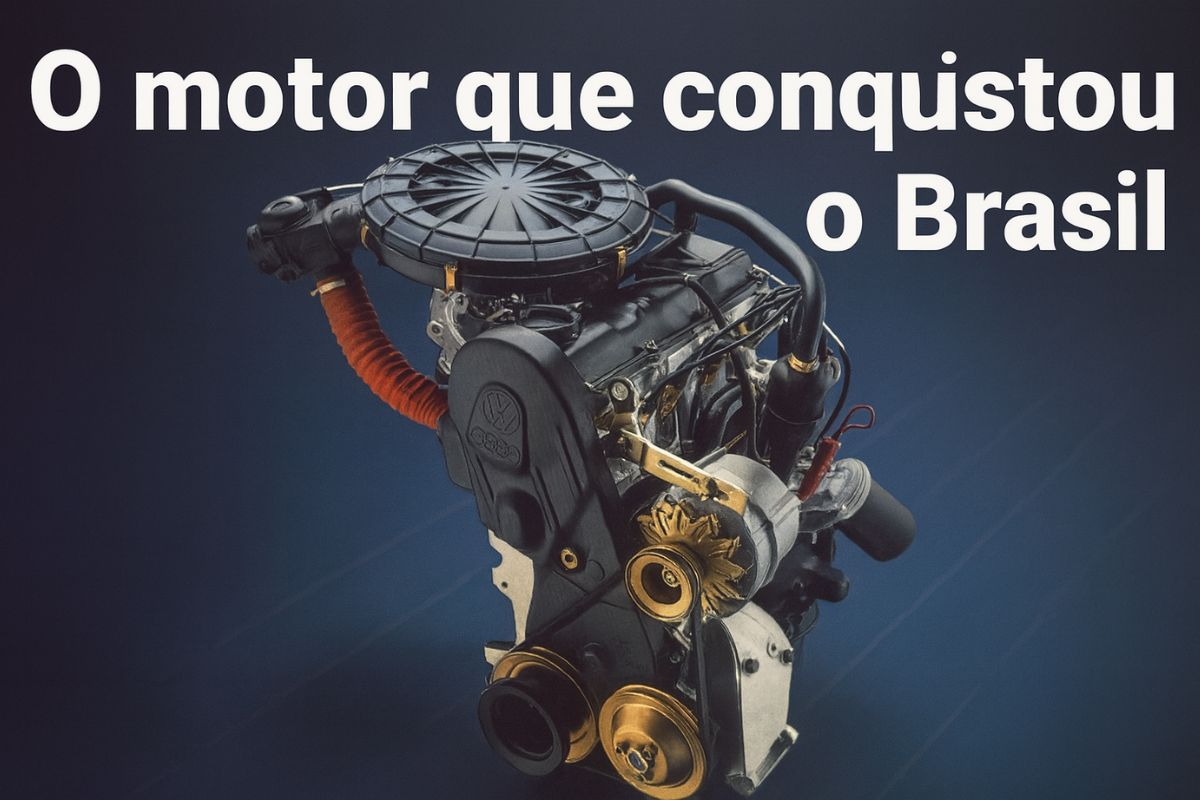


The Engine That Became National Culture: The AP Engine Transcended Decades, Gained Turbocharged Versions, and Dominated Tracks and Garages
After World War II, Volkswagen was restructured by British forces in the city of Wolfsburg, Lower Saxony, and returned to action with the “people’s car” – a project originally conceived in the 1930s. The model, which would later become the legendary Beetle, was introduced in Brazil in the early 1950s, initially assembled in the CKD system by Brasmotor.
Equipped with a rear-mounted, air-cooled boxer engine, the Beetle stood out for its mechanical resilience and simplicity of maintenance. This successful formula paved the way for an entire family of Volkswagen vehicles powered by the same engine, such as the Kombi, the Brasília, the SP2, and the Variant.
The Time for Modernization and the Purchase of Auto Union
Despite the success of the boxer engine, Volkswagen knew it needed to modernize its lineup to remain competitive. In 1964, it acquired the Auto Union group, owner of the DKW, NSU, and Audi brands. The union provided access to more modern projects, especially from Audi, which at that time was already experimenting with water-cooled engines and front-wheel drive.
-
Chinese automakers race against a 35% tax, accelerate the race against time, and hastily unload thousands of cars in Brazil, with BYD mobilizing 90 car carriers and Geely reinforcing lots before the end of quotas.

-
Corolla for R$ 6,000 and luxurious 25% cheaper: Is it possible to buy cars in Paraguay and drive them in Brazil?
-
Starting at R$ 210,000 and with a 2.8 turbo diesel engine of 204 hp, this 4×4 pickup received a discount of over R$ 55,000 for companies in June 2026 and became one of the most aggressive offers in the segment; Toyota Hilux for CNPJ

-
Chinese SUV priced at R$ 432,000 arrives in Brazil and challenges traditional models: GWM Wey 07 Dark Edition has 512 hp, over 5 meters, goes from 0 to 100 in 4.9 seconds, and aims to surpass SW4 in technology.



One of these projects was the Audi K70 sedan, launched in 1970 with a front-mounted, 1.6-liter, water-cooled engine and front-wheel drive — an important break from traditional VW architecture. Although it was not an immediate success among brand enthusiasts, the K70 represented the beginning of Volkswagen’s technological shift.
The Birth of the EA 827 Engine in Europe
In 1972, Audi unveiled the model 80, a modern sedan that would introduce the EA 827 engine. The technical name referred to the internal order of Audi’s development. It was a four-cylinder inline engine, with a cast iron block, aluminum cylinder head, single overhead cam, and two valves per cylinder, driven by a timing belt. Initially, it was available in 1.3 and 1.5-liter versions, with power outputs between 55 and 75 hp.
The origins of the project traced back to DKW in the 1960s, with the so-called “Mexico engine,” which aimed at military applications. Engineer Ludwig Kraus, then head of Auto Union, was responsible for adapting and refining this project for civilian use. The mechanics inspired by the Mercedes-Benz M118 were used exclusively by Audi.
The Transformation of the Golf and the Advance of Front-Wheel Drive
In 1974, Volkswagen launched the Golf in Europe, a compact hatchback with front-wheel drive and a transverse-mounted EA 827 engine. With engine options ranging from 1.1 to 1.5 liters and a weight of less than 800 kg, the Golf stood out for its agile and economical performance. The highlight came in 1976, with the Golf GTI: 1.6-liter engine with Bosch K-Jetronic mechanical injection, 110 hp, and a top speed of 182 km/h.
This recipe would inspire a new generation of sporty compacts and consolidate the EA 827 as a reference among European engines of the time.

The Arrival in Brazil and Tropical Adaptation
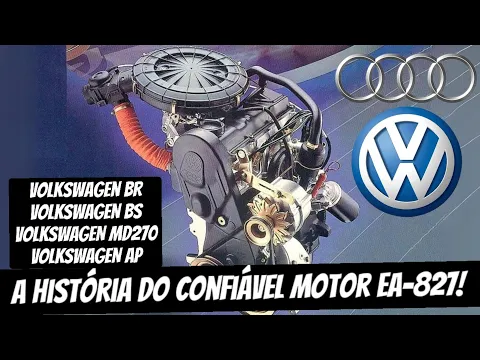
In Brazil, the Passat was the first model to receive the EA 827 engine, still in 1974, in 1.5 (BR) and 1.6 (BS) versions. Besides its modern mechanics, it brought McPherson suspension and improved dynamic behavior. In 1980, with the launch of the Gol, the old boxer engine was still used, now in the front. But the turning point came with the Voyage, a sedan derived from the Gol, which debuted the 1.5-liter EA 827 engine with liquid cooling.
In 1983, Volkswagen do Brasil launched the MD 270 engine, a nationalized and improved version of the EA 827, adapted for ethanol. The main feature was the increase in torque at low revs. In 1985, the name that would become legendary emerged: AP — standing for “Alta Performance.” The first models were:
- AP 600 (1.6 liters, 85 hp)
- AP 800 (1.8 liters, 94 hp)
- AP 800S (1.8 liters, 99 hp)
The engines equipped the Gol, Voyage, Parati, Saveiro, Santana, and Passat, with excellent performance and mechanical reliability.
The Era of Turbos and Performance Culture
During the 1980s, Volkswagen expanded the EA 827 family with new versions, including a 1.6-liter diesel engine that equipped the Kombi, with a front radiator and great fuel economy (over 13 km/l). However, the highlight was the AP 2000, a 2.0-liter engine, launched in 1988 and initially used in the Santana.
In Europe, Audi created the EA 828, a five-cylinder version of the EA 827, which became famous in rally competitions, such as the legendary Audi Quattro S1 from Group B. Equipped with a 2.1-liter turbo engine, it reached 600 hp and won the mythical Pikes Peak ascent with Walter Röhrl and Michèle Mouton.
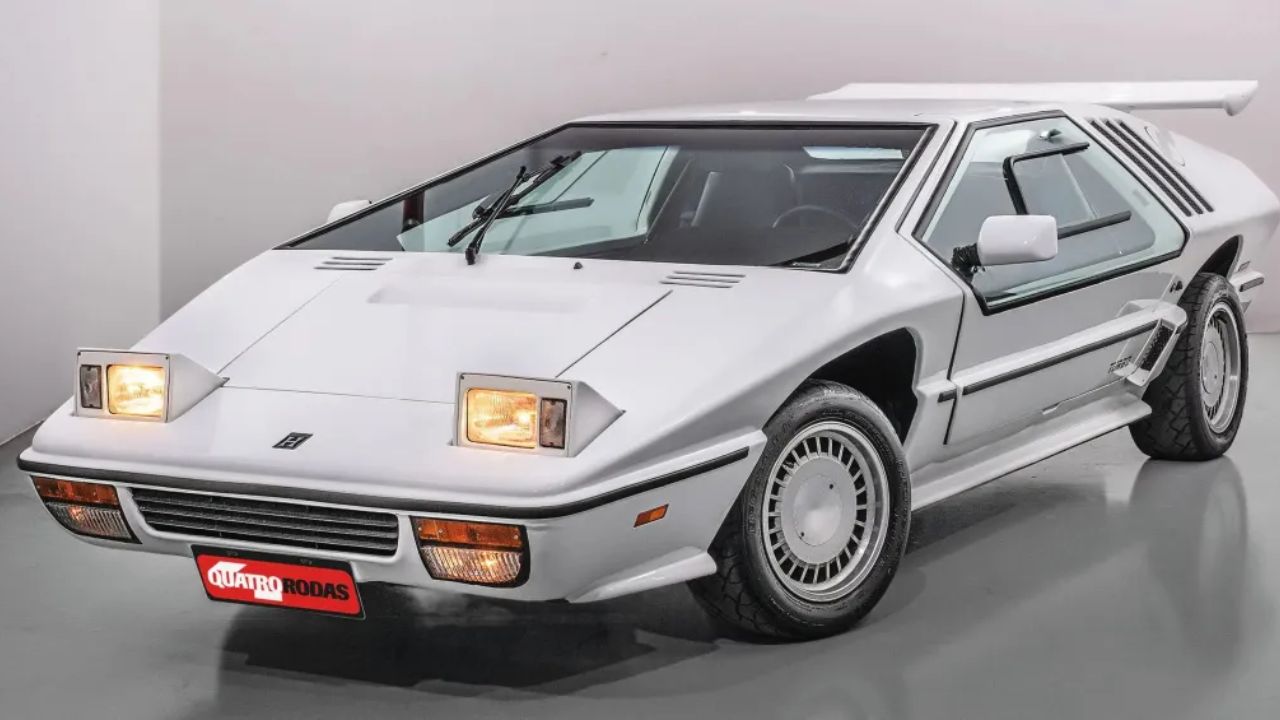
In Brazil, companies like Larus Turbo popularized the use of turbochargers on the AP engine, achieving powers of up to 1000 hp in extreme preparations. Rare sports vehicles, such as the Hofstetter Turbo, also adopted the factory turbo AP 2.0.
Autolatina Phase and New Technical Horizons
With the formation of the Autolatina group in 1987, Volkswagen and Ford began to share engines and platforms. The AP engine was used in Ford models such as Verona, Escort, and Versailles. In return, Volkswagen adopted Ford’s CHT engine in some of its entry-level cars.
In 1994, the group was disbanded, but the engines continued to be used by both automakers for some time. By the late 1990s, Volkswagen introduced the AT 1000 engine, a European-derived version of the EA 827 in 1.0 version, with OHC head, cross-flow, and multi-point fuel injection. The 16-valve version also emerged, the first national engine with four valves per cylinder in a 1.0 engine.
Flexibility, Innovations, and the End of an Era
In 2000, Volkswagen launched the 1.0 16V Turbo engine with 112 hp, available in the Gol and Parati, with performance similar to that of the aspirated AP 2.0. However, the market still viewed factory-turbocharged cars with suspicion, and production was halted in 2003.
The same year marked the arrival of the first AP Total Flex engine in the Gol Power 1.6, capable of running on gasoline or ethanol — a technological milestone in Brazil and a salvation for ethanol, which was then in decline.
The production of the Santana was discontinued in 2006, after more than 548,000 units. The AP 2.0 exited the scene in 2009, and the 1.6 in 2013, along with the Parati.
An Eternal Engine
Even out of production, the legacy of the AP engine remains alive. Whether for easy access to parts, robustness, or the automotive culture that formed around it, the AP continues to be modified in workshops, racing, off-roading, and serving as a basis for projects exceeding 1000 hp.
Its merits are recognized even today by mechanics, enthusiasts, and engineers. Many claim it was the most reliable and versatile engine ever produced in Brazil — and it is no exaggeration. The EA 827/AP transcended generations, economic scenarios, crises, and trends, always maintaining its essence: a simple, robust engine with enormous potential.
And You?
Have you ever had a car with an AP engine? Did you modify it, or simply drive thousands of kilometers without issues? Share your story in the comments and help keep alive the memory of one of the greatest icons of Brazilian automotive engineering.





Eu tenho um na garagem todo zerado, na carroceria de um Santana 2000 MI 2.0, totalmente standart, obviamente retificado cabeçote e feito toda manutenção necessária
Motor AP/ 827 simplesmente FENOMENAL eu tive um AP 2.0 um ” canhão”, porém somente um detalhe; as paredes das galerias do cabeçote eram um pouco finas, exigindo muito cuidado no sistema de arrefecimento.
Tive um gol, motor ap 1.8. O acelerador parece que não tinha fim e não baixava óleo!