





 Portuguese
  English
  Spanish
  7 min of reading
  0 comments


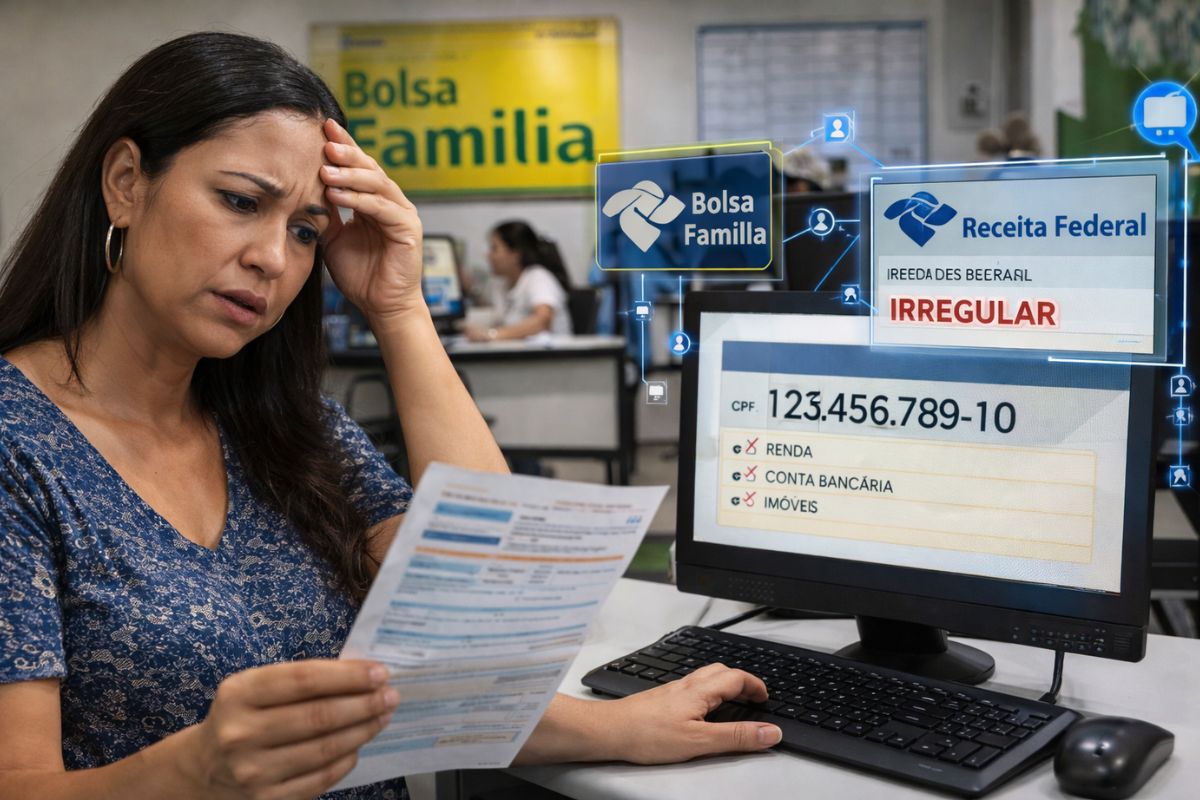
The deadline is 24 months, and those who do not attend the CRAS may lose access to the free electricity bill, free gas, Social CNH, and even Minha Casa Minha Vida without prior notice
If you depend on Bolsa Família, the free electricity bill, or any other federal government social program, pay close attention to what follows. The Cadastro Único completed 25 years in 2026, and along with the celebration came a level of oversight never seen before. The government now cross-references CadÚnico data with information from the Federal Revenue, formal employment records, and other official databases. And it does this in real-time. In other words, if your registration is outdated, the system can automatically block your benefit without anyone having to press a button.
This information was confirmed by the Ministry of Development and Social Assistance, Family and Hunger Combat (MDS), which manages the Cadastro Único through the official site gov.br/mds.
What changed in the CadÚnico rules in 2026
The big change is the integration between government databases. According to information published by the MDS on the Cadastro Único portal, the system now automatically identifies when a family has had a change in income, moved to a new address, or added a new member. If these changes are not communicated, the benefit may be blocked, suspended, or even canceled.
-
Famous sertanejo singer and the automaker BYD appear together on the federal government’s dirty list after instances of work analogous to slavery in Goiás and Bahia.

-
Correios lose more than 3,000 employees in mass layoffs and still aim to reach 10,000 dismissals in an attempt to save a state-owned company that has accumulated losses of R$ 6 billion and a negative net worth of R$ 10 billion.
-
Latin America is stagnant, and Brazil is part of the problem, says the World Bank in a report that highlights Argentina as the main positive exception in the region thanks to fiscal adjustment and Milei’s reforms.

-
Germany is investing in the interior of São Paulo to test the production of green hydrogen and aviation fuel made from sugarcane in a partnership with Cocal and Siemens that could change the Brazilian energy sector.

Previously, oversight relied almost entirely on the good faith of families. Each one would go there, declare their situation, and that was it. Not anymore. The electronic cross-referencing happens all the time. Let me give you a practical example: if someone in your family got a formal job and you didn’t inform CadÚnico, the system can detect this inconsistency on its own and block the Bolsa Família payment the following month.
The 24-month rule still applies. Every family needs to update their registration every two years, even if absolutely nothing has changed. But now there is an important detail: any change in family composition, address, or income must be reported immediately. You can no longer wait for the next biennial update to resolve it.
Whoever does not update the Cadastro Único may lose Bolsa Família in 2026
Many people do not know, but CadÚnico is the gateway to dozens of social programs. Losing the active registration means losing access to all of them at once. And the list is long.
Bolsa Família pays a minimum of R$ 600 per family, with additional R$ 50 for pregnant women, adolescents aged 7 to 17 years, and babies up to 7 months, according to the official calendar of April 2026 released by the MDS. Families with the Cadastro Único outdated for more than 24 months may have their benefit automatically suspended, and those who have already had Bolsa Família cut know the headache it is to resolve.
The Luz do Povo program, sanctioned by President Lula through the conversion of Provisional Measure No. 1,300, guarantees total exemption on the electricity bill for families registered in CadÚnico with an income of up to half a minimum wage per person, provided that the monthly consumption stays within 80 kWh. According to the Ministry of Mines and Energy, more than 17 million families are expected to benefit. And starting in January 2026, those with an income between half and one minimum wage per capita will also start receiving discounts for consumption of up to 120 kWh. But be careful: if CadÚnico is not active, the discount on the electricity bill simply does not appear.
The Gás do Povo program revamped the old “Gás dos Brasileiros” program and introduced a new feature that makes a difference in daily life: now the beneficiary can pick up the 13 kg gas cylinder directly at accredited resellers, without paying anything. The text was approved by the Senate in February 2026, and according to the federal government, more than 15 million families may be entitled to the free service.
The Social CNH, created by Law 15.153/2025, guarantees free licensing for people registered in CadÚnico with a per capita income of up to half a minimum wage. The program covers all stages, from theoretical classes to the issuance of the final document.
The Pé-de-Meia program is aimed at high school students from families registered in the Cadastro Único and offers financial incentives to keep young people in school. Minha Casa Minha Vida also requires registration in CadÚnico as a prerequisite for lower income brackets.
And the BPC (Continuous Cash Benefit), paid by INSS, guarantees a monthly minimum salary of R$ 1,621 in 2026 for seniors over 65 years old and people with disabilities in vulnerable situations. Here too, the Cadastro Único needs to be up to date for the beneficiary to maintain access.
There is also exemption from fees in federal public competitions, ID Jovem, and other state and municipal programs that use the Bolsa Família Cadastro Único as a basis. So, we are not talking about losing one benefit. We are talking about losing several at the same time.
Blocking, suspension, and cancellation: what is the difference?
This is a very common confusion and it is worth explaining clearly, because the difference between the three can mean resolving everything in a week or having to start from scratch.
Blocking is the first warning sign. It happens when there is some inconsistency in the registration or when the family fails to meet some conditionality, such as maintaining children’s school attendance or keeping vaccinations up to date. The benefit becomes temporarily unavailable but can be released after the situation is regularized at the CRAS.
Suspension is more serious. According to the rules released by the MDS, it occurs when the family does not update the data for more than 24 months. Payment is cut off and only resumes after the family head goes to the CRAS with all the documentation and updates the registration in person.
Cancellation is the worst-case scenario. It happens when the family’s income exceeds the allowed limit, when there is repeated non-compliance with conditionalities, or when the system identifies serious irregularities, such as income omission. In this case, it is not simply a matter of updating. The family needs to redo the entire registration process from the beginning. That is why so many people research how to avoid losing Bolsa Família in 2026: once canceled, the way back is long.
What documents are needed to update CadÚnico
Even with all the new technology, the update process remains in-person. The “Meu CadÚnico” app, available for free on Google Play and the App Store, is used to check data, issue registration proof, and make a pre-registration. But the final validation must be done in person at the CRAS, with an interview and presentation of documents.
For the update, the family head (who must be over 16 years old and preferably a woman, according to MDS guidelines) needs to bring the following documents to update CadÚnico:
Photo ID, such as RG or work card. CPF or voter registration card. Updated proof of residence, preferably the electricity bill.
For other family members, it is necessary to present the CPF of all, birth or marriage certificate, RG, and proof of school enrollment for children and adolescents up to 17 years old.
According to the official government portal, there are three ways to schedule an appointment in 2026: by phone 121 (Social Disk, with free calls from landlines and cell phones), online in municipalities that offer online scheduling, or directly at the CRAS. In smaller towns, service is usually on a first-come, first-served basis, without the need for scheduling.
The interview lasts about an hour. The tip is to go with enough time and all documents organized so you don’t have to return again.
Beware of scams
This alert is always important. The federal government does not request passwords, bank details, or any type of payment via SMS, WhatsApp, email, or phone call. If you receive a message asking for this type of information in the name of CadÚnico or Bolsa Família, do not click on any links and do not provide your details. The only official phone service channel is the Social Disk 121.
The “Cadastro em Ação” campaign is rolling out across Brazil
To mark the 25 years of CadÚnico, the MDS launched the national campaign “Cadastro em Ação,” which is promoting registration update efforts in all regions of the country. According to a report published by the TV Prefeito portal in April 2026, the actions have already passed through states like Piauí and Pernambuco, including services in rural and quilombola communities, with guidance on social programs and services such as issuing the Elderly Free Pass.
In Campo Grande (MS), the City Hall held a series of lectures at the 21 CRAS in the city, which serve more than 178,000 registered families, as reported by the Municipal Department of Social Assistance and Citizenship.
The message is simple: if you or someone in your family depends on any social program, do not wait for the benefit to be cut to act. Go to the nearest CRAS, bring your documents, and update your registration. It takes an hour of your morning and can ensure months of peace of mind.
With information from the Ministry of Development and Social Assistance (MDS), gov.br portal, Ministry of Mines and Energy, and TV Prefeito.








Seja o primeiro a reagir!