





 English
  Francês
  Alemão
  Italiano
  Japonês
  Norueguês
  Portuguese
  Spanish
  5 min of reading
  0 comments



Created for heavy transport in remote areas, the Mil Mi-26 brings together unusual dimensions, high cargo capacity, and a history of use in military, civil, and logistical missions that spans decades in world aviation.
The Mil Mi-26 is a heavy helicopter created in the former Soviet Union to transport loads outside the standard of rotary-wing aviation.
With the capacity to carry up to 20 tons, the aircraft began to be used in military missions, logistical operations, and transportation of large equipment in areas without easy access by planes or land.
Developed to meet transportation demands in remote regions and war scenarios, the Mi-26 entered service in the 1980s and became known for a relevant technical fact: it is the largest helicopter to enter serial production.
-
Seen from space, a colossal ‘Y’ cuts through the largest desert in China, blending a jade-filled river, red and white mountains, and revealing the absurd scale of the transformation of the Taklamakan surrounded by a green wall with billions of trees.

-
The Pacific Ocean reveals what the cliffs of Big Sur have hidden for millennia: Pfeiffer Beach, in California, features swirling purple sand formed by garnet crystals and displays a stone arch that is illuminated by the sun in winter for just a few days each year.

-
Aursjøvegen in Norway is a 100-kilometer gravel road that crosses chasms and dark tunnels carved into the rock at an altitude of 947 meters in the fjords and is only open for four months a year.

-
With about 4,000 m², the building constructed in a traditional neighborhood in France looks like a rainbow, has a colorful facade, mixes vibrant glass, and creates one of the most unusual visuals in Bordeaux.


Over the last few decades, the model has been employed in logistical support missions, heavy air transport, and retrieval of equipment in hard-to-reach locations.
The Mi-26 project was focused on the transport of large cargo
The helicopter was developed by the Mil design bureau, a Soviet manufacturer of rotary-wing aircraft, amid the need to expand heavy air transport capacity.
The project resulted in a platform designed to operate in harsh environments, including cold and isolated regions, with a reinforced structure and internal space for bulky cargo, vehicles, and personnel.
The first flight of the Mi-26 took place in December 1977.
Its entry into service was recorded in 1983, when the aircraft began to be employed in military and civil functions.
Since then, the model occupies a unique position in helicopter aviation due to the combination of size and cargo capacity.
The dimensions help explain this characteristic.

The aircraft is about 40 meters long, with a main rotor approximately 32 meters in diameter and a height of around 8 meters.
On the ground, the fuselage has proportions comparable to a low-rise building, which has led to recurring comparisons with a three-story building.
Dimensions and power put the Mi-26 in another category
The helicopter’s lift depends on an unusual mechanical set even among heavy aircraft.
The Mi-26 uses a main rotor with eight blades and two Lotarev D-136 turboshaft engines.
Each engine delivers about 11,200 shp, power compatible with a maximum takeoff weight of 56 tons.
In practice, this configuration allows for the transport of large volumes inside the cabin or in external cargo, secured by cable.
The nominal capacity of 20 tons placed the Mi-26 among the helicopters with the highest capacity ever produced.
Therefore, the model has been used in heavy transport and logistical support tasks in different operational contexts.
Additionally, the project was designed to maintain operational safety in severe conditions.
Technical sources indicate that the system allows flight with only one engine in specific situations, provided that the mission weight and operating conditions are within the expected limits.
Real missions expanded the helicopter’s visibility
The trajectory of the Mi-26 includes operations that helped consolidate its relevance in the sector.
The model was employed in real missions for the transport and recovery of equipment, which expanded its visibility outside the military Soviet and Russian environments.
One of the most cited episodes occurred in 2002, in Afghanistan, when a civil Mi-26 was contracted to recover US CH-47 Chinook helicopters in a mountainous area.

The case has frequently been mentioned as an example of the model’s cargo capacity in hard-to-reach scenarios.
There are also records of the aircraft’s use in response to the nuclear disaster of Chernobyl in 1986.
Variants of the Mi-26 were employed in support and containment operations, including the transport of materials used in an attempt to reduce the immediate effects of the accident.
In the civil field, the helicopter was also used in exceptional transport operations.
A well-known case occurred in 1999, when a Mi-26 transported a block of permafrost with remains of a preserved mammoth in Siberia.
The operation was cited by international media and by records from the aviation sector as an example of the aircraft’s use outside the military environment.
Military and civil use kept the project active
Although the Mi-26 is often associated with military operations, its trajectory also includes relief missions, transportation of industrial equipment, and support to areas affected by natural disasters.
In these cases, the main advantage lies in the ability to operate in locations without adequate ground or airport infrastructure.
This profile has contributed to the model’s continued activity for decades.
At the same time, the combination of spacious cabin, operational range, and high payload has kept the helicopter as a relevant option for removing fuselages, moving large parts, and transporting contingents in remote areas.
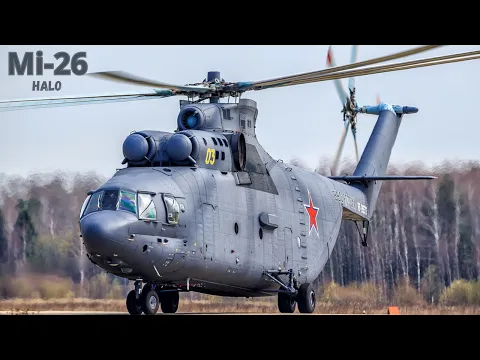

Over time, the project has also received modernized versions.
Among them is the Mi-26T2V, presented as an evolution of the original model, with improvements in navigation, avionics, and features aimed at operation in hostile environments.
The place of the Mi-26 in world heavy aviation
The Mi-26 remains a reference when it comes to heavy transport by helicopter.
The aircraft is not the largest ever conceived experimentally, but it remains the largest to enter serial production and to operate effectively for decades.
This fact helps explain why the model often appears in comparisons with more recent aircraft from the United States and other countries.
Although later projects have incorporated advances in electronics, sensors, and protection systems, few have gathered the same payload capacity as the Mi-26 in a single platform.
More than four decades after entering service, the helicopter continues to be cited in specialized publications and in historical records of heavy aviation.
The legacy of the model is associated with the scale of the project, the power of the mechanical set, and its use in operations that required large-scale air transport under adverse conditions.








Seja o primeiro a reagir!