





 Portuguese
  English
  Spanish
  6 min of reading
  0 comments


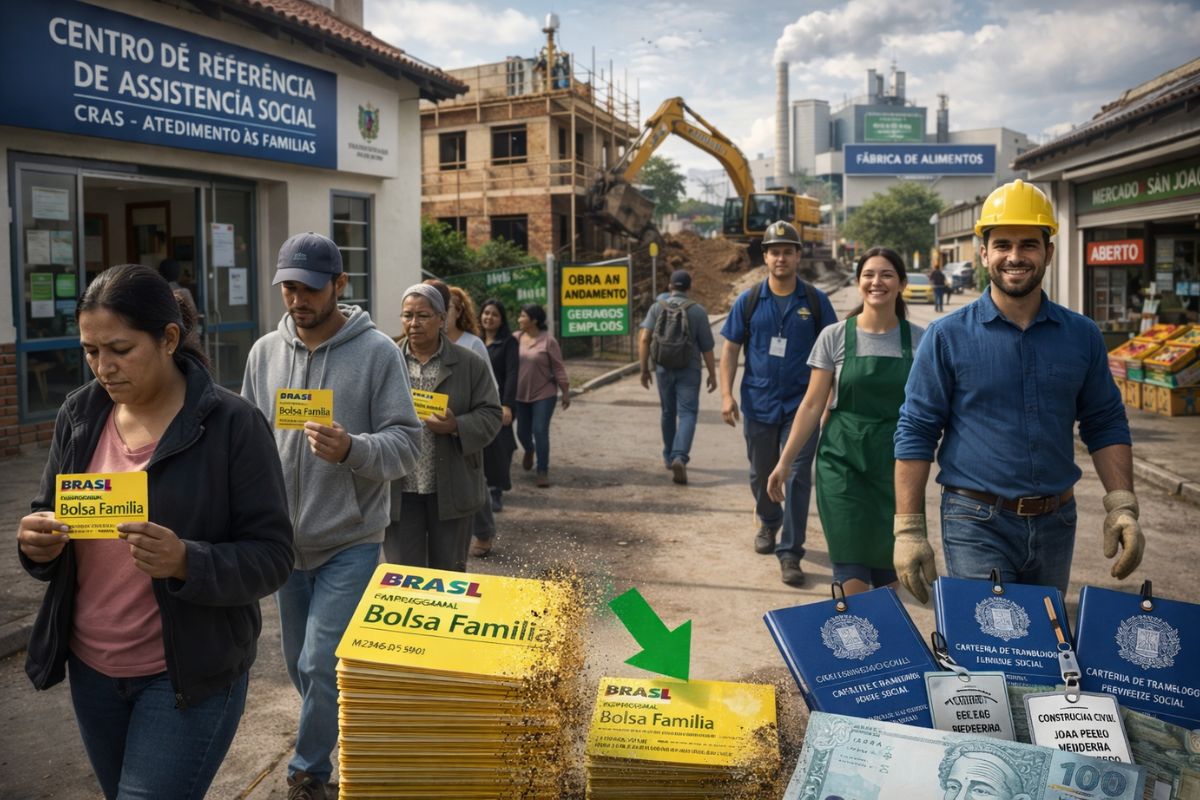
Bento Gonçalves, in Rio Grande do Sul, reduced the number of Bolsa Família beneficiaries by 38% in about a year and a half using active search to find each registered person and connect them directly to job vacancies in the region, a result far above the national average of 11% and the state average of 15%, with teams that prepare resumes and make direct referrals to companies.
A city in southern Brazil is doing what no other municipality has achieved on the same scale with the Bolsa Família. In Bento Gonçalves, in Rio Grande do Sul, the city hall decided to go beyond traditional assistance and started actively seeking beneficiaries of the program to connect them directly to job vacancies. The result is impressive: in about a year and a half, the municipality reduced the number of families served by almost 40%. While the average reduction in Brazil was 11% and in Rio Grande do Sul 15%, Bento Gonçalves achieved 38%, more than three times the national index.
The data comes from the Ministry of Development and Social Assistance, Family and Fight Against Hunger (MDS) and draws attention precisely because of the discrepancy. This is not about cutting benefits by decree or bureaucratic cancellation. The strategy is based on active search: city hall teams go after each beneficiary of the Bolsa Família, understand the individual situation, provide support in resume preparation, and directly refer them to companies that are hiring. It is a model that transforms the social program from a permanent destination into a temporary bridge to the job market.
What Bento Gonçalves Did Differently with the Bolsa Família
The central change lies in the method. In most Brazilian municipalities, Bolsa Família operates passively: the government deposits the benefit, and the citizen continues to receive it as long as they meet the requirements.
-
The bluest city in Brazil has just gained a new floating bridge for the free crossing between the island and the mainland, connecting residents and visitors to the historic center of São Francisco do Sul every day of the week.

-
In a silent race, Shopee signs a mega contract in Guarulhos and accelerates the e-commerce war with faster deliveries, pressured shipping, and a new threat to rivals in Brazil.

-
Oil surged to $115 a barrel due to the war in the Middle East, and diesel in Brazil has already risen to R$ 7.45 per liter, while the United States…

-
Brazilian city bets on the business environment to generate jobs and attract investments in the energy sector — secretary reveals strategy at Macaé Energy 2026.


In Bento Gonçalves, the city hall reversed the logic. Instead of waiting for the beneficiary to seek help to exit the program, municipal teams actively search for people, visit addresses, check conditions, and offer concrete opportunities.
From the initial contact, the city hall checks the beneficiary’s interest in entering the job market. For those who show willingness, the municipality offers direct support: help in resume preparation, professional guidance, and referrals to local companies with open positions.
The municipality acts as a bridge between those who need jobs and those who need to hire—a role that is not typically fulfilled by social assistance.
Additionally, the initiative provides initial support during the transition. Beneficiaries who accept a job offer receive minimum conditions to sustain themselves until their salary starts coming in.
This detail is crucial: without support during the transition, many people refuse job offers for fear of losing Bolsa Família before having guaranteed income. Bento Gonçalves addressed this bottleneck by offering security during the adaptation period.
The Active Search and the Registration Control That Made the Difference
The active search in Bento Gonçalves is not limited to offering jobs. When municipal teams cannot locate a beneficiary at the address provided in the Bolsa Família registration, the case is forwarded to federal management.
The result can be the blocking of the benefit until the person regularizes their data—a measure that combats fraud and ensures that resources reach those who truly need them.
This registration control is another factor that contributed to the 38% reduction in beneficiaries. Some of the people who left the program were not referred to jobs but were identified as irregular beneficiaries—people who moved to another city, who already had income above the limit, or who simply did not exist at the declared address.
The active search revealed inconsistencies that passive management did not detect, cleaning the registry and directing resources to those who are genuinely in vulnerable situations.
Mayor Diogo Siqueira (PL) summarized the philosophy behind the strategy in an interview with CNN Brazil: “We believe that it is much more important to get people to work than to give another benefit.” The phrase encapsulates the model of Bento Gonçalves: Bolsa Família as a temporary path, not a permanent destination.
The Numbers That Place Bento Gonçalves Above the National Average
The comparison with state and national indices gives dimension to the result. In the same period that Bento Gonçalves reduced its Bolsa Família beneficiaries by 38%, the state of Rio Grande do Sul as a whole recorded a decrease of 15%, and all of Brazil reached only 11%.
The difference is more than three times the national average—a performance that finds no parallel in any other municipality of similar size.
The economic context helps to understand part of the result. Bento Gonçalves is located in the Serra Gaúcha, a region with a diversified economy, a furniture and wine production hub, and an unemployment rate historically below the national average.
The availability of job vacancies in the region facilitates the referral of beneficiaries—something that would be more difficult in municipalities with high unemployment rates and few formal opportunities.
Still, the differential of Bento Gonçalves is not the local economy, but the political decision to use active search as a transition tool.
Other municipalities in the Serra Gaúcha with similar economic conditions have not achieved similar results, indicating that the strategy of going after beneficiaries and connecting them to the job market is the determining factor.
The Bolsa Família on a National Scale and What the Bento Gonçalves Model Can Teach
Currently, Bolsa Família serves 18.73 million families in all 5,570 Brazilian municipalities. The monthly investment from the Federal Government reaches R$ 12.76 billion, with an average transfer value of R$ 683.75 per family.
These numbers show the size and importance of the program for the country’s social protection network and also the cost it represents for the public budget.
The program includes mechanisms such as the Early Childhood Benefit, aimed at children up to six years old, as well as additional amounts for pregnant women, nursing mothers, and youth.
There is also the protection rule, which allows families to temporarily remain in Bolsa Família even after an increase in income, receiving part of the benefit during the transition.
These instruments recognize that exiting the program needs to be gradual, and it is precisely this principle that Bento Gonçalves applied actively.
The question that the Gaúcho model raises is whether active search can be replicated on a national scale. In municipalities with a heated economy and job availability, the strategy has clear potential.
In regions with structural unemployment and few formal opportunities, the challenge is greater, but the principle of going after beneficiaries, checking registrations, and offering concrete support applies to any context. What Bento Gonçalves proved is that treating Bolsa Família as a springboard, not as a permanent net, produces measurable results.
With information from the portal NDMAIS.
What do you think of the Bento Gonçalves model for reducing Bolsa Família? Should active job search be adopted in all municipalities, or does the reality of each region require different strategies? Leave your opinion in the comments—this debate about social assistance and the job market needs diverse voices.










Seja o primeiro a reagir!