





 Portuguese
  English
  Spanish
  5 min of reading
  0 comments



Lonely routine after school, early autonomy, and distinct impacts throughout adult life gain a new scientific reading, which relates childhood freedom to emotional development, but also points out risks when stable bonds and consistent emotional presence are lacking.
Many adults who spent their childhood entering their homes alone after school, heating their own food, and managing their afternoons without an adult nearby grew up in a context that today literature describes more cautiously than memory often allows.
Research on so-called latchkey kids indicates that early autonomy can, under certain conditions, foster independence, practical self-regulation, and problem-solving ability, but it also shows that the effects vary according to the child’s age, the time without supervision, and, above all, the quality of the bond with caregivers.
Childhood without supervision and the origin of latchkey kids
The term latchkey child did not originate in the 1980s, although it became especially associated with childhood in that decade.
-
Adolescents who regularly participate in household tasks develop up to 40% more sense of self-efficacy, according to studies in psychology, impacting autonomy, academic performance, emotional health, and the ability to cope with challenges in adulthood.

-
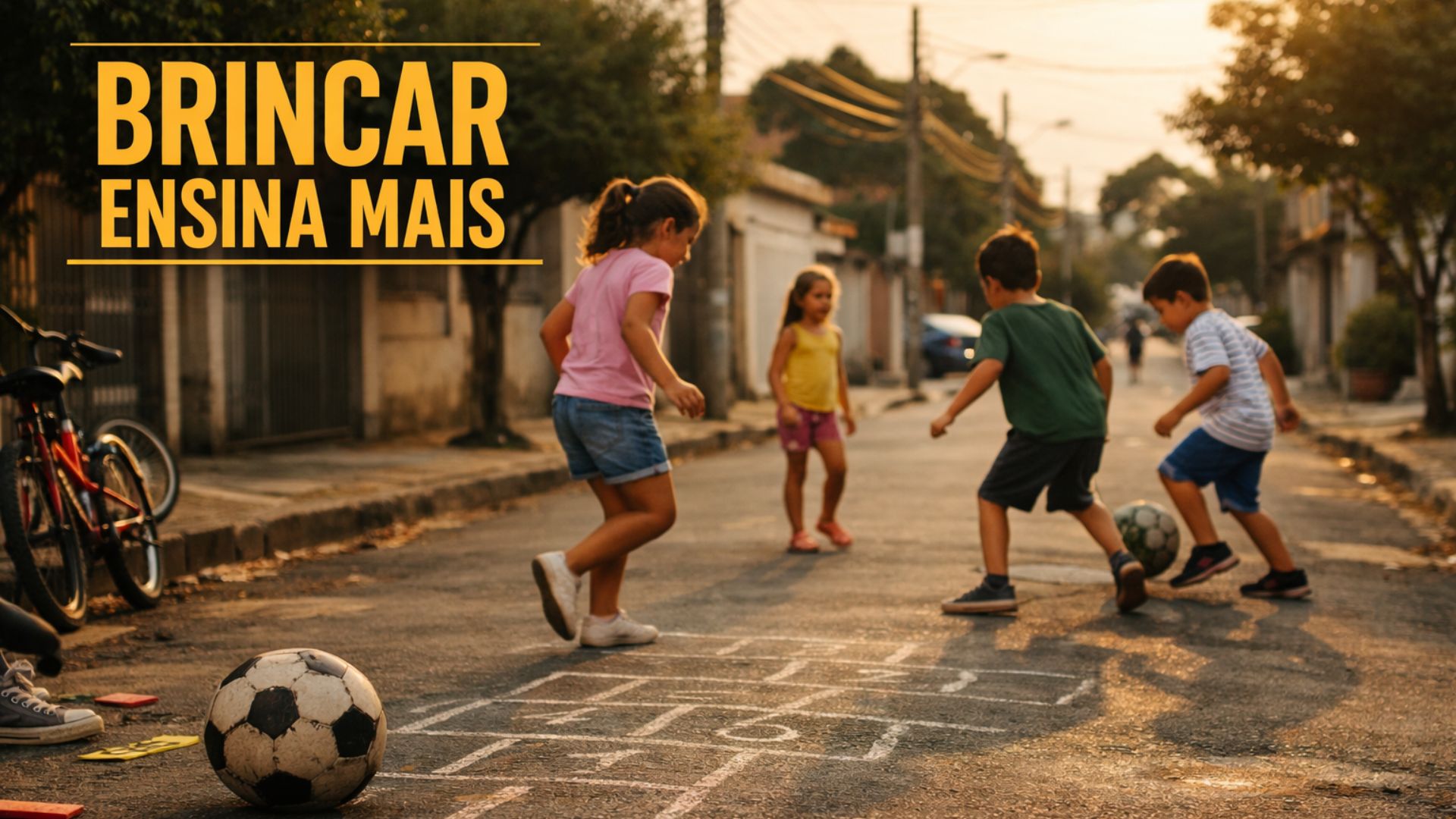
Children who played in the street without rules developed up to 5 essential emotional skills, such as resilience, self-control, and empathy, according to psychology, and may today have greater mental balance in the face of frustrations and challenges of adult life.
-
Brazil’s neighbor presents a super military aircraft with a digital glass cockpit, +6G/-3G aerobatics, a replacement for a model over 40 years old, testing in 2027, and production expected in 2030 with 100% national technology.

-
The 3rd best city in Brazil is located in the interior of São Paulo and impresses by reaching 12th place among 5,570 cities in the IPS 2025, with highlights in 57 indicators and a strong university hub.

Lexical records place the use of the term as early as the 1940s, and academic literature shows that the phenomenon gained public visibility long before it became a generational marker linked to the children of families where adults worked outside during school hours.
In the United States, this debate grew alongside the expansion of maternal employment, the reorganization of families, and the lack of formal care alternatives during after-school hours.
A 1988 study on the phenomenon points to the increase in mothers’ participation in the workforce and the rise of single-parent households among the factors explaining the presence of children alone at home after school.
Although the image of the child with a key hanging around their neck has become almost a cultural emblem of the time, science recommends avoiding easy generalizations.
Not every child who lived this routine developed the same emotional resources, and the very notion of an “entire generation” shaped in the same way runs into a basic limit of cohort research: generational labels help describe broad trends but do not serve as automatic proof of shared psychological traits among all.
Child autonomy, adaptation, and emotional development
The most solid part of the literature does not treat the absence of supervision as a virtue in itself, but rather as an experience that can produce distinct effects.
Recent reviews and studies on free play and exposure to age-appropriate risks indicate that contexts with more autonomy allow children to experience uncertainty, make decisions, and test limits, which is associated with the development of confidence, perseverance, tolerance for discomfort, and a greater sense of agency.
This point helps explain why so many adults who grew up with more freedom report familiarity with unexpected situations.
When a child needs to manage small tasks, deal with everyday frustrations, and organize part of their own routine, they exercise repertoires that may later appear as functional autonomy, initiative, and less dependence on immediate validation.
Still, studies speak of possibilities and associations, not a straight line between “growing up alone” and “becoming a more emotionally strong adult.”
There is also an important component of perceived control.
Works on locus of control and self-efficacy show that repeated experiences of action and consequence tend to strengthen the feeling that one’s own effort interferes with the outcome, and this type of belief relates to greater coping with adversities at different stages of life.
The necessary caution here is not to confuse built autonomy with normalized neglect.
Risks of prolonged absence of supervision in adolescence
The literature on self-care without supervision also records consistent risks, especially in adolescence.
Studies and reviews on risk behavior indicate that long periods without adult supervision, especially when combined with unstructured free time and strong peer influence, may be associated with an increase in conduct problems, smoking, and other harmful exposures.
This is the point that tends to disappear when the childhood of the 1980s is remembered only as a school of resilience.
The same experience that, for some children, meant training for independence, for others represented fear, loneliness, or vulnerability.
A classic literature review already treated the success or failure of this arrangement as something dependent on concrete variables, such as the child’s maturity, home environment, duration of adult absence, and existence of clear rules.
Moreover, the most recent scientific production reinforces that stable and nurturing relationships remain a decisive protective factor.
Safe, stable, and emotionally responsive environments reduce harm and increase the chance for the child to transform challenges into learning, rather than toxic stress.
In other words, autonomy tends to produce better outcomes when accompanied by emotional presence, even if not by constant surveillance.
Generation X, adaptability, and the limits of generalizations
It is at this intersection of practical freedom and emotional support that childhood without supervision helps to be understood with less romanticization and more precision.
Some adults who went through this daily life developed useful repertoires in unstable environments, such as a greater willingness to decide alone, improvise solutions, and endure intervals of uncertainty without freezing.
This aligns with frequent descriptions attributed to the Generation X, generally defined as those born between 1965 and 1980, but does not scientifically authorize the claim that this entire group exhibits more emotional control or a homogeneous adaptive superiority.
The main lesson that emerges from the studies is not the defense of abandonment as a method, nor the automatic celebration of a tough childhood as if deprivation were synonymous with robust formation.
What the evidence suggests is something less epic and more useful: children need space to act, err, calculate risks, and gain confidence progressively, but they need to do so within reliable, predictable, and protective relationships.
When this balance exists, independence ceases to be helplessness and begins to function as real learning of adaptation.





Seja o primeiro a reagir!