





 Portuguese
  English
  Spanish
  7 min of reading
  0 comments


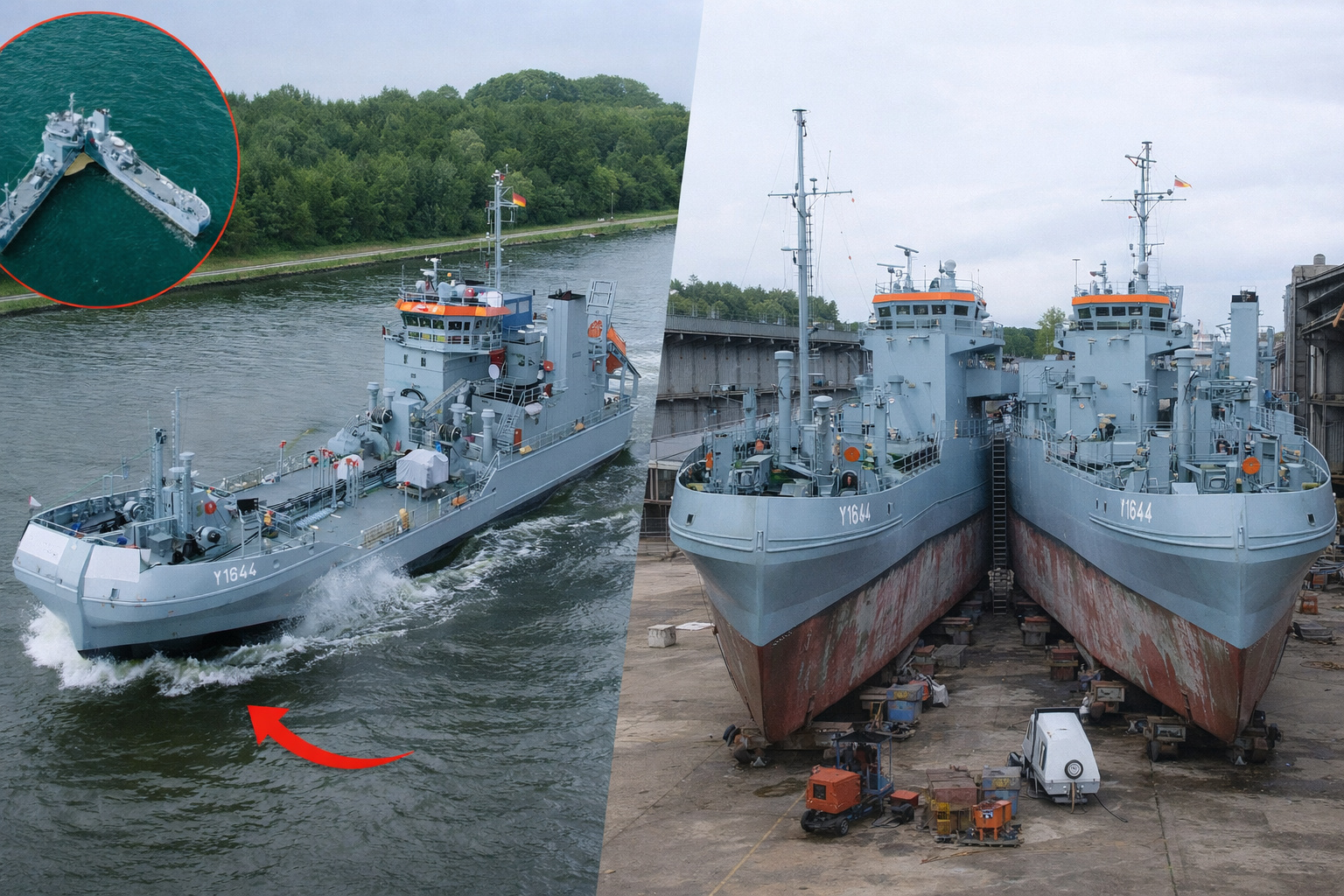
Designed for environmental emergencies, the Bottsand ship uses an exclusive system that opens the hull to collect spilled oil, separating oil and water with efficiency and operational safety at sea.
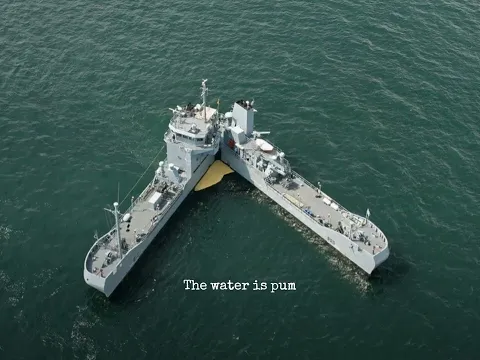
When a ship breaks in half in the ocean, it is usually the end of it. In the case of the Bottsand, it is the beginning of the work. The Bottsand class (Type 738), operated by the German Navy, consists of two oil recovery ships — the Bottsand and the Eversand — whose hull was designed from the factory to open longitudinally in two halves during environmental cleanup operations. The bow separates at 65 degrees, creating an opening of more than 40 square meters that engulfs oil-contaminated water. The water is pumped into an internal tank of 790 cubic meters, where the oil is separated and stored. In one hour, each ship can clean up to 140 cubic meters of ocean surface covered by a layer of 2 millimeters of oil.
The concept that came from a tanker cut in half
The idea behind the Bottsand is surprisingly simple. Engineers at the C. Lühring shipyard in Brake, Germany, started from a basic concept: take a conventional coastal tanker of 500 tons and cut it in half longitudinally, from bow to stern.

In normal navigation mode, the ship operates like any other — closed hull, conventional propulsion, speed of up to 10 knots. When it arrives at a spill, hydraulic pistons come into action and separate the two halves of the hull at the bow, opening a V-shaped channel that acts like a giant mouth facing the surface of the sea.
-
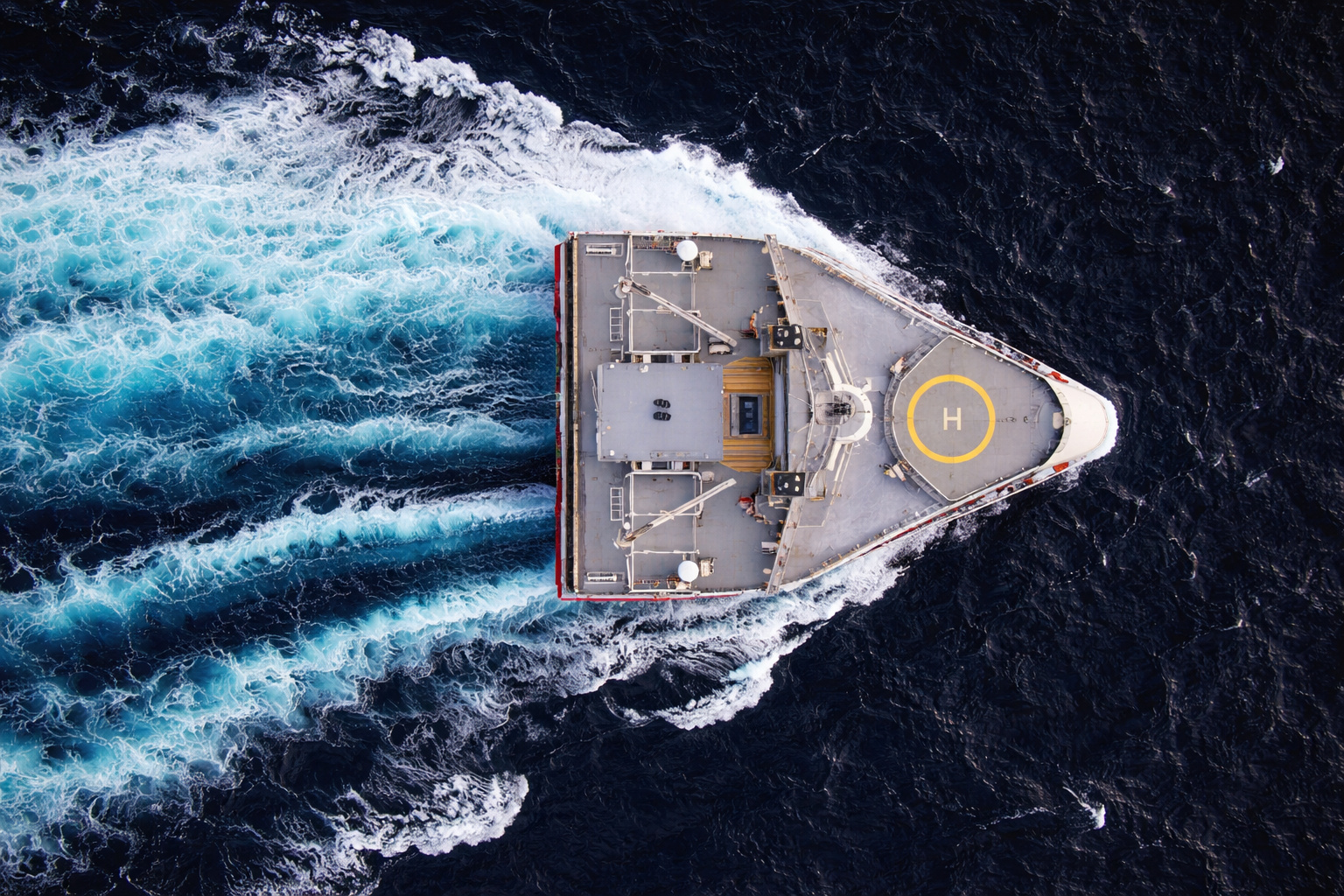
With almost 70 meters in width at the stern and a shape resembling a “giant slice of cheese,” the Ramform Titan tows up to 24 seismic cables to sweep the ocean floor in 3D and reveal oil reserves hidden beneath kilometers of sediment.
-
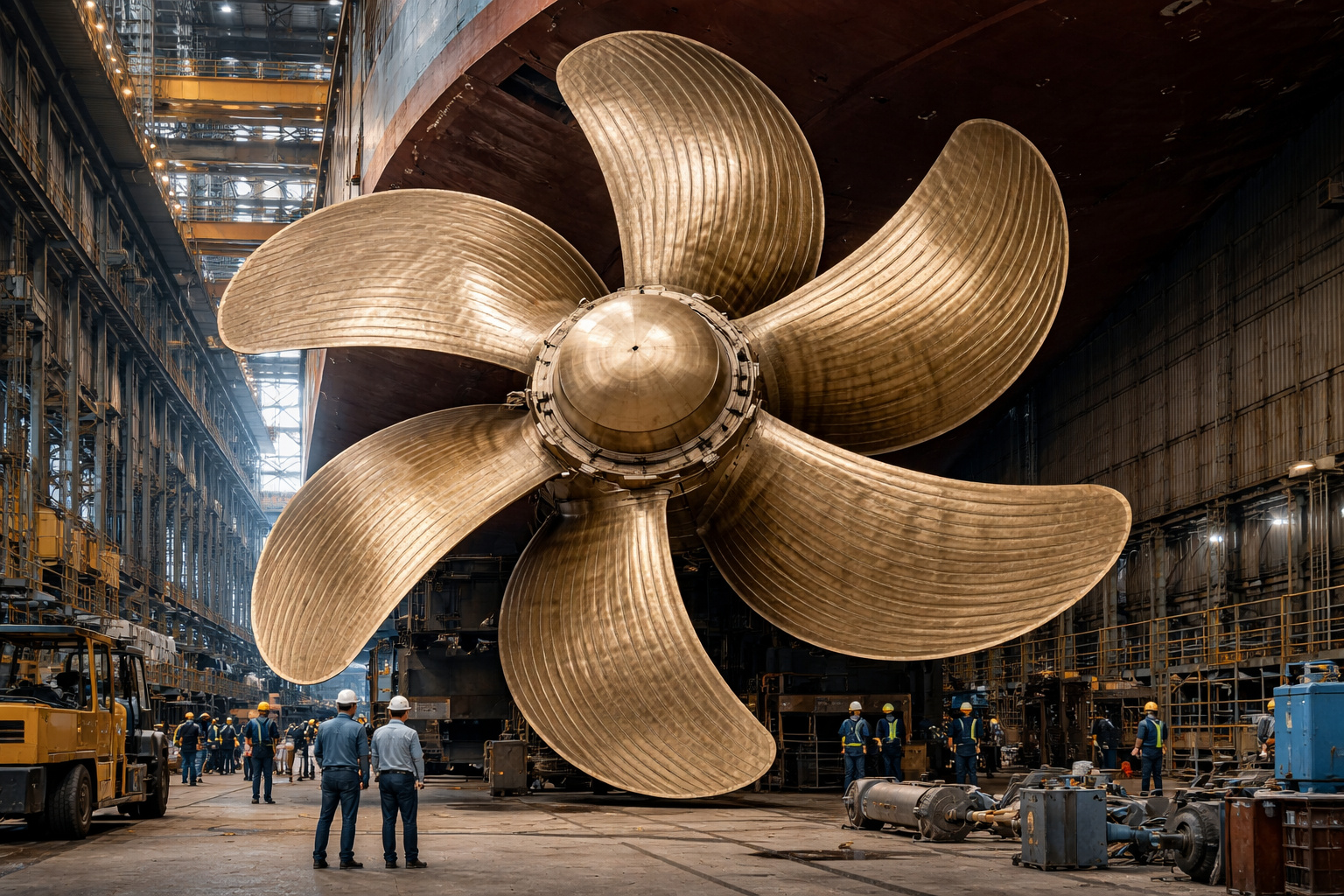
How a 131-ton, 11-meter propeller supports 90% of global trade and transforms the largest container ships on the planet.
-
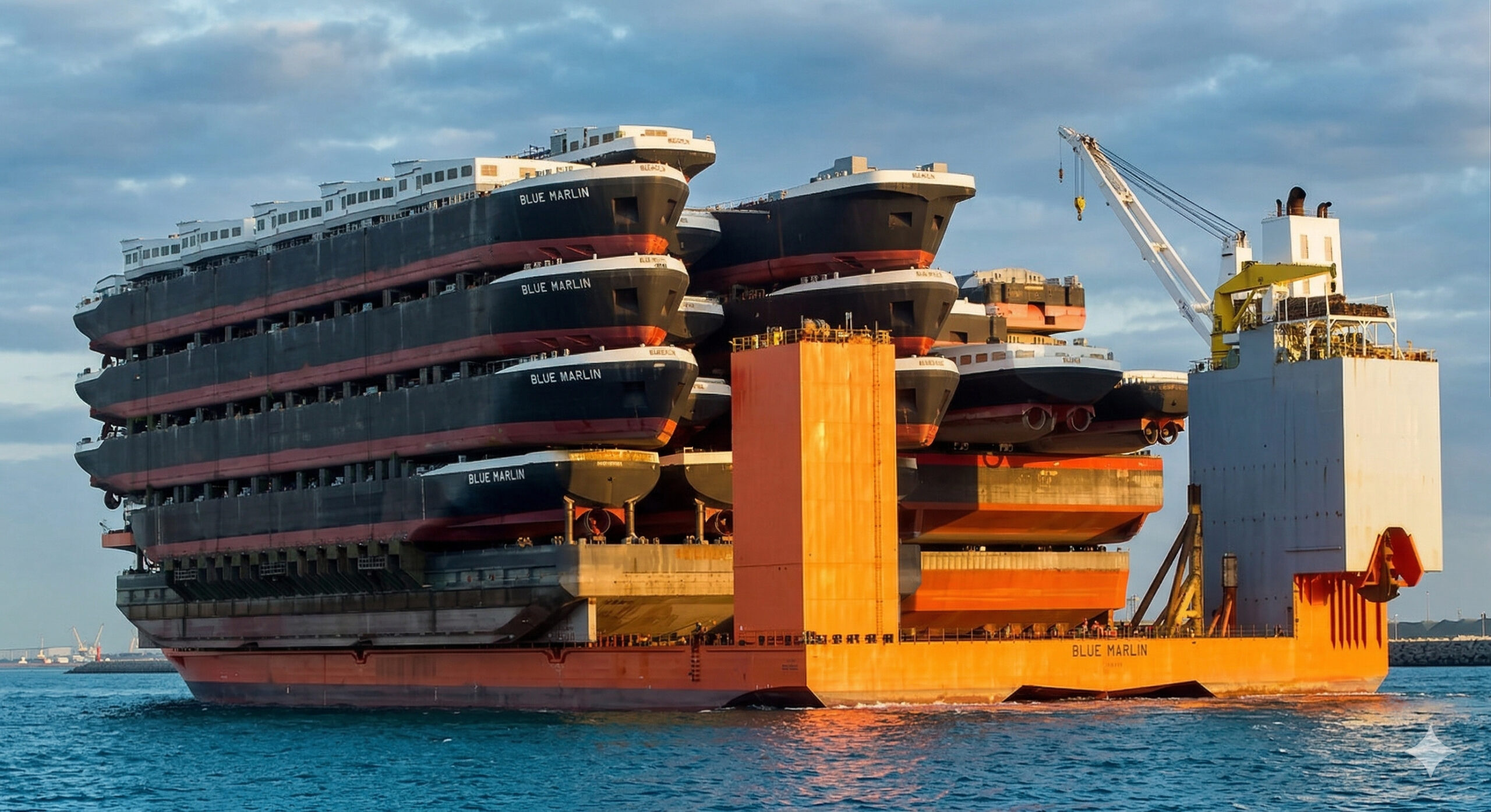
With a length of 225 meters and a capacity of 76 thousand tons, this ship “sinks” its own deck down to 28 meters deep to accommodate war destroyers, oil platforms, and giant radars floating above, and then emerges with everything intact on top like a colossal tray crossing oceans.
-
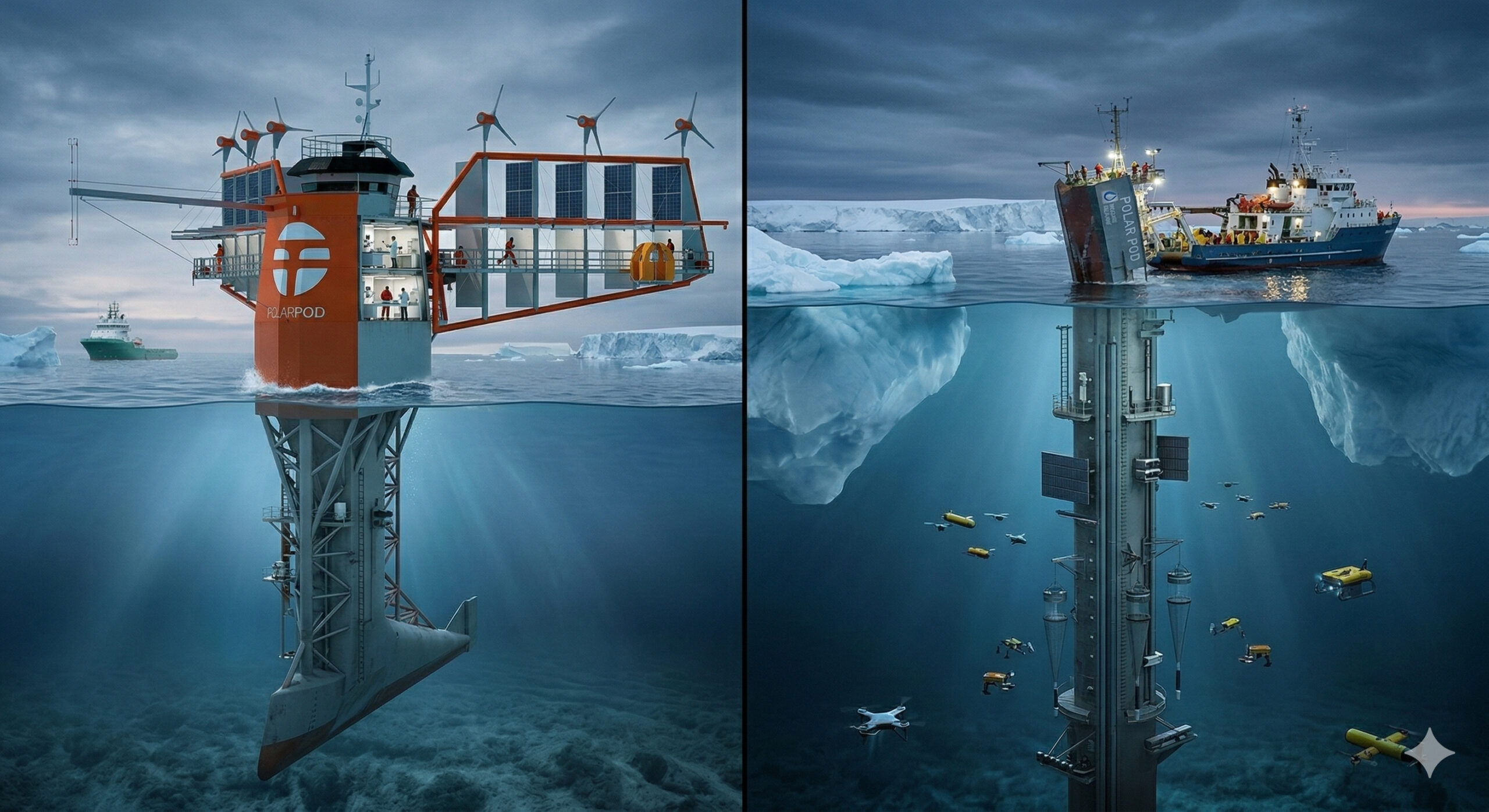
A 100-meter platform without a motor, without a keel, and operating upside down rotates 90 degrees in the ocean, sinks 75 meters, and drifts around Antarctica for two years driven by the planet’s most powerful current to study the largest carbon sink on Earth, still poorly understood by science for accurate climate modeling.

The oily water enters through the channel, is directed to the pumping system, and flows to the separation tanks inside the ship. When the tank fills up or the operation ends, the hull closes back, and the ship navigates normally to the discharge point.
The Thor prototype that proved the idea worked
Before the Bottsand, there was the Thor. Built in 1981 by the same shipyard with support from the Federal Ministry of Research and Technology of West Germany, the Thor was the prototype that validated the concept of a divisible hull in real sea conditions.
Tests demonstrated that the hydraulic separation of the hull was mechanically feasible, that the stability of the ship was maintained during the opening, and that the oil collection system worked as designed. With the data from the Thor, the shipyard developed an expanded and improved version — the Bottsand — which entered service in the German Navy in 1984. The second ship of the class, Eversand, was commissioned in 1987.
46 meters, 650 tons, and six civilians on board
The Bottsand measures 46.3 meters in length, 12 meters in beam (width), and 5.2 meters in depth. The operational draft is 3.1 meters, and the displacement is 650 tons. Propulsion is provided by engines with a total power of 759 kW, sufficient for a maximum speed of 10 knots.

The crew consists of only six people — all civilians. Although it belongs to the German Navy, the Bottsand is not operated by military personnel. The crew members are civilian employees specialized in marine pollution response operations. The ship is an auxiliary vessel of the Navy, classified as a water pollution control vessel.
Where they are stationed
The Bottsand is based at the Naval Base Command in Warnemünde, in the Baltic Sea. The Eversand is stationed at the naval base in Wilhelmshaven, in the North Sea. Both are operationally under the Havariekommando, the central command for maritime emergencies in Germany, based in Cuxhaven.
The geographical distribution is strategic: one ship covers the Baltic and the other covers the North Sea — the two main spill risk areas along the German coasts. The location allows either of the two ships to reach the site of an incident within a few hours.
The North Sea as a reason for existence
The Bottsand did not come about by chance. It was a direct response to a series of oil spills that affected the coasts of the North Sea throughout the 1960s and 1970s. The heavy traffic of tankers between the North Sea terminals and European ports created a constant risk of collisions, groundings, and leaks.
The disaster of the Amoco Cadiz in 1978, which spilled 223,000 tons of crude oil off the coast of Brittany, France, accelerated the development of response technologies across Europe. West Germany, with its long coast on the North Sea and the Baltic, invested in its own solutions — and the concept of the ship that splits in half was one of them.
How oil-water separation works
When the oily water is pumped into the 790 cubic meter tank, the separation process begins. The system takes advantage of the difference in density between oil and seawater: the lighter oil naturally floats to the surface inside the tank.
Internal separators direct the oil to dedicated storage compartments, while clean water is returned to the sea. The system does not require chemicals — it operates by gravity and fluid mechanics. The efficiency depends on the type of oil spilled: lighter oils separate more quickly, while heavy and emulsified oils take longer and may reduce processing capacity.
140 cubic meters per hour
The cleaning rate of the Bottsand — 140 cubic meters of contaminated surface per hour, considering a layer of oil of 2 millimeters — may seem modest compared to catastrophic spills like that of the Deepwater Horizon, which released 4.9 million barrels in the Gulf of Mexico in 2010. And indeed it is.

The Bottsand was not designed for ocean-scale disasters. It was designed for the most common and statistically frequent type of incident: operational leaks in ports, minor collisions between ships, pipeline ruptures during cargo transfer, and small coastal spills. In these scenarios — which represent the overwhelming majority of incidents recorded globally — a ship that arrives quickly, opens the hull, collects the oil, and leaves is exactly what is needed.
The ship that is two ships
Viewed from above, the silhouette of the Bottsand with the hull open resembles a giant clamp biting into the surface of the sea. The two halves of the hull function as side walls of a floating channel, channeling the oily water to the center, where the collection system operates.
The maximum opening of 65 degrees is controlled by hydraulic pistons that can adjust the angle according to the density of the spill and the sea conditions. In rougher seas, the opening can be reduced to maintain stability. In calm waters with extensive patches, the maximum opening increases the collection area. Each operation is adjusted in real-time by the crew.
Why no one has copied
The concept of the Bottsand is ingenious, proven, and operational for over 40 years. Yet, no other navy or environmental agency in the world has built a ship with a divisible hull for oil cleanup.
The most likely explanation is a combination of factors: the cost of developing a hull with sufficient structural integrity to open and close repeatedly at sea is high; conventional spill response ships, equipped with side-collecting arms and skimmers, are cheaper and more versatile; and most countries invest in fleets of smaller, more numerous vessels rather than unique specialized ships. The Bottsand occupies a niche that no one else wanted to fill.
Four decades of quiet service
The Bottsand entered service in 1984. The Eversand, in 1987. Both remain operational more than 35 years later. During this time, they have responded to dozens of pollution incidents along the German coasts of the North Sea and the Baltic — almost always away from the spotlight of international media.
Unlike major disasters that mobilize entire fleets and generate global coverage, the work of the Bottsand is routine, local, and invisible. A small leak at a port terminal, a patch detected by aerial patrol, an incident during fuel transfer between ships — these are the scenarios in which the ship opens the hull, does the work, and returns to base without anyone outside the German Navy knowing that something happened.
The Eversand that changed hands
In 2015, the operational management of the Eversand — the second ship of the class — was transferred from the German Navy to the company EMO Offshore, based in Emden. EMO, which already operated its own fleet of offshore service vessels under the German flag transporting personnel and cargo to wind farms in the North Sea and the Baltic, took over the operation of the Eversand on behalf of the Federal Ministry of Transport and Digital Infrastructure of Germany.

The transfer reflects a broader trend in the management of auxiliary vessels: environmental function ships that belong to the Navy but are operated by specialized civilian companies. The Bottsand remains under direct management of the Navy at the Warnemünde Command. The two ships remain under the coordination of the Havariekommando for activation in emergencies, regardless of who operates each on a day-to-day basis.
The James Bond movie that almost existed
The image of a military ship splitting in half in the ocean has obvious cinematic appeal. The Sea Shadow, the American stealth ship, inspired the villain of a James Bond movie. The Bottsand, with its hull that opens like a shark’s jaw, would be a natural candidate for an action scene.
But the Bottsand is not glamorous. It is not secret. It is not armed. It is a cleanup ship operated by six civilians that collects oil from the surface of the sea and returns clean water to the ocean. If there is a conceptual opposite of a warship, it is the Bottsand: a military vessel whose only weapon is the ability to swallow pollution and separate poison from water. And perhaps that is exactly why, despite being the most unusual naval design in operation in the world, almost no one has ever heard of it.







Seja o primeiro a reagir!