





 Portuguese
  English
  Spanish
  4 min of reading
  0 comments


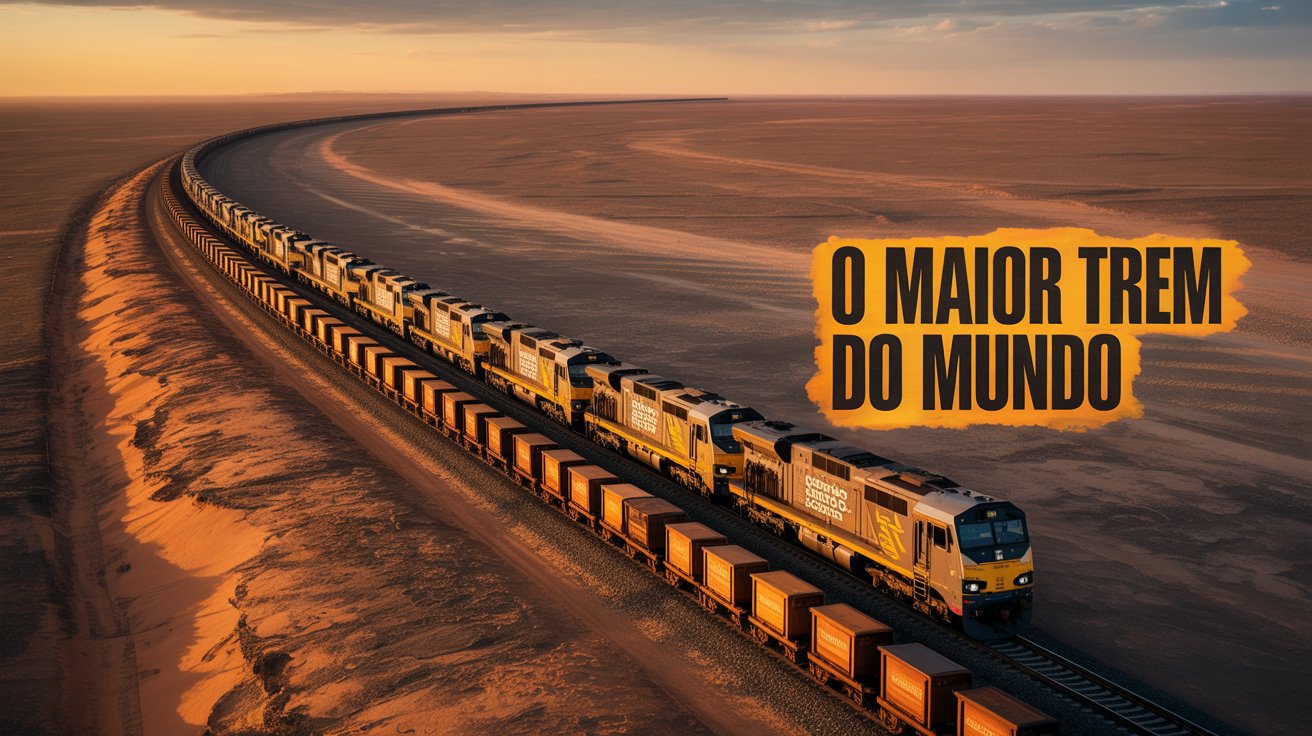
Record-Breaking Freight Train Impresses With Weight, Length, and Technology, Revealing How Giant Railway Operations Are Transforming Resource Transportation on a Global Scale.
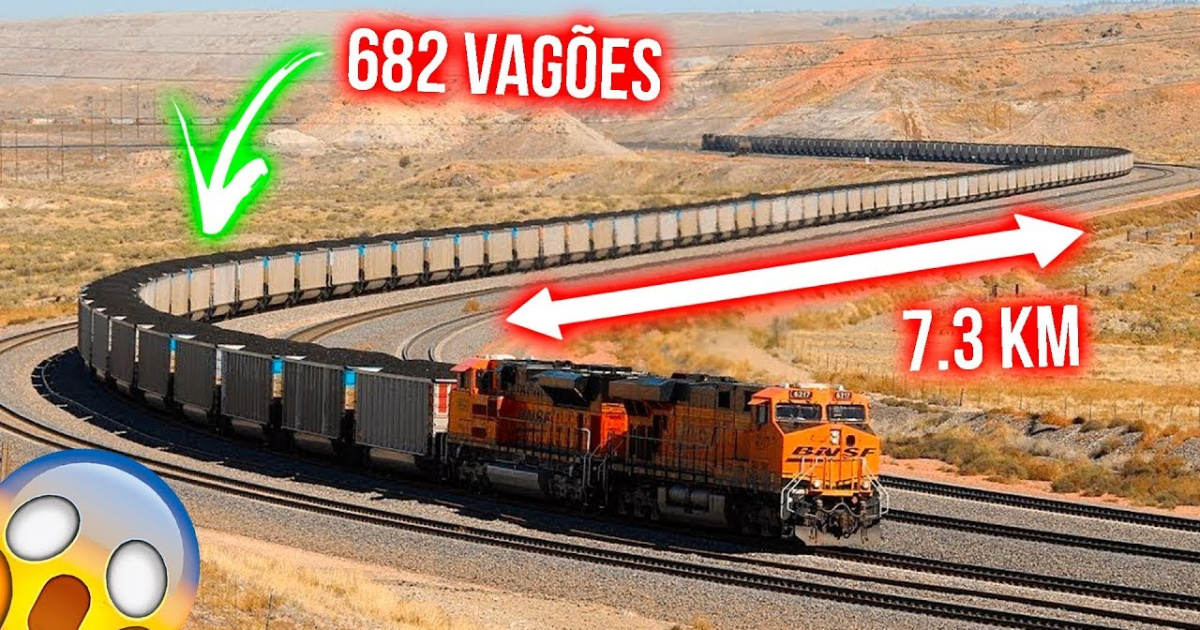
The longest train in the world belongs to BHP, in Australia, and reached 7.353 km in length with 682 cars and eight locomotives distributed throughout the train, during a historic test conducted on June 21, 2001.
In addition to its length, this formation also set the record for the heaviest train in the world, with a total weight of 99,732.1 tons, consolidating the Australian iron ore operation as a global reference in railway logistics.
The Longest Train in the World: Inside the Australian Record
The record was achieved by BHP by operating a special train on the iron ore corridor of the Mount Newman Railway in northwest Australia, to the port of Port Hedland.
-
Friends have been building a small “town” for 30 years to grow old together, with compact houses, a common area, nature surrounding it, and a collective life project designed for friendship, coexistence, and simplicity.

-
This small town in Germany created its own currency 24 years ago, today it circulates millions per year, is accepted in over 300 stores, and the German government allowed all of this to happen under one condition.

-
Curitiba is shrinking and is expected to lose 97,000 residents by 2050, while inland cities in Paraná such as Sarandi, Araucária, and Toledo are experiencing accelerated growth that is changing the entire state’s map.

-
Tourists were poisoned on Everest in a million-dollar fraud scheme involving helicopters that diverted over $19 million and shocked international authorities.


To enable the longest train in the world, the company employed distributed locomotives along the train, a technique that splits traction and braking to reduce stress on couplings and improve stability on curves.
The mark of 7.353 km with 682 cars has been recognized as the standard to beat ever since.
The Heaviest Train in the World: Capacity and Route
This same train holds the title of heaviest train in the world, with 99,732.1 tons, according to the Guinness World Records.
The train carried iron ore on an operational test mission over a route of approximately 275 km to the Port Hedland area, demonstrating the robustness of the power and braking solutions of the system.
This achievement has solidified the expression “heaviest train in the world” as synonymous with the Australian record, frequently used in technical and promotional publications.
India Raises the Bar in Asia With the Rudrastra
While the absolute record remains in Australia, India has just established its longest train by operating the Rudrastra, with 354 cars, seven locomotives, and about 4.5 km in length.
According to East Central Railway (ECR), the train was formed by the union of six standard rakes and marked a new milestone for the Indian system.
In a recent test, the Rudrastra traveled approximately 401 km between Ganjkhwaja (Uttar Pradesh) and coal yards on the border of Latehar/Lohardaga (Jharkhand), with an average speed reported of about 40 km/h, and was split for unloading at two different points.
Railway authorities in the country have been describing the Rudrastra as the longest ever operated in its network in Asia, emphasizing the leap in regional capacity.
“Rudrastra is the longest freight train ever operated by Indian Railways,” said the ECR in a statement.
How 8 Dispersed Locomotives Make a Difference
To turn a train into the longest train in the world, it is crucial to distribute the locomotives along the composition, a practice known as Distributed Power (DP).
In this arrangement, the engineer of the lead locomotive remotely controls the intermediate and rear units, coordinating traction and braking through radio and electronic systems.
DP reduces peak stress on couplings, improves adhesion, lowers brake recharge time, and allows for longer and heavier trains without compromising safety—decisive factors in enabling the heaviest train in the world.
Other improvements, such as electronically controlled pneumatic brakes (ECP), also contribute to faster and more uniform braking responses in giant compositions.
Brazil on the Map of Giant Trains
Brazil operates some of the longest ore trains on the planet.
On the Carajás Railway, Vale’s trains typically reach 330 cars and about 3 km in length on broad gauge, operating between the mines in Pará and the port in Maranhão.
Although they do not surpass the longest train in the world, these trains rank among the highest capacity per trip in global mining, sustaining strategic export chains.
Trends: Automation, Data, and Climate Efficiency
The next frontier for the longest train in the world and the heaviest train in the world involves automation and real-time monitoring.
In the Pilbara region, Rio Tinto fully operationalized, in 2019, the AutoHaul™ network, considered the world’s first fully autonomous heavy-haul railway, with trains monitored from an operations center in Perth.
Automating repetitive tasks, using algorithms for fleet management, and telemetry for critical components help reduce fuel consumption, optimize crossing windows, and enhance line safety—gains that allow maintaining, comfortably, the standards of the heaviest train in the world without sacrificing reliability.









Seja o primeiro a reagir!