





 Portuguese
  English
  Spanish
  5 min of reading
  0 comments


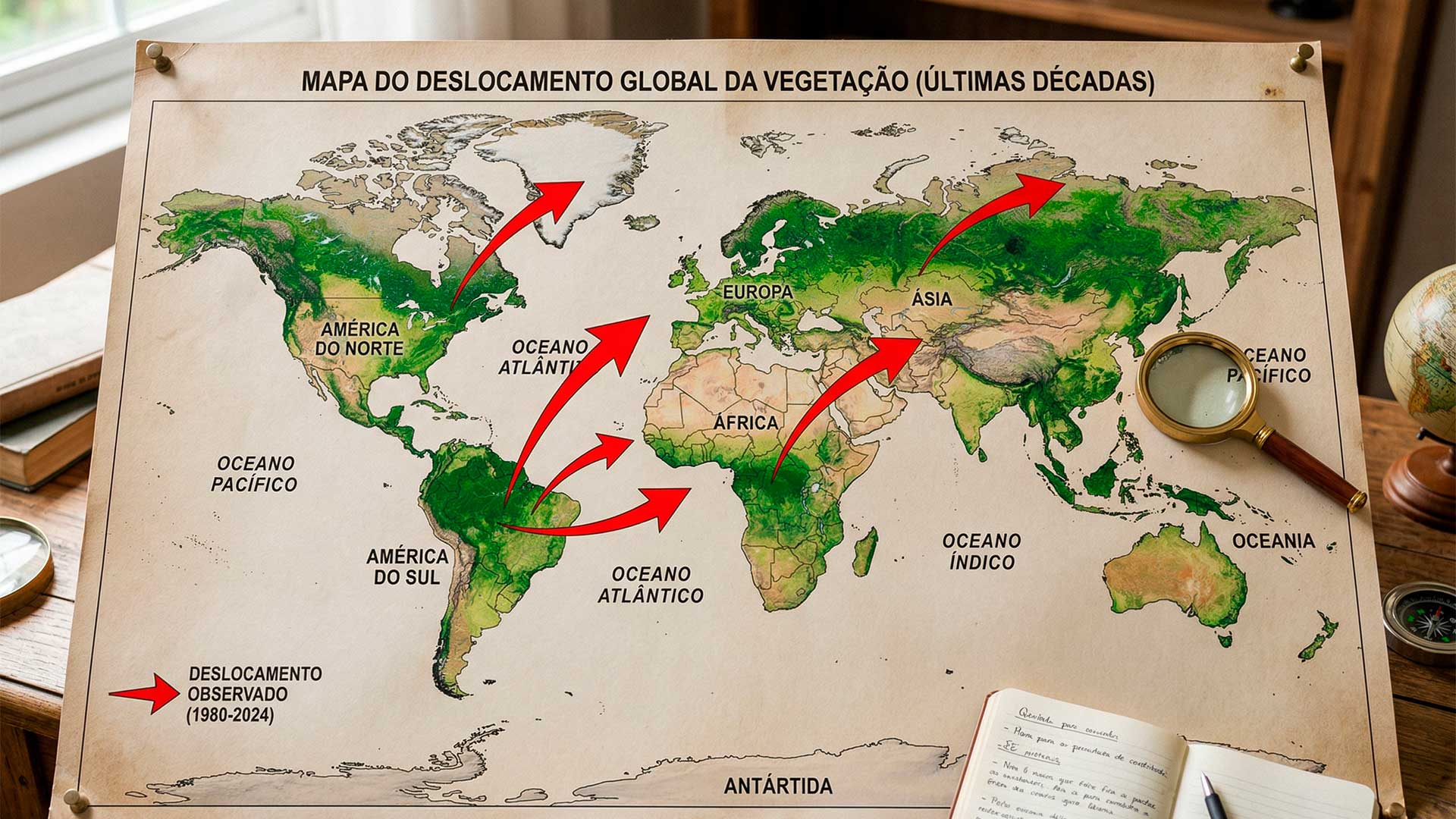
Study identified that the global vegetation wave is changing direction on the planet and has begun to move faster in the last decade, with direct effects on climate, soil, and agriculture
The so-called green pole of the Earth, referring to the movement of vegetation zones and plant biomass on the planet, has been migrating to the northeast for decades. The movement gained momentum starting in 2010, at a much faster pace than scientists expected.
This change helps explain why some regions are becoming more favorable for plant growth, while others are losing water balance and productive capacity. In practice, the phenomenon alters rainfall patterns, solar incidence, and ecological dynamics at different latitudes.
The result is not only of interest to climate science. It has a direct impact on agricultural boundaries, food security, rural productivity, and long-term planning in areas that depend on environmental stability.
-
Scientists capture for the first time clear images of a tectonic plate fragmenting in real time under the Pacific Ocean and compare the process to a train derailing in slow motion, car by car.

-
Antarctica hides fortunes in gold and silver that could spark a giant conflict among nations!
-
A study reveals that the hungriest black holes in the universe are going dormant due to a lack of matter.

-
Gigantic lithium deposit hidden in supervolcano in the US could transform the battery industry, boost electric vehicles, and place Elon Musk at the center of a new global energy race.
The research describing this process was published in the scientific journal PNAS, in the article Accelerated north–east shift of the global green wave trajectory. The work reinforces that the planet’s vegetation is not stationary and responds sensitively to ongoing thermal and environmental changes.
What does the shift of the green pole mean and why does this migration of vegetation increasingly worry researchers and rural producers
In practice, the shift of the green pole indicates that the center of mass of global vegetation is moving. It is not a visible line on the map, but a pattern detected through environmental data analysis and satellite monitoring, capable of showing where the planet’s most intense biological activity is migrating.
When this green wave advances in another direction, there is a reorganization of ecosystem functioning. Areas previously considered peripheral for certain crops may gain importance, while traditionally productive regions may face greater climate pressure, soil degradation, and loss of regularity in harvests.
This rearrangement also shortens the adaptation time in the field. With the acceleration observed since 2010, the producer has to deal with faster changes in fertility, agricultural calendar, and soil water behavior.
Why the acceleration since 2010 changes the debate on climate change and pressures agricultural planning in several regions of the planet
The most concerning data from the study is precisely the speed. Scientists observed that the movement to the northeast is not new, but it gained momentum in the last decade, indicating a more intense transformation process than previously predicted in earlier scenarios.
This is significant because agriculture works with long investment cycles. Land purchase, soil correction, infrastructure implementation, irrigation, and genetic seed selection depend on some predictability, and this predictability becomes more fragile when environmental patterns change rapidly.
In practical terms, arable lands cease to be a static asset. The productive value of an area increasingly depends on climatic and ecological behavior in the medium and long term, which can alter market decisions, territorial expansion, and even land use policies.
Moreover, the change in vegetation is often accompanied by alterations in rainfall distribution and thermal load throughout the year. This affects everything from plant vigor to the economic viability of crops that depend on more stable climatic windows.
How the advance of vegetation into new areas interferes with productivity, pests, and production costs in the field
The displacement of green zones creates new opportunities but also imposes high costs. Regions that begin to receive more favorable conditions may become new agricultural frontiers, while established areas need to invest more to maintain the same level of productivity.
In this scenario, traditional planting calendars come under pressure. Genetic varieties chosen for a previous climatic reality may lose performance, requiring rapid adaptation of seeds, management, and technology.
Another relevant effect is the migration of pests and diseases. As vegetation changes its geographical range, organisms associated with that environment may also advance, making sanitary control more complex and costly for producers.
In many cases, agricultural expansion begins to depend on heavy investments in irrigation, soil correction, environmental monitoring, and biotechnology. Without this, the risk of crop failure increases precisely in areas where the productive potential seemed promising.
Therefore, the study of global vegetation behavior has ceased to be just an academic topic. It has become a strategic tool for those who need to decide where to invest, what to plant, and how to reduce losses in the face of an ever-changing environmental geography.
Satellite monitoring, soil moisture, and thermal analysis gain central role in adapting to new green frontiers
To respond to this scenario, ecosystem monitoring becomes crucial. Continuous analysis of satellite data helps identify where the vegetation index is growing, where the soil maintains moisture at depth, and which areas are experiencing greater thermal stress.
Among the most important points of attention are the detailed mapping of the vegetation index by satellite, real-time monitoring of deep soil moisture, and thermal trend analysis for cultivar selection. These three axes allow for anticipating risks and repositioning investments.
Without this monitoring, the chance of error increases significantly. Expensive structures may be installed in locations that will lose climatic competitiveness, while more promising areas may be overlooked due to a lack of technical reading of the environment.
This type of intelligence also strengthens conservation strategies. When the producer better understands natural regeneration, soil health, and water behavior in a region, they can balance productivity and resilience with greater security.
Technology, regenerative planting, and biotechnology come to the forefront of the response to reduce losses and maintain competitiveness
Adapting to new cultivation zones requires more than just changing seeds. The scenario calls for a management shift, focusing on climate resilience, diversification, and intensive use of information to make more precise decisions.
Among the practices identified as fundamental are the implementation of regenerative direct planting systems, the use of biotechnology adapted to severe water stress, and the diversification of land portfolios in different regions. These measures help to dilute risks in an increasingly unpredictable environment.
Another resource gaining traction is artificial intelligence, used to cross historical climate series with environmental projections and local farm indicators. This allows for testing scenarios, adjusting management, and identifying in advance where the best chances of return are.
In the long term, companies and producers who ignore the geographical transition of vegetation tend to become trapped in less efficient models that are more vulnerable to climate volatility. Those who incorporate global data into local reality will be better positioned to sustain productivity and water efficiency.
The debate about the green pole of the Earth shows that food production increasingly depends on the ability to read the planet’s signals. And this applies to both science and the field, which already feels the effects of shifting vegetation in everyday life.
Do you think that agribusiness and governments are prepared for such a rapid change in the global vegetation map? Leave your comment and let us know if this type of transformation is still underestimated or if it should already be at the center of decisions regarding climate, soil, and production.







Seja o primeiro a reagir!