





 English
  Francês
  Alemão
  Italiano
  Japonês
  Norueguês
  Portuguese
  Spanish
  6 min of reading
  0 comments


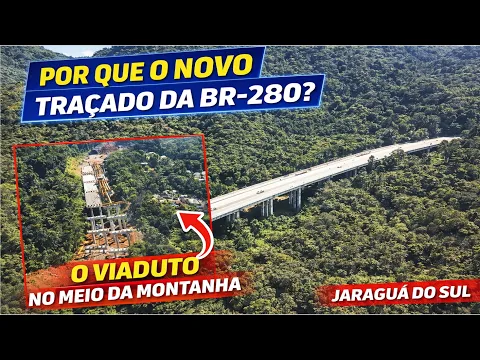
The mountain in the section of Jaraguá do Sul became the axis of one of the most impressive fronts of BR-280, with a highway opened in the rocky mass, a viaduct of more than 50 meters high and almost 500 meters long to divert heavy traffic from urban areas.
The mountain ceased to be just a geographical obstacle and became the center of one of the most ambitious works of the duplication of BR-280 in Santa Catarina. In the new layout built near Jaraguá do Sul, the highway literally emerges from the middle of the slope, in an area marked by difficult terrain, nearby urban occupation, and the urgent need to reorganize the circulation of heavy vehicles.
In this scenario, the solution found was to open an entirely new path. Instead of insisting on adapting the existing urban section, the project took the highway into the mountain, where rock cuts, tunnels, embankments, and a large viaduct emerge. It is a heavy engineering response to one of the most sensitive points of BR-280.
Geography and urban occupation pushed the work into the mountain
The new layout of BR-280 in Jaraguá do Sul did not arise by chance. The very configuration of the site made a simple solution unfeasible. On one side, the rugged geography.
-
Seen from space, a colossal ‘Y’ cuts through the largest desert in China, blending a jade-filled river, red and white mountains, and revealing the absurd scale of the transformation of the Taklamakan surrounded by a green wall with billions of trees.

-
The Pacific Ocean reveals what the cliffs of Big Sur have hidden for millennia: Pfeiffer Beach, in California, features swirling purple sand formed by garnet crystals and displays a stone arch that is illuminated by the sun in winter for just a few days each year.

-
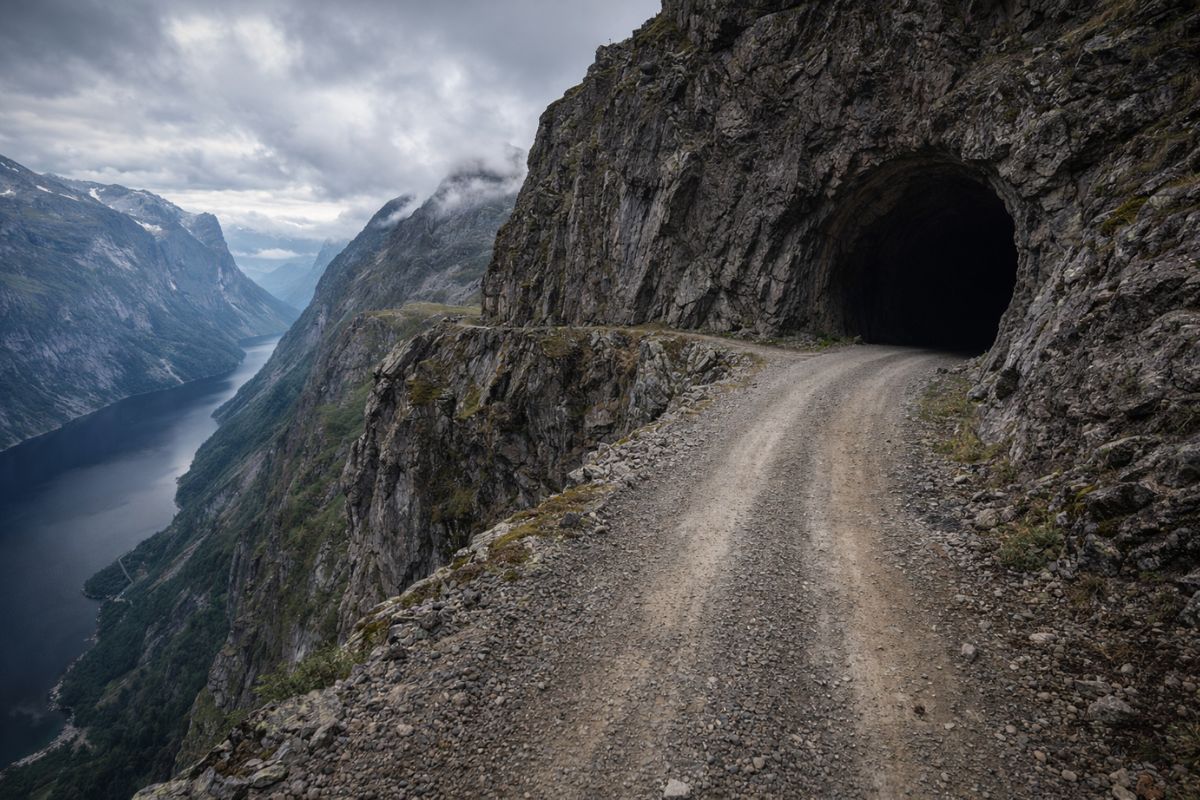
Aursjøvegen in Norway is a 100-kilometer gravel road that crosses chasms and dark tunnels carved into the rock at an altitude of 947 meters in the fjords and is only open for four months a year.
-
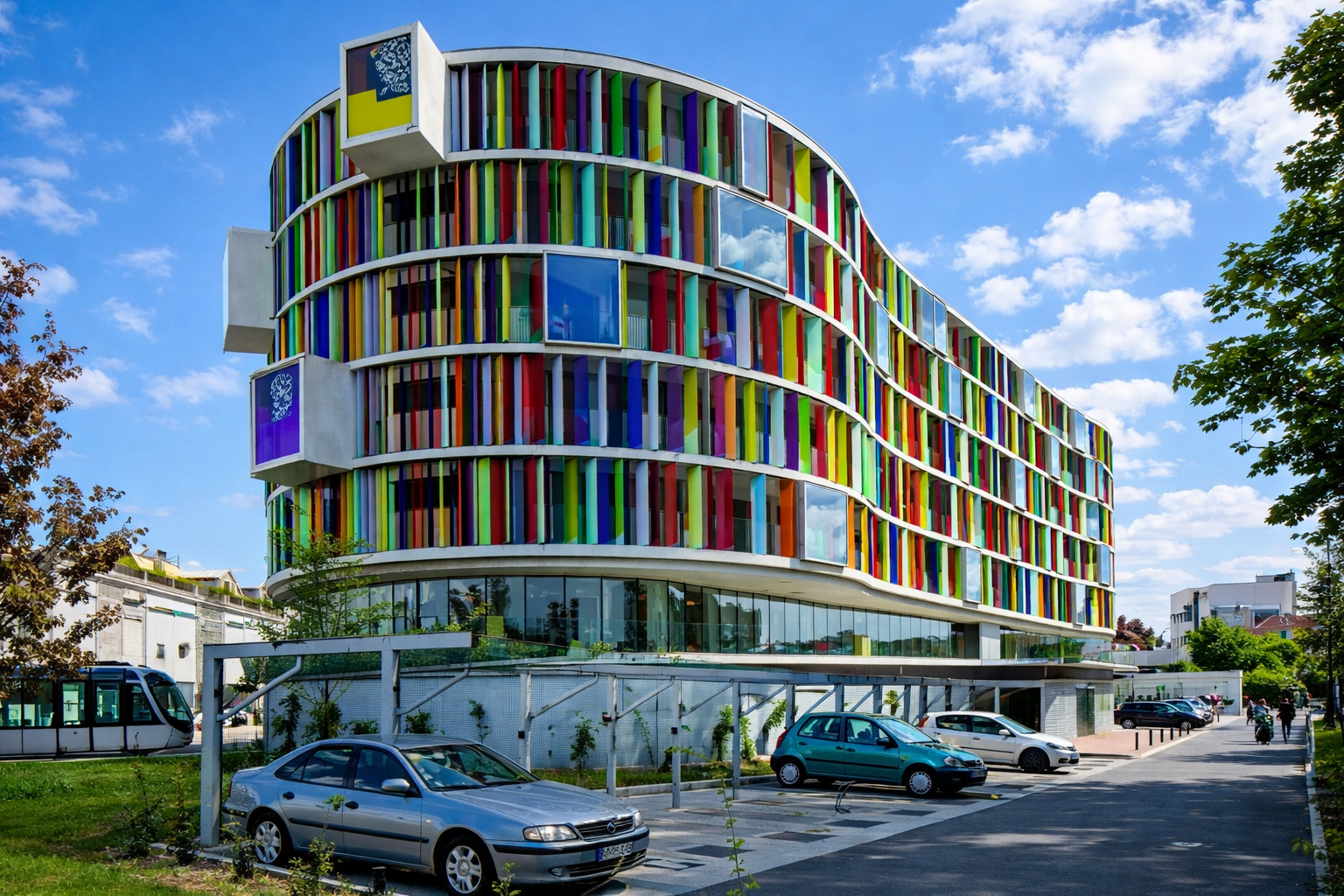
With about 4,000 m², the building constructed in a traditional neighborhood in France looks like a rainbow, has a colorful facade, mixes vibrant glass, and creates one of the most unusual visuals in Bordeaux.

On the other, neighborhoods already densely occupied, with many houses and buildings, such as the João Pessoa region. This encounter between hard terrain and consolidated occupation drastically reduced the alternatives.
Therefore, the work advanced through the interior of the mountain. In several sections, the highway is being constructed exactly between the top of the terrain and the urbanized area. It is not just a road passing through a slope.
It is a roadway corridor shaped within the landscape, in a space where any wrong decision would amplify urban, social, and environmental impact.
Giant viaduct became the best way out at a critical point

In one of the most remarkable parts of the work, the highway reaches a valley area, with the presence of springs and streams below. At this point, one of the alternatives would be to extend the embankment with a large volume of material, including rock from the explosions of the Morro do Vieira tunnels.
But this option would require an enormous amount of material and would increase the intervention on the local fauna and flora. In light of this, the chosen solution was the construction of a viaduct.
It was at this point that the mountain demanded a more sophisticated response, and it came in the form of an impressively scaled structure.
According to the base, the viaduct has pillars that exceed 50 meters in height and approach 500 meters in length from one bank to another. Even from a distance, it already appears as one of the most emblematic elements of the new layout.
It is the type of work that completely changes the perception of the section and shows the extent of the ongoing intervention.
New layout aims to remove BR-280 from within the city
The logic of the work goes far beyond the visual impact. The central objective of the new layout is to remove the heavy traffic that currently crosses urban areas of Jaraguá do Sul and Guaramirim. This is one of the most important points of the entire project.
When BR-280 reaches Jaraguá do Sul, it loses typical highway characteristics and begins to function as an urban avenue. This makes the duplication in that axis much more difficult and more expensive from a social and economic standpoint. It would be a heavy intervention in an already occupied area, with broad consequences for the city.
Therefore, the creation of this new section from scratch appeared as a more coherent alternative. Instead of trying to fit an expanded highway into the urban fabric, the project shifts the flow to a new route, designed to accommodate traffic more efficiently and with less conflict with the daily life of the municipalities.
Work creates a new dual-lane highway

The project is not limited to a single viaduct or an isolated cut in the slope. The base indicates that the new layout will have about 22 to 23 kilometers of highway, already in dual lanes, with shoulders, lane dividers, bridges, and viaducts.
This shows that the mountain is just one part of the total challenge. The work forms a new roadway axis, designed to reorganize circulation in one of the most problematic sections of BR-280. It is practically a new regional infrastructure being implemented to solve historical traffic bottlenecks.
Morro do Vieira concentrates another of the most complex sections
Just ahead of the large viaduct, the project advances to another difficult stage: the cut of the mountain to connect with a smaller viaduct and, subsequently, the arrival at the Morro do Vieira tunnels. The forecast described in the base is for two tunnels, one with two lanes to the west and another with two lanes to the east.
This set further increases the complexity of the work. The execution involves rock drilling, fragmentation of the mass, and reuse of the material detonated at other points of the highway itself. In other words, the mountain is not just crossed. It also provides part of the physical base that supports the construction around.
Detonated rock helps to feed other fronts of the work
In one of the recorded descriptions, what seems to be smoke over the terrain is actually dust generated by the machinery that drills the rock. This detail helps to show the heavy stage of execution.
The rocky mass is being prepared for future detonations, and the extracted stones should be used as base and fill material in other segments.
This reuse reinforces the integrated nature of the work. Each advance within the mountain produces effects on other fronts of the layout, both through the opening of paths and the provision of material. In projects of this scale, engineering does not work in isolated blocks. Everything is interconnected.
Progress draws attention, but pace is still concerning
Despite the scale of the intervention and the visible progress in structures such as the viaduct, the base also highlights an important limitation: there is no official date published for the completion of the section, and the progress is not occurring at the speed considered ideal.
This is a relevant point because it helps to balance the perception of the work. On one side, there is an impressive solution, with a highway emerging from the mountain and large-scale structures.
On the other, there remains frustration with the slower pace than necessary for such a strategic connection. The grandeur of the project does not eliminate the demand for delivery.
Section promises to change the travel experience and the logic of traffic
When completed, this new segment should profoundly alter the way BR-280 cuts through the region. In addition to diverting heavy traffic from urban areas, the layout tends to create a visually striking journey, precisely because it traverses slopes, valleys, viaducts, and tunnels in sequence.
But the main gain is not in the scenery. It is in the function. The mountain, which today appears as a symbol of the challenge, can also become a symbol of the solution, by allowing the highway to regain characteristics more compatible with its logistical and regional role. That is what makes this section so strategic within the duplication.
In your opinion, is a project of this scale within the mountain the most efficient solution to remove heavy traffic from the urban areas of BR-280?








Seja o primeiro a reagir!