





 Portuguese
  English
  Spanish
  5 min of reading
  0 comments


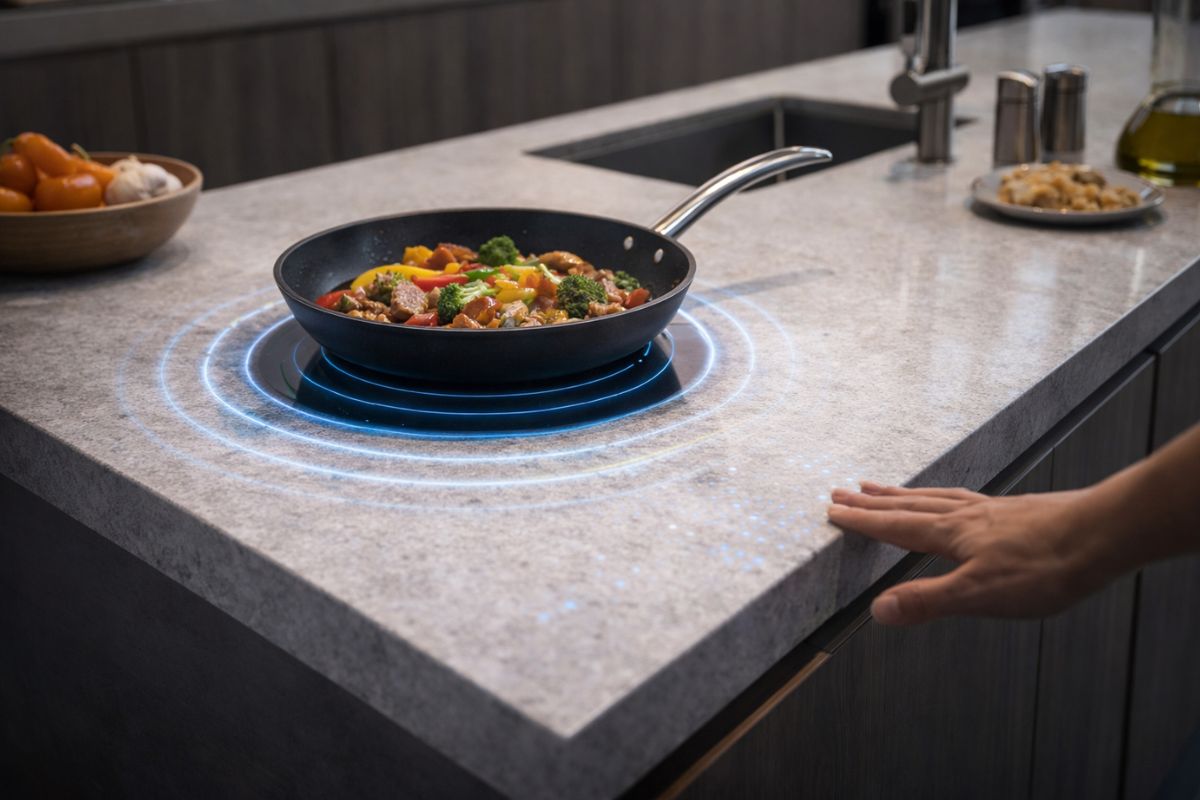
Invisible induction systems position the stove under porcelain or stone countertops, leaving the surface smooth and continuous, and the heat goes straight to the pot instead of heating the environment, with manufacturers claiming that this stove cooks up to 50% faster than traditional induction and can be up to three times more efficient than gas stoves
The induction stove with a glass top was considered the modern and safe choice for any renovated kitchen.
It heats quickly, is easy to clean, and seems less risky than an open flame.
But in 2026, this stove begins to lose ground to a technology that simply makes it disappear: invisible induction systems that hide the entire stove under the stone or porcelain countertop, leaving a smooth and continuous surface.
-
Garlic with pure honey undergoes a natural fermentation that transforms the two ingredients into a versatile condiment for marinades, sauces, and roasted vegetables, and it can also be used as a natural treatment in your garden.

-
A woman in the United States hired six immigrants for a $10,000 job on her house, and when the work was almost done, she allegedly called ICE to avoid paying and to have the workers deported.

-
iPhone in 2026: the technological innovations that go beyond cameras and processors

-
The longest public work in history began in Antiquity, spanned empires, was attempted by Nero, and was only completed 2,500 years later, turning the Corinth Canal into one of the most incredible stories of world engineering.


The idea is simple: instead of having a visible stove fitted into the countertop, the electronic components are underneath, and the heat goes straight to the pot without heating the environment.
Manufacturers of this new invisible stove claim that it can cook up to 50% faster and use less energy than traditional induction, because almost all the heat produced goes to the food, not to the kitchen air.
And with the electricity bill weighing more and more on consumers’ pockets, the question they are asking is straightforward: why keep a stove that heats the entire kitchen when there is one that only heats the pot?
How the invisible stove that disappears under the counter works

Invisible induction systems position the stove’s electronic components under the countertop, leaving a continuous surface on top.
There are no cutouts, no different glass, no frame: the stove simply disappears. You cook on the same countertop where you prepare food, and when you’re done, it becomes a smooth surface again.
Cooking Surface Prime sells a built-in induction stove system designed to work with porcelain. The company’s slogan sums up the proposal: “you don’t see it, you live it.”
Inalco promotes a similar idea with its MDi induction surfaces, presenting them as an authentic countertop with an invisible induction stove that keeps the kitchen visually clean.
In May 2025, Caesarstone announced a collaboration with Invisacook to create an invisible induction stove under porcelain, with a silicone mat that keeps the surface heated only under the pot.
For the consumer, the advantage is a flat and uninterrupted countertop where you can cook wherever you need and clean as if you were cleaning a table.
The difference between traditional induction, vitroceramic, and invisible stoves

The induction stove uses a magnetic field to heat the pot directly. The surface remains cooler because the heat is generated inside the utensil, not on the stove’s surface.
A radiant vitroceramic stove is the classic electric model: a glowing heating element heats the glass, and the glass transfers heat to the pot. It is slower and wastes more energy than induction.
The invisible stove still works by induction but places more material between the coil and the pot, because the components are under stone or porcelain instead of under glass.
That’s why these systems specify exact materials for the countertop and thickness limits, so the stove can distribute heat efficiently without damaging the surface.
According to a guide from a U.S. federal energy agency, induction can be up to three times more efficient than gas and up to 10% more efficient than conventional electric stoves, because it only generates heat when there is a pot on the surface.
The Energy Star program indicates that gas stoves transfer energy with an efficiency of about 32%, electric resistance stoves range between 75% and 80%, and induction stoves achieve about 85%.
The invisible stove cooks even 50% faster and uses less energy
Claims of cooking up to 50% faster frequently appear in the marketing of the latest invisible stove systems.
The logic is that if less heat escapes from the sides of the pot, more of the paid electricity is used to cook the food, not to heat the kitchen air.
Bosch claims that some of its induction cooktops can boil water up to twice as fast with the turbo mode compared to radiant electric stoves.
In invisible systems, better heat direction is the central argument: since the stove is embedded under dense material and the heat is directed upwards, lateral waste is even lower.
In practice, this can mean less cooking time, less residual heat in the kitchen, and a lower electricity bill at the end of the month, especially for those who cook every day.
A less stuffy kitchen is also a perceived benefit: with less heat lost to the environment, the thermal sensation improves, especially in summer.
What to consider before replacing your stove with an invisible system
The invisible technology has clear advantages but also limitations that consumers need to know before deciding.
The invisible induction stove requires compatible magnetic pots, just like traditional induction. If your utensils are made of aluminum, glass, or copper, they will need to be replaced.
Some homeowners opt for hybrid stoves that combine induction zones with gas burners, reducing the need to replace all utensils at once.
For those who do not want to renovate the entire kitchen, there are portable induction cooktops that offer quick and efficient cooking in a compact unit, without the need for construction.
The portable induction stove is a low-risk way to test if the technology fits your routine before investing in a built-in system that requires specific countertops and professional installation.
For renters, students, or those with small kitchens, the portable induction stove may be the most practical solution: it cooks faster without heating the environment and fits in any space.
The stove that disappears in the countertop and can change the kitchen forever
The invisible induction stove hides the components under the stone countertop, heats only the pot, promises to cook up to 50% faster, and uses less energy than any traditional stove.
The technology transforms the countertop into a stove and the stove into a countertop, eliminating the boundary between preparing and cooking and creating a continuous surface that is easier to clean, safer for families, and more efficient on the electricity bill.
The traditional induction stove is still a good choice. But when the technology that replaces it cooks faster, uses less, and disappears in the countertop, the question is how long it will continue to be the automatic choice.
Would you replace your stove with an invisible system built into the countertop? Do you already use induction or still prefer gas? Do you think this technology will become popular or is it just for luxury kitchens? Leave your comments and share this article with anyone renovating their kitchen.









Seja o primeiro a reagir!