





 Portuguese
  English
  Spanish
  5 min of reading
  0 comments


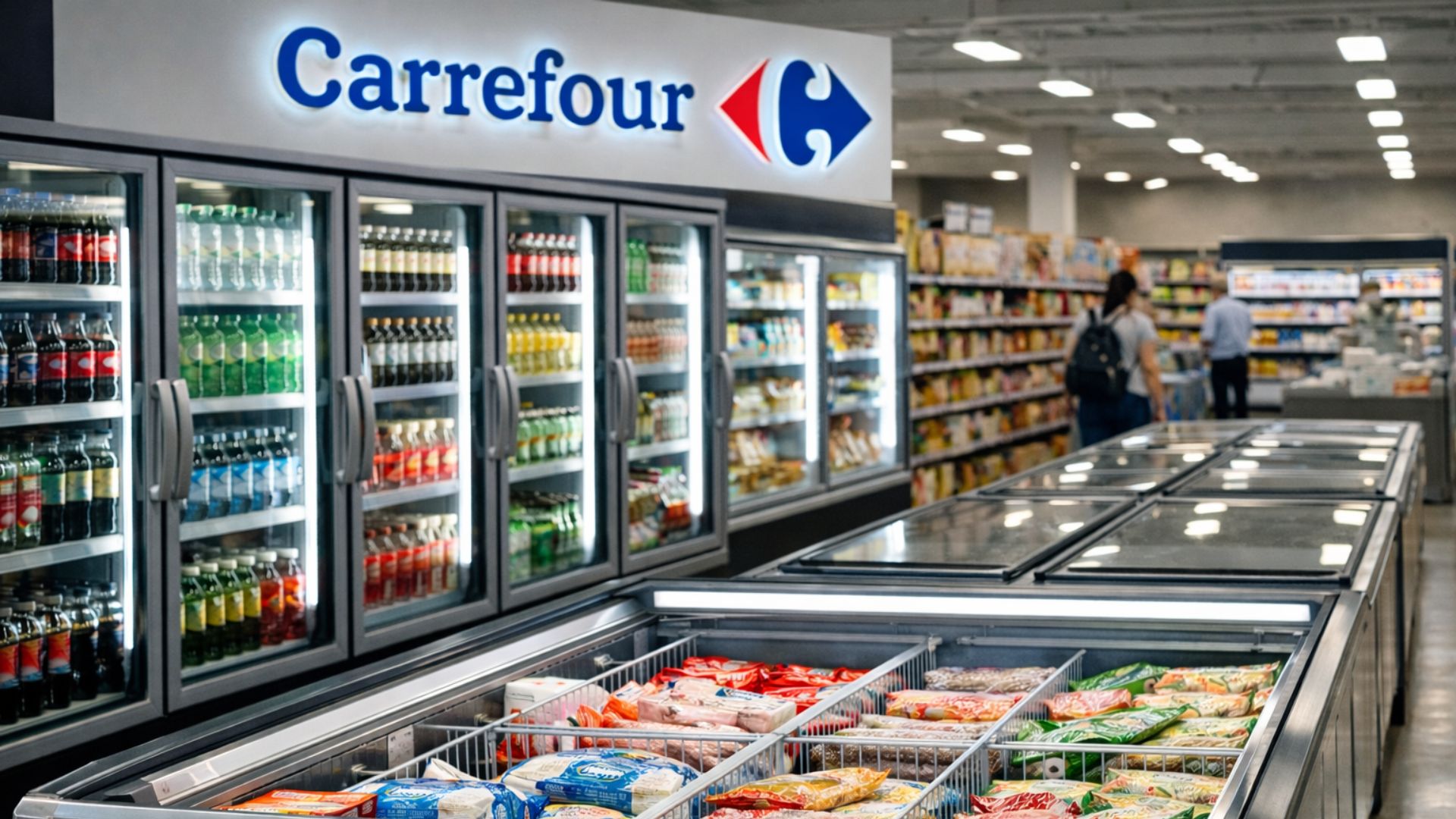
Hidden electricity consumption in Brazilian supermarkets takes center stage with pressure for efficiency in refrigeration equipment, responsible for a significant part of retail operating costs and now at the center of regulatory proposals seeking to reduce costs and emissions.
The largest part of a Brazilian supermarket’s electricity bill may be concentrated out of the consumer’s sight, in the systems that keep food, beverages, and frozen items at the proper temperature throughout the day.
Estimates associated with the United for Efficiency initiative, linked to the United Nations Environment Programme, indicate that cooling can represent more than 65% of the energy consumption of an average store in the country, while commercial refrigeration equipment used in the preservation and display of products accounts for about 25% of that total.
Where energy weighs most in supermarket operations

This weight helps explain why freezers, display cases, islands, and beverage coolers have begun to occupy a larger space on the federal government’s energy efficiency agenda.
-
German reactor of 16 meters with twisted magnetic fields reaches a historic milestone in nuclear fusion by generating high-energy helium ions that simulate alpha particles from the Sun; progress in Wendelstein 7-X could unlock plasma control and explain phenomena observed in our star.
-
Long before modern medicine, an artificial leg made of bronze and wood buried in Italy showed that amputees were already receiving complex prosthetics around 300 B.C., at a technical level that seems unlikely for antiquity.

-
Scientists identify a unique cell that appears only during pregnancy and acts in the connection between the placenta and blood flow, revealing an essential mechanism for fetal development and possible causes of gestational complications.

-
It took just two days of walking in the jungles of New Guinea to find the plane that historians had been searching for for 80 years: the legendary Marge still had its original red paint and the face of the woman who named the most feared fighter of World War II.

In a sector that relies on continuous operation and strict temperature control to avoid losses, electricity expenditure ceases to be just a technical data point and begins to directly influence the cost structure of supermarket chains.
Contrary to what often appears in public perception, the most sensitive expense is not necessarily in store lighting or cash registers, but in the so-called cold chain that supports the routine of food retail.
These are equipment that remain on for long periods, even outside peak hours, and need to compensate for door openings, heat exchange with the environment, and constant cold replenishment to preserve product quality.
This group includes refrigerated counters, vertical displays, perishable showcases, beverage coolers, and ice cream freezers, among other devices spread across high-traffic areas.
As they operate without significant interruption throughout the business day, these systems accumulate a substantial impact on monthly consumption and have become one of the main targets of discussions on efficiency in commerce.
Commercial refrigeration market in Brazil and energy impact
The size of the installed base reinforces the dimension of the regulatory and economic problem.
Data released by the Ministry of Mines and Energy indicates that Brazil has approximately 7 million units of commercial refrigeration in operation, distributed mainly among wholesalers, retailers, hotels, and restaurants, which amplifies the aggregated effect of small differences in energy performance between older models and more efficient equipment.

When this scale is placed at the center of the analysis, the debate ceases to interest only manufacturers and specialists in the electrical sector.
In such a broad universe, choosing equipment with lower consumption can alter recurring expenses over the years, especially in businesses where refrigeration operates as essential infrastructure rather than as an accessory item of the store.
The problem is that the segment advanced for a long time without an official standard that allowed standardized comparison between devices.
In a statement about the completion of technical studies, the MME reported that, without formal regulation, manufacturers adopt different testing conditions, which complicates the reading of energy performance between brands and categories and reduces transparency for those who need to decide on purchases based on total operating costs.
New rules and energy efficiency in food retail
Commercial refrigeration entered the public agenda precisely because it combines high consumption, continuous use, and a regulatory space still in consolidation.
The documentation of the project coordinated by the MME indicates that these devices have become a priority due to their significant consumption and because they still do not have, within the scope of the work developed, minimum energy performance standards and labeling comparable to that already widespread in residential appliances.
The numbers used by the government to support regulatory advancement help to gauge the relevance of the topic.
According to the ministry, the technical regulation of energy efficiency for commercial refrigerators could generate savings of 2.4 TWh per year and prevent the emission of about 1.1 million tons of CO2 equivalent annually, a projection that transformed a subject previously restricted to technical backrooms into a permanent agenda of energy policy.
In addition to the environmental perspective, the context of electrical demand in commerce reinforces the urgency of the discussion.
The Energy Research Company recorded that the consumption of the commercial class reached 26,138 GWh in the fourth quarter of 2024, the second largest quarterly volume in the historical series that began in 2004, in a scenario influenced by the performance of retail and services, which amplifies the strategic weight of equipment that operates continuously in stores.
Regulatory timeline advances and targets invisible equipment


The regulatory movement has gained more concrete contours over the past two years.
In March 2025, the MME reported that the regulatory proposal for commercial refrigerators would be developed that year, classifying the segment as one of significant energy consumption and still without specific regulation, a framing that consolidated the entry of the topic into the formal agenda of the Energy Efficiency Indicators and Levels Management Committee.
After that, the regulatory agenda published in February 2026 advanced a step further and provided for the conduct of a regulatory impact analysis for commercial refrigerators in the first half, followed by a public consultation in the second half and subsequent publication of the regulatory act.
With this, commercial refrigeration ceased to be merely a subject of study and began to follow an official schedule within the public policy of energy efficiency.
This movement tends to affect precisely the equipment least perceived by the final consumer, although they are decisive for the daily operation of the supermarket.
What appears before the customer is the glass door, the row of frozen goods, or the beverage aisle; what persistently weighs on the bill includes compressors, heat exchangers, thermal insulation, intense usage patterns, and continuous cold replenishment in open and busy environments.
By concentrating regulatory pressure on freezers, counters, and showcases, the government signals that an important part of the efficiency of Brazilian commerce may be hidden in equipment that is almost always absent from public discussions about energy.
For food retail, this discussion involves less appearance and more operation: conserving products, reducing losses, reliably comparing technologies, and limiting an invisible cost that remains embedded in the daily functioning of stores.








Seja o primeiro a reagir!